
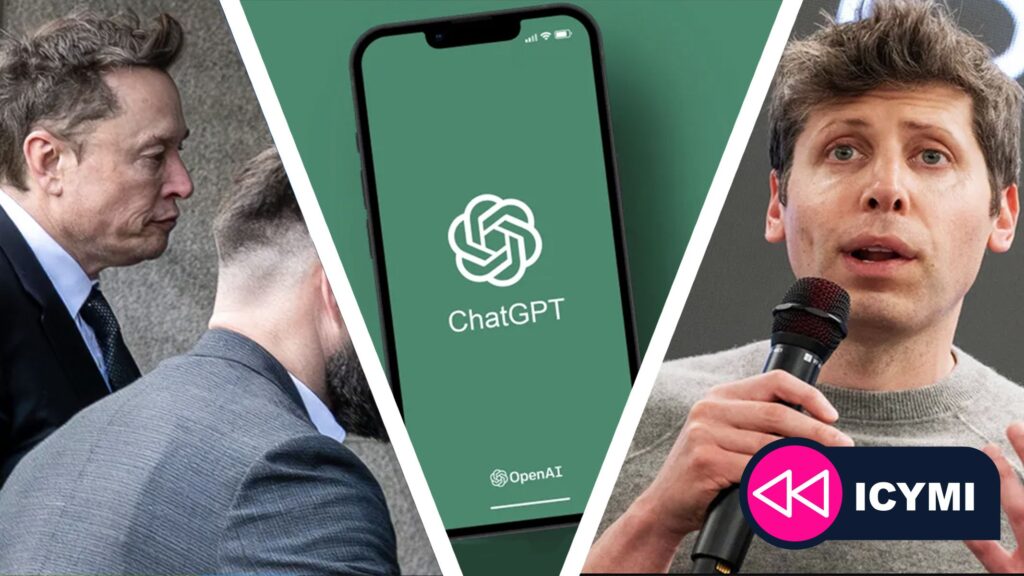
This week, all eyes are on Elon Musk’s lawsuit against OpenAI CEO Sam Altman. It’s the culmination of a feud that’s been raging for years and has played out mostly online until now, and it’s likely to have huge implications for not only the future of OpenAI, but the future of the AI industry as a whole. So far, the courtroom details have already been extraordinary—and not always in ways that flatter.
Alongside the trial, several other big AI news caught my attention this week. Lots, as always, involving OpenAI — from news that the company may soon launch a phone to the discovery that a code model was told not to reference goblins or mythical creatures.
The article continues below
As always, I’ve rounded up the best stories you need to know below. Think you paid attention to my roundup of the latest AI news from last week? Take the quiz below to find out.
Were you paying attention last week? Take my AI news quiz
The best AI headlines from the past week
Welcome to ICYMI AI, your weekly roundup of the most important developments in artificial intelligence. Here are the biggest AI stories from last week and why they matter.
Musk vs Altman trial is the biggest drama in artificial intelligence
Elon Musk is suing OpenAI, CEO Sam Altman and company co-founder Greg Brockman for a whopping $130 billion. He claims they betrayed the company’s original plan to be a non-profit. However, his motivations are complicated by the fact that he runs his own AI company, xAI. However, there is more to this trial than the drama.
At its core, this experiment really feels like a test of whether AI companies can ever stick to a mission, especially remain a non-profit, when money, computing, and competition scale up to dizzying levels. If Musk wins, OpenAI could face a very messy restructuring that will affect leadership, funding and product development. If he loses, it will reinforce that building the latest AI technology can always pull companies toward commercial priorities, regardless of how they started.
Either way, it puts a lot of pressure on external regulation to fill the gap that good intentions alone cannot close.
OpenAI may be building an AI-packed phone
Reports surfaced this week that OpenAI, the creators of ChatGPT, may be building a smartphone. Analyst Ming-Chi Kuo reported that the device is in development with MediaTek and Qualcomm working on a custom chip and Luxshare handling manufacturing. Speculation is that mass production is the target for 2028. However, OpenAI has not commented.
It seems the concept behind this OpenAI phone will replace apps with AI agents, maintaining context and completing tasks on your behalf — similar to Google’s plans to make AI a layer above everything we reported on last week.
But think of the wider implications, if OpenAI controls the hardware, it means it will completely bypass big tech players like Apple and Google. As we said last week, how you feel about OpenAI increasingly trying to build an ecosystem rather than just being a chatbot depends on how much you trust OpenAI.
Are young people tired of AI already?
A new report from The Verge that is sure to ruffle a few feathers this week finds that the more young people use AI, the less they like it. According to the report, despite being among the biggest users of chatbot tools, Gen Z workers and students are increasingly resentful of what many describe as an AI-centric future being forced upon them — with some actively choosing career paths where they’ll never have to use it.
This matters, because for the past year the dominant story has been adoption, especially among young people, who I’ve seen described as “AI natives” many times. But this is one of several clear signs of friction in recent weeks. If the people who are expected to build, use and normalize AI in the long term are already losing confidence, it complicates the idea that the technology will just slide into everyday life.
More AI news you might have missed
- China’s power grid will soon be powered by an army of humanoid robots: According to the South China Morning Post, the Chinese government plans to put thousands of robots to work on the country’s infrastructure. It’s interesting to see what large-scale AI deployment might look like and highlights how China leans toward rapid, government-backed deployment of AI compared to the US.
- OpenAI tells its latest model to stop talking about goblins: In one of the more light-hearted stories of the week, Wired reports that OpenAI really wants their coding agent to never talk about goblins, gremlins, or any other animals or creatures. It seems that previous iterations of the model assumed that “bugs” meant mythical creatures and it is why OpenAI had to spell things out in new instructions.
- We compared ChatGPT Images 2.0 and Google’s Nano Banana 2: We used real-world prompts, but which AI image generator do you think came out the best? You’ll have to click through to find out, but we were intrigued to find that while both models were similar, one excelled when it came to realism.
- I tried using ChatGPT to follow The 7 Habits of Highly Effective People step by step: TechRadar’s AI editor Graham used ChatGPT to break down a classic self-help system into a structured plan. The results were surprising and prove that ChatGPT can really excel as a self-development partner.
- OpenAI hit with lawsuits over failure to report school shootings: We saw this one coming last week. According to reports, OpenAI’s moderation tools flagged Jesse Van Rootselaar’s ChatGPT account for discussions of violence. But after much debate, OpenAI did not report her to local law enforcement and instead disabled her account. Now several families are suing OpenAI for not acting earlier.
- The Pentagon now has an agreement with seven AI companies: Companies such as OpenAI, Google, Nvidia and several others have now agreed to ‘any lawful use’ of their technology by the US military. Anthropic was not included. This agreement raises all sorts of questions about where the boundaries are drawn and who decides how these systems are used.

Follow TechRadar on Google News and add us as a preferred source to get our expert news, reviews and opinions in your feeds.


