
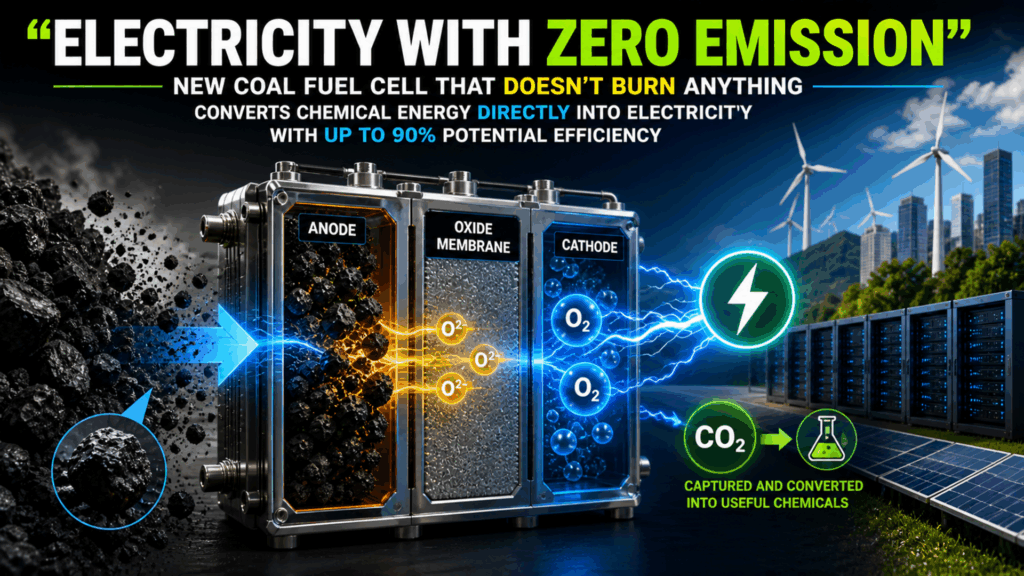
- The ZC-DCFC converts coal into electricity without combustion or turbines
- Xie Heping’s system bypasses Carnot limits with direct electrochemical conversion
- Coal powder reacts inside fuel cells to instantly generate electricity
For more than a century, coal has carried an environmental stigma that few other energy sources share.
The familiar image of chimneys belching gray fumes has become shorthand for industrial pollution and climate damage.
Yet a research team led by Xie Heping at Shenzhen University now claims to have completely rewritten this narrative.
The article continues below
How a non-combustion system actually works
The team claims that their technology does not burn coal at all and produces electricity without releasing carbon dioxide into the atmosphere.
The system, described as a zero-carbon carbon fuel cell, or ZC-DCFC, replaces heat-driven processes with direct chemical-to-electrical conversion inside a controlled cell environment.
Instead of setting coal on fire, the system pulverizes the fuel into a fine powder, then dries and cleans it.
The processed material then undergoes surface treatment to optimize its reactivity to an electrochemical environment.
Oxygen enters the cathode side of the fuel cell while the prepared carbon is fed into the anode chamber.
Inside the cell, an oxide membrane facilitates direct oxidation of the carbon particles, generating electricity on the spot.
This approach eliminates conventional stages such as steam generation and mechanical turbines.
Traditional coal plants operate via an indirect pathway, burning fuel to generate heat, then steam and finally mechanical rotation.
This multi-stage chain hits a hard ceiling known as the Carnot limit, which typically limits thermal efficiency to around 40%.
The direct carbon fuel cell with no carbon emission loses no energy because it is not associated with combustion.
The new method converts chemical energy directly into electricity, with a potential efficiency of up to 90%.
Managing carbon without releasing it
When the coal enters the anode chamber, the reaction produces carbon dioxide, which is immediately captured on site.
Instead of venting the gas into the atmosphere, the system catalytically converts it into useful chemical feedstocks such as synthesis gas.
It can also stabilize it into compounds such as sodium bicarbonate used in industrial applications, chemical raw materials or flue gas treatment.
This closed-loop handling makes operation both silent and clean, an approach that contrasts with conventional coal combustion.
The approach could prove critical to cleaning up China’s booming data center industry, which requires huge baseload power as it faces mounting pressure to cut emissions.
Since 2018, Xie’s research group has gradually advanced the technology through successive iterations, addressing persistent problems in materials science and cell durability.
Previous versions of direct carbon fuel cells struggled with low power density and short operating lifetimes.
The latest design improves stack scalability, long-term stability and carbon conversion efficiency.
Xie claims the concept could apply to deep coal seams located about 1.2 miles underground, turning coal into electricity in situ without expensive mining and transportation operations.
If the claims are true, this technology could mark a turning point not only for China, but also for many nations that have since “abandoned” their coal mines due to the proliferation of crude oil.
Via SCMP
Follow TechRadar on Google News and add us as a preferred source to get our expert news, reviews and opinions in your feeds.


