- The president says that “every Pakistani became a soldier” when the war was introduced.
- Argues that Pakistan is now globally recognized as a force for peace, stability.
- Says Pakistan helped facilitate US-Iran ceasefire through diplomacy.
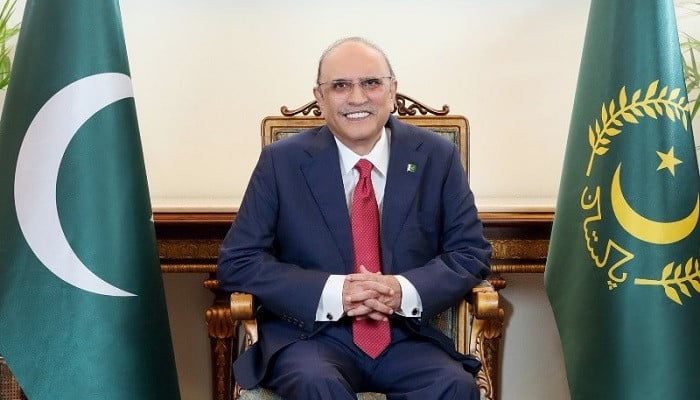
President Asif Ali Zardari on Saturday honored the nation and the armed forces on the first anniversary of Marka-e-Haq, praising the military leadership for delivering what he described as a resolute, calculated and disciplined response to external aggression.
In a statement issued by the media wing of the presidency, the president termed Field Marshal Asim Munir’s leadership, strategy and “courageous decisions” as crucial to the success of the operation. He also praised Air Chief Marshal Zaheer Ahmad Babar Sidhu and the Pakistan Air Force for their “extraordinary skill and professional expertise”, while praising Admiral Naveed Ashraf and the naval forces for maintaining full operational readiness and robust defense capabilities.
President Zardari said the events of April and May last year were not just a military episode but a moment of national reckoning. “When India, under the guise of Pahalgam false flag operation, launched unprovoked attacks on our soil targeting civilian areas as well as military installations, Pakistan responded with discipline, precision, courage and unity,” he said.
The President said that Operation Bunyan-um-Marsoos, described as the decisive centerpiece of Marka-e-Haq, demonstrated the capabilities of Pakistan Armed Forces when supported by national unity. “Our response was calibrated, measured, precise and proportionate. Our message was unequivocal,” he said, adding that Marka-e-Haq showed the world that Pakistan’s deterrence rested on professional competence, tri-service coordination and the unwavering resolve of its people. Paying tribute to the armed forces and martyrs, President Zardari said every Pakistani became a soldier when war was imposed on the country. “It is part of our DNA that when a war is forced upon us, every Pakistani becomes a soldier – some in uniform and most without,” he noted.
The President said that Pakistan is now recognized globally as a state capable not only of defending itself but also of contributing to peace and stability. Referring to recent tensions in West Asia, he said Pakistan had played a key diplomatic role in facilitating a ceasefire between the US and Iran and encouraging both sides to negotiate. “Our efforts helped avoid further bloodshed and contributed to stabilizing the wider regional environment,” he said, reaffirming Pakistan’s commitment to promoting peace, dialogue and stability.
On the Kashmir dispute, the president said no honest assessment of South Asia’s security challenges could ignore the issue, which he described as the main cause of regional instability.
President Zardari also criticized India’s suspension of the Indus Waters Treaty, terming it a “weaponisation of water”. He noted that the treaty, brokered by the World Bank and signed in 1960, had survived wars and decades of hostility between two nuclear-armed neighbors. “It was designed to be beyond the reach of political crises,” he said, adding that India’s unilateral decision to suspend the agreement lacked legal basis and threatened the livelihoods of millions. “Water is not a bargaining chip,” the president said, reiterating that Pakistan would defend its water rights with the same determination shown in defending its territory.
Affirming Pakistan’s stance on terrorism, President Zardari said that the country itself remained a victim of terrorism and was determined to eliminate “Fitna al-Khawarij” and “Fitna al-Hindustan” in all forms.