
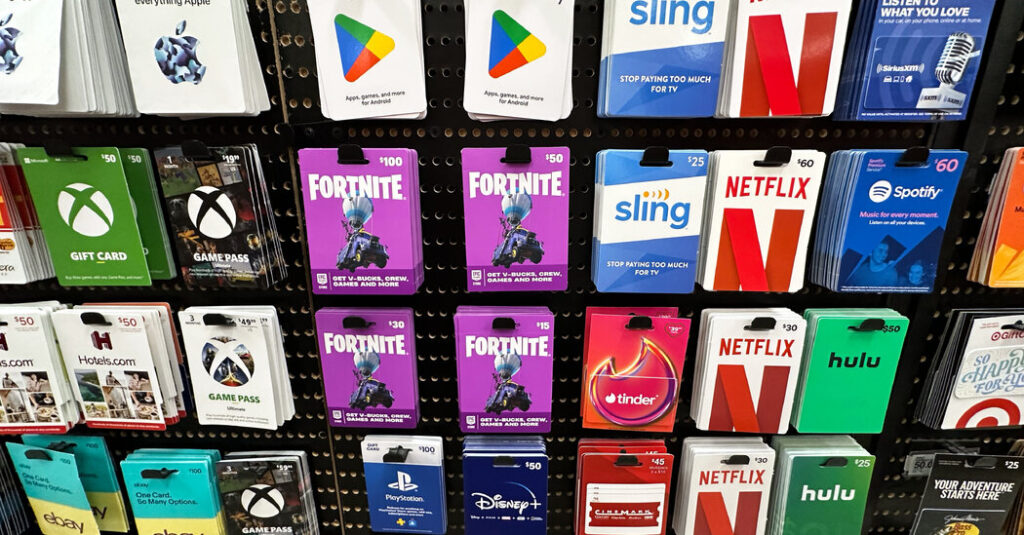
If it seems like a big part of your life has a subscription now — your TV, your car, even your white noise machine — you’d be right.
Take Eleanor Lewis, a 35-year-old software engineer in Brooklyn, who’s paying for a video game she’s no longer interested in. She’s subscribed to D&D Beyond — a companion to the original role-playing game — for what feels like “forever.”
“I haven’t played Dungeons & Dragons in five years,” Ms Lewis said. “I literally don’t even like Dungeons & Dragons, but I’m stuck with this stupid Dungeons and Dragons Beyond subscription that I can’t figure out how to get rid of.”
That’s just one example of products or services that can take long-term residence in credit card statements. There are your streaming channels. Shopping sites, such as Amazon Prime. Wholesale clubs for household goods, like Costco. The ink for your printer. Cloud storage and the tools that make your computer useful, such as image editing software.
It can even be your underwear. Car wash. The bed where you sleep. The networks where you watch professional sports. Earthworms to feed your salamander. Dating apps. exercise bikes. Your child’s math game. Fitness trackers, such as Oura rings. Livestock cameras. Your pet robots. And don’t forget the subscriptions to certain products, like toilet paper from a company called Who Gives a Crap.
Some of your subscriptions have subscriptions — there’s Hulu and then there’s Hulu Premium. And of course there are subscriptions to manage your subscriptions.
Subscriptions have become so ubiquitous that they have become a target for theft by people like Joe Fenti, a Boston-based comedian. On a recent trip to New York, he tried using an exercise bike at his hotel. The bike, a Peloton, required him to create an account to use it.
In a sketch shared widely on Instagram, he broadcasts the new way of doing business. He portrays a modern salesman shouting, “This product is for an ad-only subscription, and you have to pay to make it stop. You have no choice.”
In an interview, Mr. Fenti, 29,: “More and more I see things becoming a service product, which really should just be hardware that you buy and then use.”
The average American has 5.2 subscriptions and spends $69 a month on them, according to new research from Bango, a UK provider of subscription platforms — though other studies put the numbers higher. In some of these analyses, including one by the Chicago-based firm C+R Research, the average subscription bill per person be more than $200.
A significant number of products—including physical goods, software, and everything in between—have moved to a subscription model. According to a 2023 Harvard Business School study, nearly 75 percent of companies that sell directly to customers offer subscriptions.
Subscriptions have been around for decades – for cable, newspapers, car leases and cell phones. (And yes, The New York Times relies on reader subscriptions, too.) The explosion of this model is a recent phenomenon.
A watershed moment in the history of subscriptions was the success of Netflix’s model, introduced in 1999, and Amazon’s launch of Amazon Prime in 2005. The moves helped make these companies big businesses, and other companies have bundled subscriptions since: Phone and Internet companies like Verizon now offer packages that include Netflix.
Fatigue sets in with some customers.
“I don’t think there’s a single thing you can sign up for at this point that isn’t trying to get you a subscription” said Shonit Kaluri, 27, who works in New York as a lender for a bank that specializes in health care. “You end up wasting a lot of money through subscriptions because you think you’re going to save money up front.”
Kaluri bought a subscription to Club Pret from cafe chain Pret A Manger, paying $50 a month for up to five Barista-made drinks a day.
“If I bought three dollars’ worth of coffee, twice a day, I actually come out on top. But at the end of the day, I didn’t actually get the $50’s worth,” Mr Kaluri said.
For businesses, subscriptions provide reliable cash flow, build a stable stream and reassure investors. A customer is also more likely to remain loyal with a subscription. Both factors bolster a company’s measure of customer lifetime value, a measure of how much money each customer generates, marketing experts say.
Customers may feel more comfortable with smaller payments, rather than upfront costs, said Giles Tongue, vice president of marketing for Bango, which operates a platform to manage subscriptions.
“If you make it a subscription product and you imagine you’re going to get a recurring payment over a number of months, that reduces the initial sense of commitment,” Mr. Tongue.
Some car companies have looked for ways to make more money after the purchase. Tesla once placed a one-time price of $10,000 on its full self-driving capability. In 2021, the company introduced a monthly subscription to the package. Earlier this year, as Tesla’s profits fell, the company moved some of its basic Autopilot features behind a paywall.
In recent years, BMW has attracted derision for offering subscriptions to heated seats, though the company later questioned that decision. (This feature was mocked by “The Daily Show.”) In 2022, Mercedes-Benz began offering a subscription for enhanced horsepower, and the company continues to sell data packages that offer some of its cars’ features as subscriptions. (Volkswagen also offered a horsepower subscription starting last year.)
“If I could go into the supermarket and sell you just plain yogurt and then in another stand send you the fruit to put in the yogurt and all those components apart, I’d love to do that,” said Gil Appel, an assistant professor of marketing at George Washington University. “You can’t do that in the supermarket. You can do that in any other app.”
As technology has advanced, tracking consumer behavior is also easy. Subscriptions allow businesses to collect more information over a longer period of time. And they represent a greater opportunity for brand loyalty and an increasingly crucial avenue for revenue. A study by Capital One Shopping last year found that 87 percent of consumers will pay more for products from a brand they trust.
“If I’m a subscription or a membership model, I have access to data that these customers intentionally give me,” said Jennifer Cline, chief marketing officer at SubSummit, an annual conference for companies in the recurring revenue industry. “I have first-party data that I collect from them passively through their behavior and their buying habits, as they buy and buy.”
Another reason for this shift is a generational change: older customers were more used to owning things and more afraid of being handed down. Millennials and Gen Zers, not so much.
“A baby boomer would want to own a car. They would wait to buy a car until they had enough money to pay for it,” said Scott Fay, professor of marketing at Syracuse University.
There’s another frustration related to consumer subscription models: the difficulty of canceling some of them, which Ms. Lewis, the software engineer, discovered with D&D Beyond. This can mean long waits on the phone or navigating dense websites just to get out of a dormant or unwanted subscription.
In response to complaints from consumers, the Federal Trade Commission under the Biden administration proposed a rule that would have made it easier to cancel memberships. It was blocked by a federal appeals court last year, citing procedural issues.
In the meantime, consumers should watch out for monthly withdrawals on their statements.


