
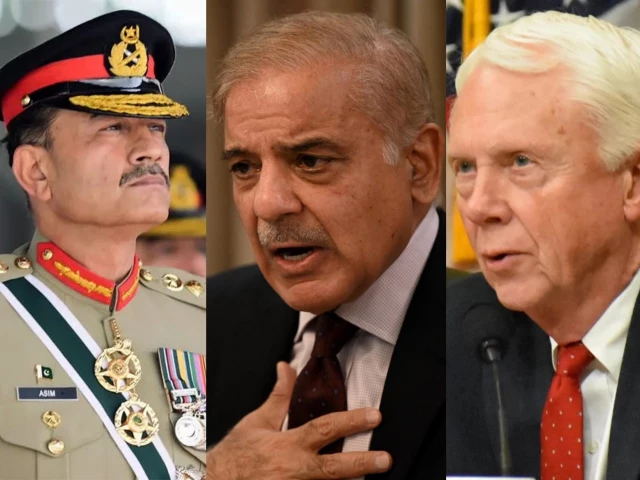
Congressman Jack Bergman calls Islamabad’s involvement ‘indispensable’ in the ongoing peace effort
US Congressman Jack Bergman praised Pakistan’s mediation role in a letter to Prime Minister Shehbaz Sharif and Chief of Defense Forces (CDF) and Chief of Army Staff Field Marshal Asim Munir.
Pakistan’s diplomatic role in facilitating ongoing US-Iran peace talks has drawn praise from a senior US lawmaker, who described Islamabad’s contribution as “indispensable” and reflecting “true statesmanship”.
US Congressman Jack Bergman, co-chairman of the Congressional Pakistan Caucus, has written a letter to Prime Minister Shehbaz Sharif and Chief of Defense Forces (CDF) and Chief of Army Staff Field Marshal Asim Munir, expressing “sincere gratitude” for Pakistan’s role in promoting dialogue between Washington and Tehran.
In the letter, dated May 15 and issued on the official letterhead of the US House of Representatives, Bergman offered one of the clearest public acknowledgments by a sitting US lawmaker of Pakistan’s involvement in the sensitive diplomatic process.
Read: Uzbek FM praises Pakistan’s constructive role in mediation, discusses bilateral ties with Dar
“I am writing as Co-Chair of the Congressional Pakistan Caucus to express my sincere gratitude for the leadership you both have demonstrated in the ongoing US-Iran peace negotiations,” Bergman wrote.
US Congressman and House Armed Services Committee member Jack Bergman expressed gratitude to Pakistan’s Defense Chief Asim Munir and Prime Minister Shehbaz Sharif for their leadership and role in supporting the US-Iran peace process. In a letter, Bergman… pic.twitter.com/ODiv30yr6v
— Pakistan TV (@PakTVGlobal) 16 May 2026
He praised Pakistan’s leadership for facilitating engagement at a critical time and said such efforts had contributed meaningfully to easing tensions and advancing the prospects for peace.
The congressman also referred to several instances where US President Donald Trump publicly acknowledged Pakistan’s role in the process. These included statements on social media and remarks during public engagements in which Trump praised Pakistan’s leadership for supporting dialogue between the two sides.
“Pakistan is great. Field Marshal Asim Munir is great. Prime Minister Shehbaz Sharif is great. They want to see something happen,” Trump was quoted as saying in one such statement.
Congressman Bergman further noted that progress in the US-Iran track had come amid sustained diplomatic efforts in which Pakistan played a constructive and facilitating role.
Bergman praised Islamabad’s mediation efforts, saying Islamabad had drawn on its “unique position” to help bring the parties to the negotiating table, framing the effort as an example of “true statesmanship.” He added that Pakistan’s role had been publicly acknowledged by the President, the White House and Congress, and said he fully supported those assessments.
“On behalf of the Congressional Pakistan Caucus, thank you. You have our deep and lasting gratitude,” the congressman wrote, before adding that he looked forward to returning to Pakistan soon to continue strengthening ties between the two countries personally.
The tone of the congressman’s message reflects a broader shift in language emerging from Washington regarding Pakistan’s regional stance. Rather than framing Islamabad through the lens of security cooperation or counter-terrorism alone, the letter presents Pakistan as an active diplomatic stakeholder capable of shaping the trajectory of high-level regional negotiations.
“The United States’ relationship with Pakistan is of continuing strategic importance, and Pakistan’s willingness to leverage its unique position to bring these parties to the table is a demonstration of true statesmanship,” Bergman wrote.
Pakistan has been mediating between Washington and Tehran to bring a lasting end to the conflict, which started with US and Israeli attacks on Iran on February 28 and was followed by Iranian retaliation against Israel and other regional countries that hosted US assets.
Also read: China praises Pakistan’s mediation role in US-Iran talks, stresses durable ceasefire
Pakistan brokered a two-week ceasefire between the US and Iran on 8 April, followed by critical talks in Islamabad, attended by high-level delegations from both countries, on 11 and 12 April.
However, neither side was able to reach an agreement to end the conflict.
Since then, the two sides have exchanged proposals and counter-proposals in an attempt to reach a middle ground and resume a second round of direct talks aimed at ending the conflict, which has already disrupted global energy supplies and daily life across the region.
While Pakistan remains hopeful for the resumption of direct talks, sources said there was no “significant” change in Iran’s previous stance on the nuclear issue in its response to US proposals.
According to sources, Tehran’s response – delivered to the US via Islamabad last week – focused primarily on an “immediate” end to hostilities, with “little” [in it] in relation to Washington’s core demands on Iran’s nuclear program”.
Also read: Prime Minister Shehbaz confirms receipt of Iran’s response to US peace proposal
Iran, the sources added, has proposed “broader and separate” talks on the nuclear issue, citing its “complexity.”
However, Tehran has “reiterated” its willingness to halt uranium enrichment for a period of five years, while rejecting Washington’s demand for a 20-year moratorium, according to the sources.


