
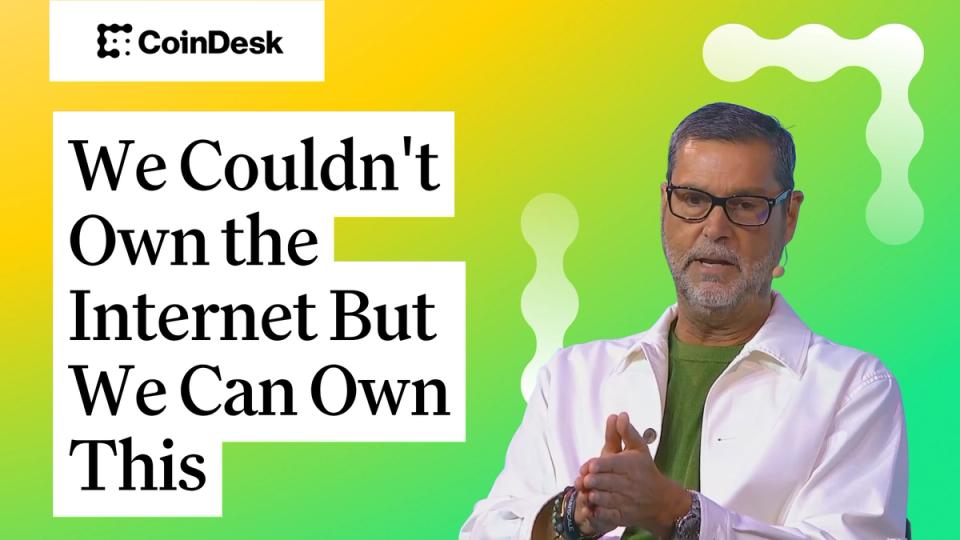
Why this matters: Pal argued that AI and blockchain are converging into a new infrastructure layer for the global economy.
- Pal said humanity is approaching a moment when AI systems become “superior intelligence” that will fundamentally change work, the economy and everyday life.
- He described crypto as the ownership layer of the future economy, allowing individuals to “front-run Wall Street” by owning blockchain infrastructure before institutions fully arrive.
- “We can own the infrastructure layer for the first time in history,” Pal said during the interview.
The big picture: Pal framed the current moment as a historic acceleration point for technology adoption.
- He said AI adoption is moving faster than the internet era, comparing it to “Metcalfe’s law in the second order”, referring to network effects.
- Pal pointed to AI-generated content growth as evidence of the shift, citing data showing that AI now produces more words annually than humans.
- “Since COVID, we’ve hyper-accelerated everything,” Pal said.
- He also highlighted the rapid adoption of GLP-1 weight loss drugs as another example of exponential technological change.
What this means for crypto: Pal said institutional adoption does not undermine crypto’s original mission.
- He argued tokenization and blockchain rails expand access to financial markets for people globally who were previously excluded.
- “Everyone is on the same level,” Pal said, referring to the ability for users worldwide to access crypto assets.
- Pal said tokenized stocks could give investors in countries like Nigeria access to assets previously unavailable to them.
- He described stablecoins, tokenization and blockchain-based finance as “a better system for everyone.”
Reading between the lines: Pal sees crypto speculation as a feature, not a bug.
- He argued that meme coins and NFTs served as stress tests for broader technological ideas.
- “Crypto is fun because we hyper-speculate everything as the way to test it,” Pal said.
- Pal said meme coins demonstrated how online attention can quickly generate capital.
- He also predicted that NFTs will eventually become fundamental digital contracts underpinning parts of the future economy.
On AI: Pal described AI as both a productivity accelerator and a societal disruptor.
- He said he already uses AI tools like Claude, ChatGPT and Grok daily as “thought partners” for research, writing and idea generation.
- Pal said AI has reduced tasks that once took days into workflows lasting only hours.
- He warned that artificial intelligence could threaten parts of the labor market, but argued that human creativity, community and experiences will become more valuable.
- “The human currency is attention,” Pal said.
Worth seeing: Pal predicted that crypto markets and AI-powered systems will continue to converge over the next decade.
- He predicted that the crypto market could eventually grow from around $2.7 trillion today to $100 trillion within a decade.
- Pal argued that wealth creation from crypto will increasingly flow into digital culture, including NFT-based art.
- He cited digital artist XCOPY as an example of crypto-native culture gaining value alongside traditional art markets.
- Asked what could derail crypto adoption, Pal replied, “Nothing is stopping this train.”


