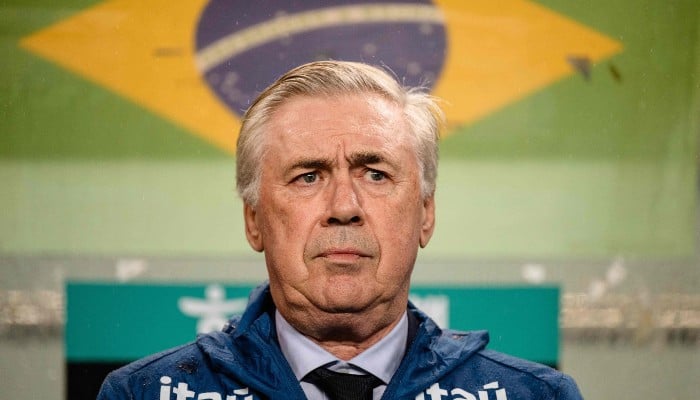
PARIS: Brazil’s quest to reclaim World Cup supremacy from their European rivals has seen them hand the reins to a European, with Italian Carlo Ancelotti tasked with ending the nation’s wait to win their sixth title.
It has been 24 years since the Selecao last won the World Cup, exactly the same amount of time they had to wait between Pele lifting the old Jules Rimet trophy in 1970 and the team’s triumph in 1994.
Ancelotti, 66, has unfinished business at the World Cup and Brazil is ripe for a revival.
“I’m not obsessed with winning the World Cup, but I have the pleasure and the passion to enjoy the moment I live in, managing the most important national team in the world,” the former Real Madrid coach recently told the Guardian.
With his measured demeanor on the sidelines and his tactical pragmatism, Ancelotti is undoubtedly the most successful coach of his generation.
He has won the Champions League five times, two with AC Milan and three with Madrid, and has won league titles in Italy, England, France, Germany and Spain.
A year ago, when he left Real, Ancelotti became Brazil’s third permanent coach since the last World Cup.
In five World Cups since winning in 2002, Brazil have lost four times in the quarter-finals and reached the semi-finals once – when they suffered a traumatizing 7-1 defeat at the hands of hosts Germany in 2014.
The end of penalties for Croatia in Qatar in 2022 brought an end to Tite’s reign.
Fernando Diniz took over for the start of the 2026 World Cup qualifiers, but lasted just six games.
In came Dorival Junior, but the veteran oversaw a quarter-final exit at the 2024 Copa America. He was sacked last March after a 4-1 thrashing in a World Cup qualifier in Argentina.
Ancelotti saw Brazil over the line, but they finished fifth in the 10-team South American qualifying group, 10 points behind first-placed Argentina.
There have since been three wins, a draw and two defeats – against Japan and France – in friendlies with the new coach testing different formations.
He hasn’t completely cleared the decks. Far from it. Eight of those who started against Croatia in 2022 are in his squad.
Central defender Eder Militao is injured along with strikers Rodrygo and Estevao. Chelsea’s Joao Pedro was left out.
Ten of Ancelotti’s 26-man squad are in their thirties, with the average age almost 29.
Neymar gambles
His decision to include Neymar caused a sensation, with the 34-year-old ex-Barcelona and Paris Saint-Germain forward set for his fourth World Cup – despite not playing for his country since 2023 due to injury.
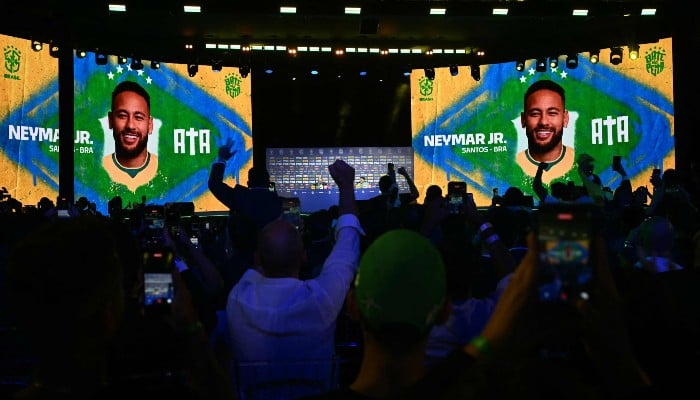
Now at Santos, Neymar will surely only have a small role, with Vinicius Junior instead leading the attack.
Matheus Cunha and Raphinha could also have big roles, while Casemiro and Bruno Guimaraes represent a solid midfield. Central defenders Gabriel Magalhaes from Arsenal and Marquinhos from PSG come straight from the Champions League final.
Ancelotti knows there are high expectations with Brazilians hungry for another title after 1958, 1962, 1970, 1994 and 2002.
As a player, Ancelotti missed Italy’s victorious 1982 World Cup campaign through injury and was an unused squad member in 1986.
He played in 1990 when Italy hosted and agonizingly lost in the semi-final on penalties to Argentina.
Then came 1994 and the shootout loss to Brazil in the final at the Pasadena Rose Bowl, with a 35-year-old Ancelotti serving as Arrigo Sacchi’s assistant.
“In other countries, the national team is not as important as it is in Brazil… Europeans do not have the same love for the national team shirt,” Ancelotti told the Guardian.
Brazil are in a group with Haiti, Scotland and Morocco and begin against the latter in New Jersey on June 13.
Should they top their group, Brazil’s path forward looks potentially very friendly, although they have not beaten a European team in a World Cup knockout match since 2002.
But the Brazilian Football Confederation (CBF) has already seen enough to give Ancelotti a new contract until the 2030 World Cup.
“We have the most successful coach in the world. We need to make the most of him being here so we leave a positive legacy for Brazilian football,” CBF president Samir Xaud said.