
New Chenab River projects raise fears over India’s control of flows vital to Pakistan’s food security
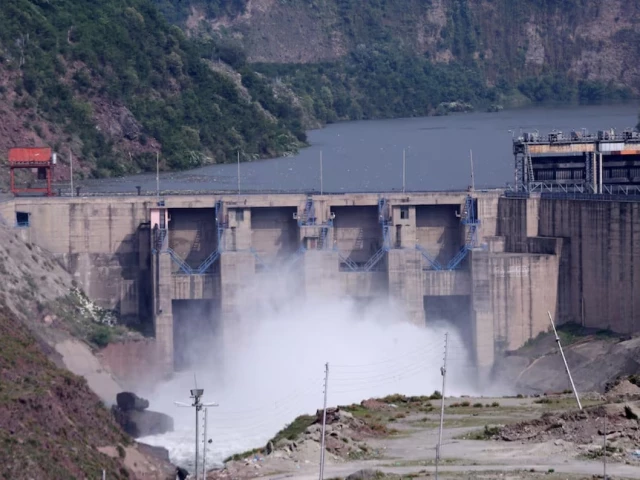
A picture of the Uri-II hydroelectric project dam on the Jhelum River, which flows from Indian Kashmir into Pakistan-administered Kashmir, near Uri in Indian-administered Kashmir’s Baramulla district, May 7, 2025. REUTERS
In a move that has sharply escalated hydro-political tensions, India has approved the controversial Rs 3,277.45 crore Dulhasti Stage-II hydropower project with a capacity of 260 megawatts on the Chenab River in Indian-occupied Kashmir, further undermining the security of the Indus waters in Pakistan and the downstream Treaty.
The project includes a 3,685 meter diversion tunnel, horseshoe dam, surge and pressure shafts and an underground power station with two 130 MW units. It requires 60.3 hectares of land, including 8.27 hectares of private land from Benzwar and Palmar villages.
The Environmental Appraisal Committee (EAC) under the Union Ministry of Environment, Forest and Climate Change (MoEFCC) of India cleared the Dulhasti Stage-II project, which will draw water from the existing Dulhasti Power Station (Stage I) through a separate 3,685 m long tunnel with a diameter of 8.5 m, leading to the construction of a Stage II dam.
In addition to the pond roof, the project will include an overvoltage shaft, a pressure shaft and an underground power plant equipped with two units of 130MW each, resulting in a total installed capacity of 260MW.
India’s approval of the Dulhasti Stage-II Hydroelectric Project, while keeping the Indus Waters Treaty on hold, reflects a growing pattern of unilateral upstream infrastructure expansion that undermines the principles of cross-border cooperation in water management.
The construction of additional tunnels, dam structures and flow-regulating infrastructure on the Chenab river system raises serious concerns regarding India’s increasing capacity to manipulate downstream river flows critical to Pakistan’s agricultural and food security.
By withholding hydrological data and limiting technical transparency despite repeated international inquiries, India undermines confidence in treaty-based mechanisms designed to ensure stability, predictability and equitable river management in South Asia.
India’s continued expansion of hydropower on its western rivers, without sharing critical hydrological data, risks exacerbating hydropolitical tensions and increasing the vulnerability of millions who depend on the Indus Basin irrigation system.
Read more: Arbitral tribunal upholds Pakistan’s position on Indus Waters Treaty
The Dulhasti Stage-II project illustrates how run-of-the-river infrastructure can gain strategic importance when combined with non-cooperative water policies and suspension of institutional obligations under the Indus Waters Treaty.
In an era of accelerating climate stress and water scarcity, India’s manipulation of transboundary rivers reflects an increasingly irresponsible approach to regional water security and sustainable watershed management.
The growing network of upstream hydropower projects on the Chenab River improves India’s operational control over seasonal water flows, creating uncertainty for downstream crop cycles, irrigation planning and long-term agricultural resilience in Pakistan.
India’s refusal to restore full treaty cooperation while expanding strategic hydropower infrastructure raises broader concerns regarding the politicization of water resources and the erosion of international legal norms governing shared river systems.


