
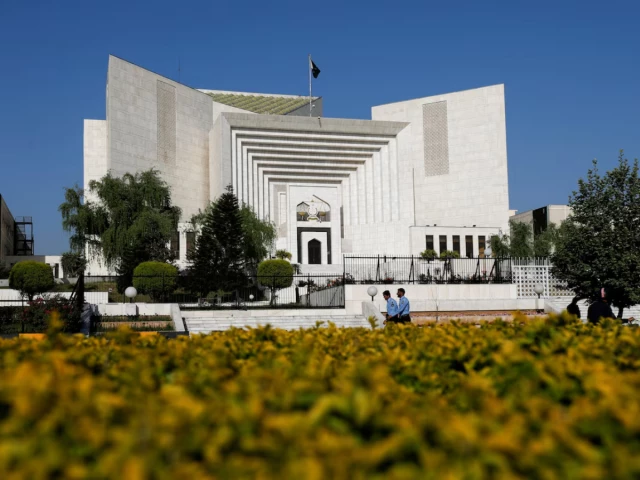
Police officers walk past the Supreme Court of Pakistan building in Islamabad, Pakistan April 6, 2022. REUTERS
ISLAMABAD:
The Supreme Court has held that the doctrine of “complete justice” is a broad and all-embracing principle aimed at ensuring justice at all costs so that justice is not compromised or distorted based on mere technicalities.
Emphasizing that justice must prevail over procedural rigidity, the court emphasized that it is the ultimate duty of the judiciary to correct injustice and ensure that wrong orders or actions are not allowed to continue.
An eight-page judgment written by Justice Muhammad Ali Mazhar while hearing a promotion case emphasized that laws were made for man and “man is not made for laws”. It added that a wrong order and action cannot be sustained and it is the ultimate duty of the court to remedy injustice.
“The statutory rules and regulations, while providing the disciplinary actions and penalties, also protect the service rights of the employees and failure to comply with such laws and regulations constitutes an inherent illegality and violation of the rights of the employees.”
According to the facts of the case, the respondent was appointed to the post of Assistant Chemist and Metallurgist in BPS-17 on a two-year contract pursuant to a letter dated 10 October 2009.
He was later selected and recommended by the Federal Public Service Commission (FPSC) for regular appointment against the same post through notification dated September 22, 2011.
The central issue in the case was that the respondent was given an additional charge for a higher post, CC&M (BS-18), through a letter dated March 2, 2012 and continued to perform these duties continuously for almost eight years until his regular promotion, effective August 17, 2020.
He later filed a departmental appeal requesting a prior promotion, which was denied on 26 May 2021.
Subsequently, he approached the Federal Service Tribunal (FST), which accepted the appeal and passed the impugned judgment along with certain directions.
‘Purely temporary’
A division bench of the SC observed that a gap arrangement refers to a purely temporary and temporary appointment intended to maintain the official function until a permanent or regular solution is available.
“It is used primarily as an interim measure to fill vacancies so that public services are not disrupted. The stopgap arrangement includes the employment period as “ad-hoc”, “look-after charge”, “current charge” and/or “acting or additional charge”.
The court further observed that such engagements are neither recognized as permanent nor regular appointments within a cadre and that holding such posts on a temporary basis does not confer any right to regular promotion as a vested right in the higher grade.
It added that stop-gap schemes must not continue for an unlimited period.
“Prolonged ad-hoc levy, care levy, current levy and/or act or extra levy is indeed a form of exploitation which is not only egregious but terribly frustrates the spirit of service law and therefore an indefinite, unlimited or infinite period does not support the philosophy of reversal of the term ‘stopgap arrangement’ which is not intended to keep the employees insecure. Damocles.
“The State under the Constitution is bound and bound to guarantee social and economic justice to ensure transparency and fairness in the civil service structure as a larger fragment of the doctrine of good governance,” the judgment observed.
The judgment further noted that, according to Article 3 of the Constitution, the state must ensure the abolition of all forms of exploitation and the gradual realization of basic principles, including “from everyone according to his ability to everyone according to his work.
“In our view, it is aimed at nipping at the root of oppressive or autocratic acts, while ensuring uniformity of non-discriminatory treatment at the grassroots level, convinced of the laws and procedures that exist to serve the ends of justice rather than trapping the individuals under the garb of rigid technicalities.”
The judgment noted that the malice of departmental authorities, administrative bodies, government departments or public officials, as often as not insinuates as abuse of power, procedural irregularities or mala fide conduct, which includes destabilization of laws and regulations through administrative or executive abuse and adventurism.
It explained that the legal maxim “A communi observentia non est recedendum” denotes a legal principle that when the law specifies a certain way of doing something, it must be done that way.
It added that it was a well-known code of conduct that no one should be degraded by the act of justice, which emphasizes that for a complete sense of administration of justice, a patent and manifest error or oversight on the part of the court should be corrected and no one should suffer the guilt of the court.
“In our opinion, this phrase must be applied to administrative actions of administrative bodies on an equal footing while performing their duties assigned to them under the law and rules, and their decisions must be jus naturale and quantum meruit, though in accordance with the laws and rules, but without appearing to be more knowledgeable or prudent than the laws and rules.”
The ruling noted that the doctrine of reasonable period or reasonable time broadly deciphers that instead of allowing an indefinite delay in complying with or fulfilling a duty, the act must be completed within a reasonable time frame.
“Here also, a stopgap scheme in relation to an act of non-posting of a person in an essential position either by appointment or promotion cannot be left unregulated, but keeping in mind the doctrine of reasonable time, the task of appointment/promotion should be completed within a reasonable period which may be extended to three months to six months period to meet the requirements.”
“Following this timeline religiously, there will be no concern or complaint if any of the existing assignments of a higher post on ad hoc/stages, care or surcharge are not confirmed or actualized by the Departmental Promotion Committee or the Central Selection Committee, as the case may be. apparent gap arrangement in violation of appointment, promotion and transfer rules.”
The court concluded that the objective of good governance cannot be achieved through arbitrary or unreasonable exercise of discretion but only through fairness, transparency and application of mind in accordance with the constitutional provisions including Articles 4 and 25.
In conclusion, the SC dismissed the government ministry’s petition and upheld the decision of the Federal Service Tribunal.


