
The infrastructure that supports global computing is undergoing a massive shift. Real computing power no longer belongs to isolated corporate data centers, but to open, global networks.
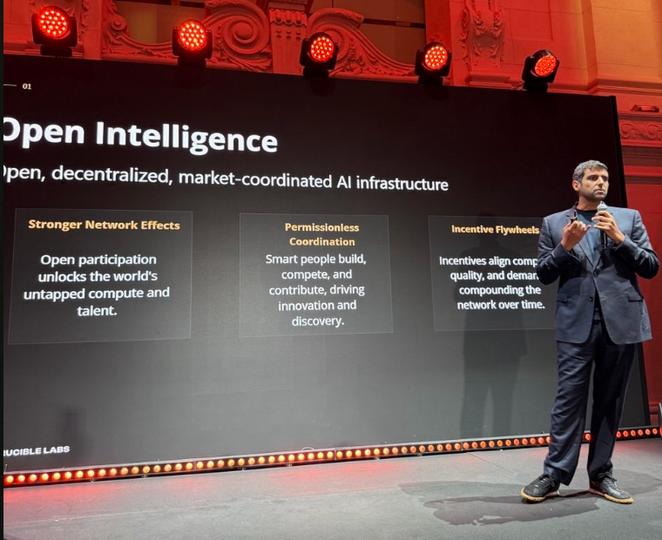
Talking by Proof of speech summit in Paris, Bittensor co-founder and Crucible Labs partner Ala Shaabana highlighted the staggering mathematics behind decentralized networks. To show the audience what distributed computing can do, he stacked the Bitcoin network against traditional enterprise setups.
“We all know that Bitcoin really dwarfs the top 100 supercomputers,” Shaabana said. “Does anyone know, by comparison, what the hash rate is? It’s over 600,000 times as much as really what these supercomputers can do. And it’s just, really, it’s Bitcoin.”
To understand Shaabana’s comment, it helps to know what Bittensor actually is.
It is a Layer 1 protocol built on the same codebase philosophy as Bitcoin: a hard cap of 21 million tokens, halvings hardcoded into predetermined blocks, no pre-mining and no venture capital. Bittensor is a decentralized network that replaces Bitcoin’s hash-puzzle mining with running and validating artificial intelligence.
The same incentive architecture that made Bitcoin a computing power 600,000 times stronger than the world’s best supercomputers is being redirected by Bittensor toward AI, organized across 128 specialized problem-solving networks called subnets. Each subnet defines its own goal, and miners compete for TAO token rewards by meeting it, meaning the network’s intelligence is shaped entirely by what it chooses to reward. That design principle, borrowed directly from Bitcoin’s playbook, underpins everything Shaabana argues below.
Change in long-term bull case
Shaabana’s core logic is simple: If coordination and code could create the world’s most powerful financial computing engine, the exact same plan can be applied to AI. By dividing a network into 128 individual problem-solving neighborhoods or subnets, developers can draw on global hardware and intelligence without a central technical monopoly.
The trick to making a distributed system work depends entirely on the incentive design. “Show me the subnet and I’ll tell you what the miners are optimizing for,” Shaabens said, adapting a famous market quote. If you reward participants for raw computational speed, they will optimize for speed. If you reward them for data retention, they will optimize for retention.
By setting these programmatic goals, open networks naturally attract talent and computing power far more efficiently than standard companies.
“The long-term bull case is no longer primarily technological,” concluded Shaabana. “It’s driven by debt, liquidity, and declining trust in traditional sovereign systems. The Subnet is truly creating markets. Intelligence is truly no longer locked behind organizational issues; signals will define truth, and performance will truly be rewarded.”


