
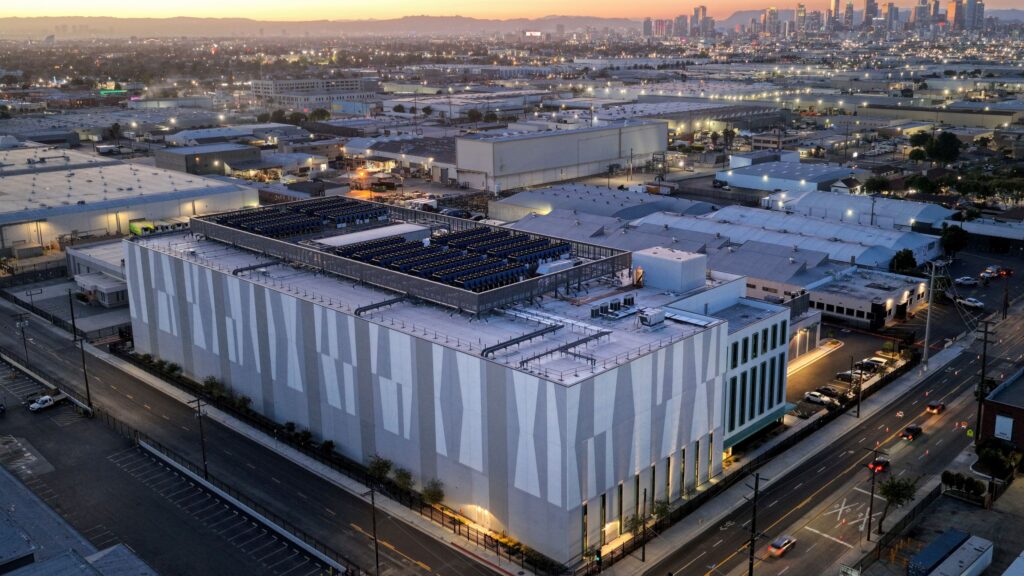
- Half of all new US data centers are now in high-risk, disaster-prone states
- 29-34% are located in earthquake, tornado or hurricane hotspots
- Data centers are driven to these states due to other restrictions
New insurance research has claimed that more than half (56%) of US data center projects planned or under construction are located in high-risk states, with many prone to hurricanes, winter storms and earthquakes.
According to data from MS Amlin, which examined 670 US data center plans, these deferred projects account for nearly $800 billion in investment.
Insurers are particularly concerned about the high concentration of projects moving to southern states, where land, tax incentives and power availability are generally more attractive.

Tornadoes, hail, wind and thunderstorms
It appears that the main concern comes from severe convective storms (SCS). Under this insurance category, tornadoes, hail, damaging winds and severe thunderstorms all pose a risk to data center construction. More than half (51%) of the planned facilities are located in high-risk SCS regions.
Existing data centers in these regions account for about $20 billion in value, but planned infrastructure would be worth about 40 times more, the report reveals.
And the concerns are not unfounded, as SCS events generated about $52 billion in insured losses across the United States last year.
But other weather factors also come into play, with more than a quarter (27%) of planned facilities located where there is high winter storm exposure, more than a fifth (21%) in states with high hurricane risk, and 3% in earthquake-prone areas.
“When assets of this scale are clustered in high-risk areas, the potential loss rate from a single storm event can add up very quickly,” Chief Underwriting Officer Martin Burke wrote.
The company also referred to Swiss Re research which revealed that insured losses from SCS have grown around 8% annually since 2008.
The data is also consistent with separate research from Texas A&M University, which found that 34% of the 2,660 US data centers it surveyed were located in hurricane hotspots, 30% were in tornado hotspots and 29% were in earthquake hotspots. Many were also in areas susceptible to wildfires and flooding.
Balancing environmental threats against energy availability and more
Securing projects isn’t the only consideration that hyperscalers and investors need to make, however, because while AI was previously limited by capacity, the biggest challenges now come from actually building capacity.
The industry has shifted its priorities to available grid capacity and cheap land to scale with demand, with many projects already facing years of delays due to poor energy availability.
Despite concentrated investment in high-risk areas, Burke sees this as a “growth opportunity” for the insurance sector where “risks need to be properly managed and understood.”
But looking ahead, the report suggests how insurance companies themselves may soon become a constraint on AI expansion, adding to the number of factors AI companies must balance.
The Texas A&M University paper identified a number of locations across northern Minnesota and Michigan’s Upper Peninsula that are considered low risk.
“It is imperative to thoroughly evaluate and improve the resilience of data centers to these climate-induced risks to ensure the continuity and reliability of AI-powered services on which our modern society increasingly depends,” the researchers concluded.
As for insurers, Burke urges underwriters to “adopt more advanced ways to manage aggregation risk.”

Follow TechRadar on Google News and add us as a preferred source to get our expert news, reviews and opinions in your feeds.


