
Budget delivers on commitment to shift from economic stability to economic growth, says Aurangzeb
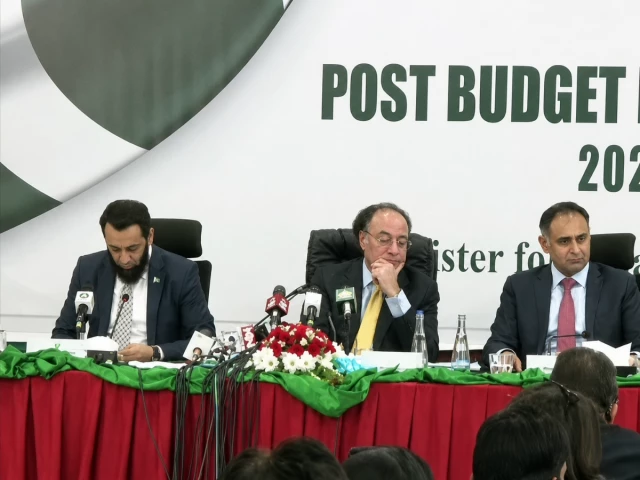
The Minister of Finance holds a press conference after the budget. Screengrab
Finance Minister Muhammad Aurangzeb, flanked by Information Minister Attaullah Tarar, Minister of State for Finance Bilal Azhar Kayani, Finance Minister Imdadullah Bosal, FBR Chairman Rashid Mahmood Langrial and Fiscal Policy Office Chief Najeeb Memon, addressed a post-Budget press conference on Saturday.
The finance minister said that last year, when discussions were held on economic stability, the government had committed to moving from stability to growth.
He said this budget lives up to that commitment, with measures taken to shift from economic stability to economic growth.
Aurangzeb said steps have been taken in the budget to promote exports, including abolition of advance tax and the proposed abolition of super tax for all exporters.
A subsidy of Rs70 to Rs71 billion has been provided to ensure an enabling environment for exporters who will also have access to finance at 4.5 per cent.
He added that the duty on the import of raw materials has been reduced to bring down production costs.
“We have made significant progress and you have read and listened to the budget speech,” Aurangzeb said, adding that the main themes of the budget are export-led growth and enabling factors.
“We have tried our best to bring all these areas into the enabling environment,” he said.
In terms of taxation, advance tax has been abolished, the finance minister noted, adding that in terms of super tax “we have dropped from 10 to 8%, which is again a very meaningful direction of travel”.
He noted that when he spoke to Prime Minister Shehbaz Sharif and the government yesterday, they specifically directed that the super tax be abolished for all exporters.
Saying that “this is not just a matter of taxation, it is also a matter of financing,” the finance minister said, “We are taking this refinancing scheme to another level”.
“For this we have given a subsidy of Rs71 billion during this budget so that this finance remains available to the exporters from Pakistan at 4.5%,” he said. He continued: “In terms of policy rate and inflation, it is at 4.5%”.
Aurangzeb expressed gratitude to the Governor of the State Bank and to those who spoke to the banks and stated that it is a very great attribute that this funding will be available at 4.5% which he said is in trillions.
In a discussion on bringing down costs in the form of semi-finished products and raw materials, the finance minister stated that the mentioned financing mechanisms are “how we can increase export competitiveness”.
He added that “our focus remains on the goods, which is very important how to reduce the trade deficit”.
He also noted that services are becoming increasingly important, especially IT services, adding that total exports of goods and services will hit $4.5 billion next year.
For this reason, he said that on the IT industry and freelancers, 0.25% FDR should be maintained.
“We made an effort to release the lowest segments of the salaried class,” Aurangzeb said, from 5% to 1% and from 15% to 13%. “But the reality is that the plates above that and especially the add-on element are all in front of you,” he added.
“If we were to take this budget in the direction of pro-business, pro-growth, then construction, of course, housing plays a very important role, and the transaction taxes that we’ve lowered, you’ve already seen about that,” he said.
Discussing agriculture, he said: “This has increased by 15% year-on-year and it has crossed 2 trillion, which is the total agricultural financing.”
The finance minister also discussed the Zarkhez-e scheme, which he said was introduced this financial year and is entirely digital.
“More importantly, it is uncollateralized; for small farmers, it is not said to keep someone as an individual or to mortgage someone’s house,” he said, adding that the scheme was introduced for small farmers and is moving in the right direction.
Further, he discussed the Prime Minister’s farm loans, especially to the youth, of which the total amount is Rs 262 billion. Of the amount, Rs 125 billion was earmarked for agriculture, the finance minister said.
Read: Achakzai questions the state’s policies, Shehbaz promises answers in the National Assembly
He also discussed Pakistan’s need for value-added machinery, which he said was not being made in the country. “We can get it from China or other countries, which will help us increase the yield,” he said.
“On all these things, customs duties, additional duties, regulatory charges have been zeroed out,” the finance minister noted.
Describing agriculture as “one of the key principles of growth”, Aurangzeb moved to discuss what he considered issues of deepening and expansion.
Elaborating, he said, he referred to “digital surveillance and other things that are going on at the moment,” and said he specifically mentioned that additional revenue is being received from this.
Discussing the new tax operating model, Aurangzeb noted that the government wants to take it towards automation. “We want to take it against AI,” he said, adding, “We’re reducing human intervention”.
To discuss the expansion, the finance minister stated that the retailer scheme was mentioned in the budget.
“We put a lot of effort into this budget, especially what was said that you only talk about economic stability, economic growth, where is that?” Aurganzeb said, adding, “So this time, the fiscal space that was available, we have used it diligently”.
Although he noted that “there is more to be done,” he said, “I will say this again, the feedback we have received is that we are moving toward economic growth”.
He added that the budget is going to play a very central role in this regard.
Finance Minister Bilal Azhar Kayani noted that “fundamentally, this is the salary grade budget, this is the industrial companies’ budget, this is the exporters’ budget, this is the construction sector’s budget”.
Kayani added, “this is the budget for the person who wants to build his own house and does not have the means to do so”.
“It is the other parts of our economy that needed resources so that our economy can move forward,” the minister said, noting that the budget aims to reduce the burden on citizens.
He stated that the Prime Minister, the Finance Minister and the entire economic team “have always admitted that very few people carry the burden of this tax on their shoulders”.
“The grade is at the top of the list,” Kayani said, adding that “that is why it has always been said that the government will give relief to the grade whenever it gets a chance”.
Kayani also discussed the reduction of the minimum and advance taxes for exporters, “whether it was the elimination of the first six slabs of super tax and the last slab should be reduced from 500 million to 10% to 8%”.
“These were basically the primary demands of our exporters and our formal industry,” he said.
He continued: “When we talk about reducing the tax burden, we have not limited that consultation and as a result, by talking to our business community, the real issues that came to us, to reduce the tax burden, the primary levers that were identified were addressed by the government.”
He noted that a week before the budget, Prime Minister Shehbaz held a detailed meeting with all chambers in the country, including the FPCCI. “Whether it was Lahore, Karachi, Quetta, Peshawar, Faisalabad, Sialkot,” he said, “everyone from their respective areas, which are part of our economy, brought their problems”.
He added that a separate meeting was held with other industry leaders, including the Pakistan Business Council. “As a result of these consultations, we have not only provided relief measures in this budget, but we also continued to make improvements throughout the year.”
Discussing taxes affecting the social sector, Kayani mentioned the GST exemption for Pink Tax or the GST exemption for contraceptives. “These are also important demands for us in terms of population control and women’s reproductive health, which were fulfilled by Prime Minister Shehbaz’s government”.
Kayani further discussed the GST exemption for the shipping industry. “During this war and conflict, we realized the importance of having our own fleet and how strategically important it is to you,” he said, noting that is why the matter was kept in sight.
“In terms of export financing and housing allocations, under Benazir’s income support program, your weakest sectors, over 10 million households have been increased through women,” the minister said.
He added that this is a public budget and because the public supported the Prime Minister in a difficult time, the stabilization phase, the improvement he had promised, has begun. “This will provide employment, trade, exports to all and will increase the purchasing power of our brothers and sisters”.
On Friday, the finance minister unveiled a Rs18.8 trillion federal budget that proposed significantly rolling back punitive taxes imposed on the wage-earning class and the real estate sector while deepening economic liberalization.
Read more: Rs18.8tr. outlay targets growth promotion
The expansionary budget of Rs 18.8 trillion was 20% or Rs 3.1 trillion higher than the last fiscal year’s revised outlay, indicating the government’s intentions to shift gears from consolidation to spending.
Despite significant contributions from four provinces, the federal government has announced a deficit of Rs7 trillion, which is higher than this fiscal year and will be filled by taking more loans. The government also plans to get $23.4 billion in foreign loans, including $2 billion through Euro and Panda bonds.


