
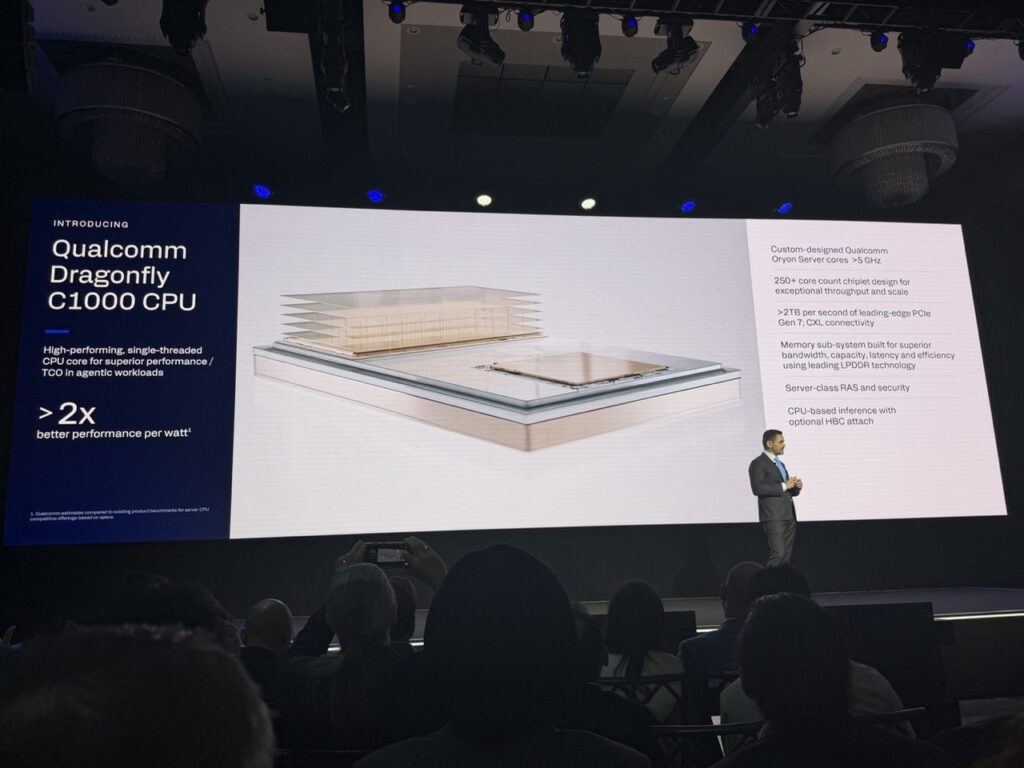
- The Qualcomm Dragonfly AI200 AI accelerator rack is the first of several releases planned by the chip designer as it aims to score victories in the data center segment
- The upcoming Dragonfly AI250 accelerator leverages its proprietary High Bandwidth Compute (HBC) to offer a theoretical 18x the amount of bandwidth of its sibling
- Qualcomm’s push comes amid an increasingly lucrative data center market struggling with memory shortages
It’s no secret that the modern AI server ecosystem is dominated by Nvidia in most countries, although China is increasingly leaning towards Huawei as its own homegrown provider of similar solutions.
Qualcomm might not be one of the first companies that comes to mind when you think of AI data centers or the chips contained within them, with many investors feeling like they’ve completely missed the boat in the server segment.
Qualcomm’s recent Investor Day 2026 event was a reminder that it’s not only still in the game, but has ambitions to carve out a big slice of an ever-larger pie by taking a different path than most of its HBM-utilizing competitors.

An alternative ecosystem to Nvidia’s industry standards?
Much of Qualcomm’s Investor Day event focused on its plans to become a significant player in the AI data center market, which is currently dominated by OEMs deploying a mix of Nvidia and AMD accelerators alongside custom silicon (ASIC) offerings from Google, Meta, Microsoft and even Amazon’s AWS.
It aims to do so by differentiating itself from the competition and relying on its own area of expertise to create an advantage: efficient Low-Power Double Data Rate (LPDDR) memory stacked in a 3D array over its AI accelerators to power next-generation AI inference workloads.
The near-memory compute architecture isn’t exactly a new play in a market teeming with similar approaches, but the numbers are hard to argue with when it comes to Qualcomm’s offering.
Qualcomm’s upcoming Dragonfly AI200 rack delivers 43 TB of LPDDR5X capacity and 414 TB/s of memory bandwidth per rack, built from accelerator cards that each carry 768GB of LPDDR5X, making it an interesting proposition, but much of the focus that hyperscalers will have will be on its Compute-Band AI250 Dragonfly sibling. (HBC) under the bonnet.
Although it offers the same memory capacity per rack, its ability to utilize memory at up to 18 times the bandwidth of its sibling gives a theoretical maximum memory bandwidth of up to 7.4 PB/s per rack, far from the AI200’s 0.4 PB/s.
Dragonfly is positioned as an inference-centric accelerator for a reason; however, HBM is still better suited for certain tasks, such as training models rather than inference, making it the memory of choice for Nvidia’s Blackwell and upcoming Rubin GPUs, as well as AMD’s Instinct offerings.
That said, Qualcomm’s solution is intriguing, even if the numbers are for specific use cases, and its ability to woo hyperscaler giants like Microsoft and Meta tends to indicate that it has potential upside, at least on paper, as AI data centers continue to increase focus on inference-centric solutions to deploy their increasingly complex models to a wider audience.

Follow TechRadar on Google News and add us as a preferred source to get our expert news, reviews and opinions in your feeds.


