The outbreak’s “true extent is not yet fully established,” said Dr. Anne Ancia, WHO representative in the DRC.
“We’d like to say it’s stabilizing, but honestly we can’t say yet,” she said.
From Bunia, the capital of Ituri province at the heart of the outbreak, Dr. Ancia told journalists in Geneva that the country’s government per July 4 has recorded 1,561 confirmed cases, including 506 deaths and 254 people who have recovered. More than 10,000 contacts are monitored.
Centering at the ‘saturation point’
To support the government-led response, the WHO is strengthening its understanding of the history of each infection case “so we can really understand the chain of transmission” and isolate any contact case, said Dr. Ancia.
The WHO representative pointed to the challenges, saying that treatment centers are “at saturation point”.
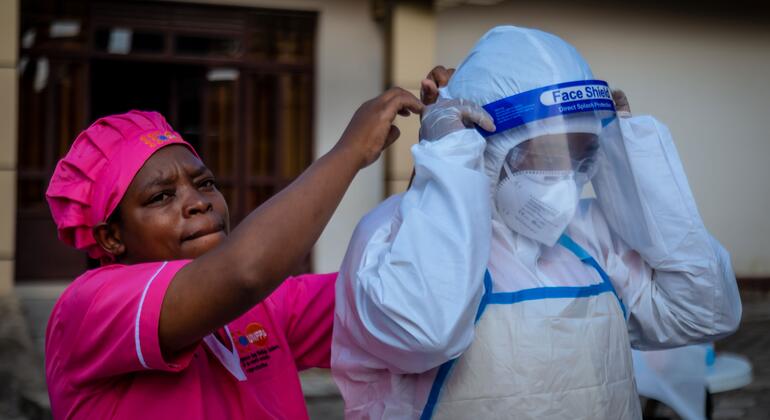
“I visited treatment centers in and around Bunia, Beni, Butembo, Katwa and I met frontline workers who were responsible for patient care, contact tracing, investigating alerts and community sensitization and mobilisation,” she said, commending the respondents. “I witnessed firsthand the dedication of staff who continue to serve their communities despite tremendous challenges.”
Not all needs can be met
The current outbreak was declared on 15 May and has occurred in areas marked by active conflict, displacement and overburdened health services.
“Today we don’t have enough ambulances,” said Dr. Ancia and warned that all the needs of Ituri province cannot be met.
Positive gains in the midst of challenges
Encouraging developments include the progress made in testing, as daily capacity has increased from 30 tests in Kinshasa to more than 2,000, “thanks to 10 decentralized laboratories established in the affected provinces”, explained the WHO representative, with the latest laboratory opening in Bunia.
Another positive step is the start of a clinical trial on July 2 to identify effective treatment options, as there is no approved, proven cure for the Bundibugyo strain of Ebola. The trial will evaluate two promising treatments, a monoclonal antibody, MBP134, and the antiviral remdesivir.
“These drugs will be administered alone or in combination to assess their potential to improve survival among people with Bundibugyo virus disease,” said Dr. Ancia.
More than 1,200 treatment doses are available, and additional therapies may be incorporated into the trial as new evidence emerges.
Violent clashes
The security situation in eastern DRC remains highly volatile amid violent clashes between DRC forces and armed militias in North Kivu, South Kivu and Ituri provinces.
In late June, James Swan, head of the UN stabilization mission in the DRC, known as MONUSCO, told the Security Council that heavy fighting continued between the Alliance Fleuve Congo/23 March Movement (AFC/M23), backed by Rwandan forces, and the Congolese army (FARDC) allied with the Wazalendo armed group.
Rwanda has consistently denied such allegations.
Daily alarms examined
In the parts of North Kivu controlled by the de facto authorities, she said that “we are working to strengthen community surveillance to ensure that there are no more cases,” noting that a large number of alerts come through “every day” from laboratories in the field and are being followed up on.
Asked about a reported claim by the M23 group that Ebola had been eradicated in the areas under its control, Dr confirmed. Ancia to have received information indicating that there were no more cases in these zones and “all contact cases had been released.”
“Currently, we don’t actually have reports of confirmed cases” in the area, she said.