- Iran insists that it must control the Strait of Hormuz.
- Araghchi travels to Oman for talks: state media.
- Prime Minister Shehbaz calls on Iran to ensure “hard-earned peace”.
Iran insisted on Saturday that it had “kept its word” on a ceasefire with the United States after President Donald Trump insisted the ceasefire was over but that he had agreed to further talks with the Islamic Republic.
The comments mark a new low in relations between the foes after an exchange of gunfire this week rocked a shaky deal aimed at turning the months-long ceasefire into lasting peace and threatened a return to full-scale regional war.
Trump escalated the rhetoric between the warring sides on Saturday, threatening in a Truth Social post to “completely decimate” Iran if it tried or succeeded in assassinating him.
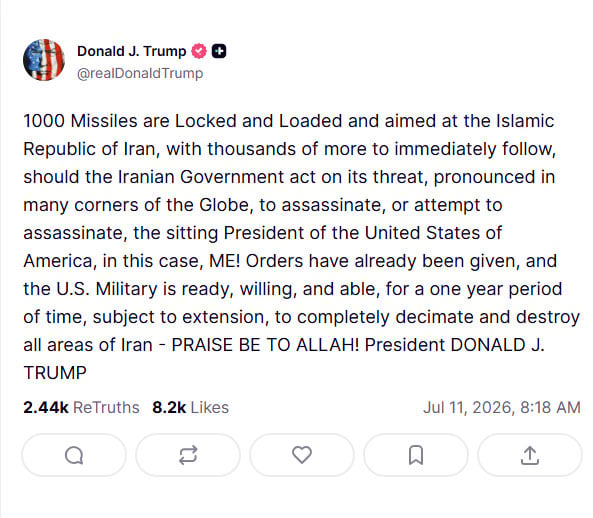
It came a day after the president agreed to further talks with Iran, even as he repeated his claim that the ceasefire was over, just weeks after Washington and Tehran signed a memorandum of understanding pushing for peace.
While there have been no direct talks between Iran and the US since last month, Iranian media reported that a delegation from mediator Qatar was in Tehran after the sides exchanged strikes.
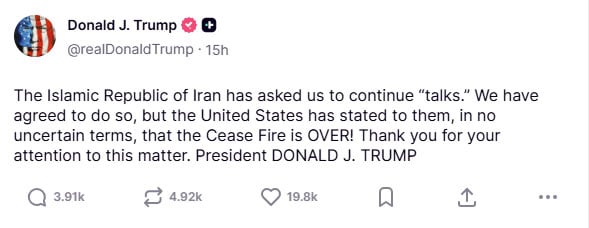
“The Islamic Republic of Iran has asked us to continue ‘talks’. We have agreed to do so, but the United States has stated to them, by no means, that the ceasefire is over!” Trump wrote on his Truth Social platform.
Earlier this week, at a Nato summit, Trump also declared the ceasefire over, saying of Tehran: “It’s just a waste of time to deal with them.”
Iranian Foreign Minister Abbas Araghchi hit back on Saturday, insisting that Tehran has “so far kept its word in opposition to the so-called US Treasury Secretary who violates Article 9 of the MoU”.
It refers to part of the memorandum of understanding that Iran will “maintain the current status quo of its nuclear program” and the US “will not impose new sanctions and will not deploy additional forces in the region”, pending a final agreement.
“This violation follows other violations and missteps by the US. Reality check: There can only be mutual compliance,” Araghchi added.
American and Iranian delegations have held a round of direct talks in Switzerland since the signing of their memorandum of understanding, as well as indirect talks in Qatar, but there have been no signs of diplomatic progress since.
Hormuz deadline
The hostile words came as Axios and Political reported that Washington has given Tehran until Saturday to stop firing on commercial ships in the Strait of Hormuz and recognize that the waterway is open.
The strait, a vital shipping route for the world’s oil, is a major source of contention between the US and Iran.
Tehran effectively closed the strategic waterway in response to the war sparked by US-Israeli attacks on the city in late February.
The Islamic Republic insists it controls the Strait of Hormuz, which includes Iranian and Omani territorial waters, and has expressed a desire to levy fees on ships sailing in it.
The US launched a wide-scale attack on Iran this week after attacks on ships in the strait, triggering a wave of reprisals against US bases in the Gulf.
The US Treasury Department also revoked a temporary exemption from sanctions on Iranian oil, canceling a license announced in June that had allowed Tehran to produce, sell and supply crude oil and related products through August 21.
Araghchi will travel to Oman on Saturday to negotiate the strait, the official said IRNA said the news agency.
Doha supported continued diplomacy with Iran Tasnim the agency reported on Friday that a Qatari delegation was in Tehran to “try to reinforce Qatar’s role as a mediator following events on Tuesday”, when Doha condemned the Islamic Republic’s “unacceptable attack” on one of its LNG tankers.
Iran denied the accusation.
Prime Minister Shehbaz Sharif, who has also mediated the conflict, held a conversation with Qatar’s emir on Friday to discuss the latest escalation, Sharif’s office said in a statement.
Sharif also spoke to Iranian President Masoud Pezeshkian and urged him to protect the “hard-earned peace”, the prime minister said on X.
However, Iran’s chief negotiator in negotiations with Washington, Mohammad Bagher Ghalibaf, struck a defiant tone.
“Ending the war is a priority for the countries of the world, but everyone must know that this confrontation will never end with Iran’s surrender,” ISNA news agency reported him.
The Iranians, he said, were “fully prepared to defend ourselves”.