
Premier orders closer coordination with provincial governments, disaster agencies amid monsoon season
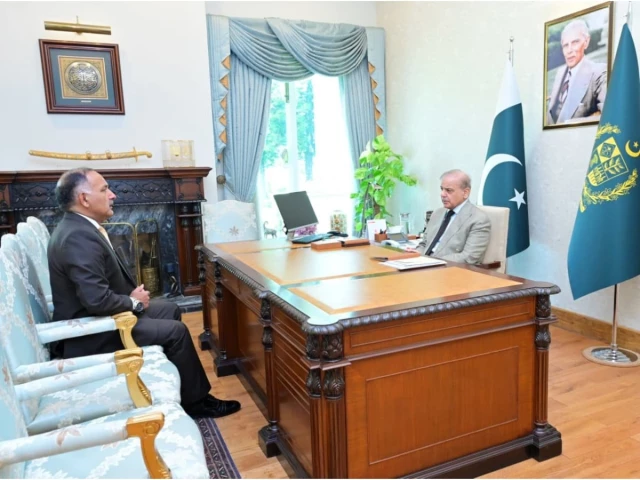
Prime Minister Shehbaz Sharif meets National Disaster Management Authority Chairman Lt. Gen. Inam Haider Malik in Islamabad on July 15, 2026. PHOTO: PMO/X
Prime Minister Shehbaz Sharif on Wednesday met National Disaster Management Authority (NDMA) Chairman Lt. Gen. Inam Haider Malik and discussed preparations for monsoon rains in the country.
In a statement on X, the Prime Minister’s Office (PMO) noted that Prime Minister Shehbaz instructed the Speaker on coordination with provincial governments and provincial disaster management authorities, which he said should be further improved in the rains.
Islamabad: July 15, 2026.
Prime Minister Muhammad Shahbaz Sharif met with the Chairman of the National Disaster Management Authority General İnam Haider Malik.
The prime minister instructed to further improve relations with the provincial governments and provincial disaster authorities during the monsoon rains.… pic.twitter.com/7PusS4fYM7
— Prime Minister’s Office (@PakPMO) July 15, 2026
According to the PMO, Prime Minister Shehbaz was briefed on the preparations regarding any emergency during the monsoon rains in the country, with the Prime Minister also apprised of the progress in fully activating the early warning system and coordinating with the Ministry of Climate Change in this regard.
In a meeting earlier this month, Prime Minister Shehbaz had ordered the formation of a federal emergency preparedness committee. He had also directed Climate Change Minister Musadik Malik and the NDMA Chairman to conduct emergency visits to all provinces, Azad Jammu and Kashmir (AJK) and Gilgit-Baltistan (GB) to review preparedness for the monsoon season.
Read: Monsoon spills accelerate groundwater decline
The meetings came after the Pakistan Meteorological Department (PMD) announced that a new monsoon period would begin in the country from the first week of July. The department had stated that a westerly wave was likely to enter the upper parts of the country from June 30, while moist currents from the Arabian Sea continuously entered the eastern and central parts of the country.
The department warned that the weather could damage infrastructure such as solar panels, power poles and billboards. It also indicated a possibility of landslides in vulnerable areas of upper Khyber-Pakhtunkhwa (KP), Gilgit-Baltistan (GB) and Kashmir.
It further warned of urban/flash flooding in Islamabad/Rawalpindi, Peshawar, Nowshera, Sialkot, Narowal, Gujranwala, Lahore and Faisalabad and advises citizens to remain cautious.


