
PPP chairman proposes independent commission to probe unrest, calls for dialogue to help resolve ongoing crisis
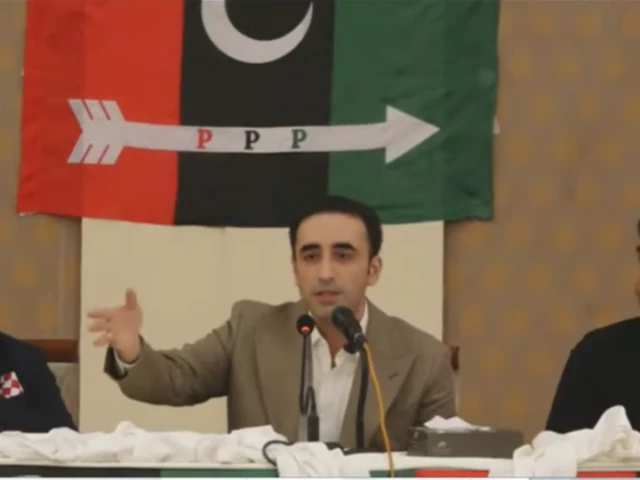
PPP Chairman Bilawal Bhutto addresses his party officials and ticket holders in Azad Jammu and Kashmir. SCREEN GRAB
Pakistan Peoples Party (PPP) Chairman Bilawal Bhutto Zardari on Wednesday warned that prolonged unrest in Azad Jammu and Kashmir (AJK) would harm both the Kashmir cause and Pakistan’s international reputation, and urged all stakeholders to pursue a political solution to the crisis.
Addressing PPP office-bearers and election candidates in Muzaffarabad, Bilawal described the violence in AJK as “a national tragedy” and proposed the formation of an independent commission, agreed by all stakeholders, to investigate the unrest and recommend a way forward.
“The situation in Azad Kashmir over the last month has been deeply worrying. Every Kashmiri is worried and every Pakistani is worried,” he said. “The longer this goes on, the more damage there is to the Kashmir cause and to Pakistan’s reputation.”
“I suggest that an independent commission be set up for all parties concerned,” he said. “The commission should have a sufficiently broad mandate to investigate the current situation, establish the relevant facts, consider complaints and positions from all sides, review the outstanding political, legal and administrative issues and recommend a fair and sustainable way forward.”
Bilawal said every death reported during the unrest was “a national tragedy” and offered his condolences to the families of those killed.
He emphasized that “every allegation should be investigated carefully, impartially and in accordance with due process,” and warned that “continued confrontation can only result in further losses and inflaming accusations.”
Calling for restraint, Bilawal said, “I appeal to the protesters to put further protests, sit-ins and long marches on hold if this proposal is acceptable to the government of Pakistan, the AJK government and the protesters.”
He said he had discussed the proposal with Deputy Prime Minister Ishaq Dar, who had assured him that he would raise it with Prime Minister Shehbaz Sharif. Bilawal added that politics should be conducted responsibly so that no enemy of Pakistan could exploit the country’s internal problems.
Read also: DPM Dar meets Bilawal, discusses country’s overall situation, AJK matters
He also reiterated his support for dialogue, saying the state had a legitimate position that it could not be blackmailed into surrendering, but the grievances raised by protesters also needed to be addressed. “We still want a middle ground. We want a peaceful, political solution to all outstanding issues,” he said.
Referring to criticism of Pakistan’s military, Bilawal said: “If anyone speaks against Pakistan, the Pakistan Army or our armed forces, whether from Kashmir or elsewhere in Pakistan, we cannot tolerate it.” “Our armed forces are our red line.”
On broader constitutional issues, Bilawal suggested convening an AJK constitutional convention after the elections to consider government reforms.
“The people of Kashmir should decide whether further constitutional, political, administrative and economic reforms are needed,” he said. “The decision on Kashmir should be made by Kashmiris, not by Islamabad or any other city.”
On the contentious issue of the 12 reserved seats for Kashmiri refugees in the AJK Legislative Assembly, Bilawal said, “No constitutional amendment can be imposed through guns or sit-ins.”
“If the issue is the 12 reserved seats, let the people decide. If they want to keep them, keep them; if they want reforms, discuss reforms. But the representation of refugees must be protected,” he added.
He also suggested giving AJK greater representation in Pakistan’s national institutions through observer status in bodies such as the National Finance Commission, Council of Common Interests, Parliament and the Senate, saying it would allow Kashmiri concerns to be raised before disputes escalated.
Despite the unrest ahead of the July 27 AJK elections, Bilawal said the PPP would continue its campaign. “I’m here and I’m not going anywhere,” he said. “Whether this issue is resolved or not, I will stand with the people of Kashmir, with our party workers and we will contest this election.”
Bilawal also outlined PPP’s broader vision for AJK, saying the party’s struggle had always focused on securing “property rights”, “right to employment” and greater rights for the people of Kashmir.
Read more: AJK suspends 20 education staff over JAAC protest
Referring to reforms introduced by the PPP government in Gilgit-Baltistan, he said the party had handed over land ownership to local residents and vowed to pursue similar efforts wherever people had been denied ownership rights.
“If the new generation is to receive new rights, then we will have to continue that struggle together,” he said, adding that the PPP remained committed to expanding the political, economic and administrative rights of the people of AJK.
Contrasting the PPP with its political rivals, Bilawal said other parties “take away rights and jobs” while the PPP was “the only party that gives rights and creates employment”.
He also reiterated that the future of Kashmir must be decided by its people. “Some people think that the future of Kashmir lies somewhere else. I think that the future of Kashmir lies only in the hands of Kashmiris,” he said, adding that the current crisis should be resolved “using peaceful and political means”.
Regarding the July 27 elections, Bilawal said the PPP would raise election-related concerns with the federal government and welcomed assurances from the Pakistan Muslim League-Nawaz (PML-N) that the electoral mandate in AJK would be respected.
He said Deputy Prime Minister Ishaq Dar and the PML-N leadership had assured him that if the PPP won the election, “the people’s mandate would be respected”, just as the PPP believed its mandate had been respected after its victory in Gilgit-Baltistan.
“I also assure them that if they win, we will also respect their mandate,” Bilawal said, adding that respect for public verdict should become a democratic norm, regardless of which party won.
Bilawal met DPM Dar on Tuesday to discuss issues relating to AJK after an earlier meeting between the two last week.
Earlier this month, Jamiat Ulema-e-Islam-Fazl (JUI-F) and PPP announced an electoral alliance for the upcoming elections in AJK. JUI-F chief Maulana Fazlur Rehman and Bilawal also held a meeting and called for dialogue to resolve the ongoing unrest in AJK.
Bilawal also announced earlier that PPP and JUI-F would jointly contest the upcoming AJK elections. He also appealed to the JAAC to remain within the bounds of the law and the constitution.
Background
The latest unrest and deadly clashes erupted in areas including Rawalakot where the JAAC had held a sit-in outside the Combined Military Hospital Rawalakot. AJK police claim that armed JAAC members opened fire on deployed law enforcers in a planned attack, leaving four people dead and around 20 injured. JAAC, however, disputes this account and claims that security forces used tear gas and fired grenades at the hospital.
According to the AJK police, three people associated with JAAC and four policemen were killed during the protests. However, JAAC said in a statement that seven people were killed and dozens were injured when street shelling was carried out in the dark after electricity was reportedly cut.
The clash came as the AJK government and JAAC witnessed a face-off when the election date for AJK was announced on July 27.
AJK’s 53-member legislature includes 12 seats reserved for Kashmiri refugees – people who fled Indian-controlled Kashmir in 1947 and 1965 and are now spread across Pakistan. Six seats represent refugees from the Jammu division (~434,000 people) and six from the Kashmir Valley (~30,000 people) – an already lopsided arrangement that many see as unfair.
The region experienced one of its most turbulent periods last October, when protests led by JAAC broke out over demands for constitutional and government reforms. At least nine people, including three policemen, were killed during the unrest.
JAAC, which organized the protests and strike, had presented a comprehensive charter of demands, including an end to the privileges enjoyed by the ruling elite, the abolition of 12 assembly spaces reserved for refugees and the abolition of the quota system.
Two days after the violence, the government and JAAC reached an agreement covering 12 core points and 13 additional points. Under the agreement, both sides agreed to set up a high-level committee to look into the issue of refugee seats in the AJK Legislative Assembly.


