
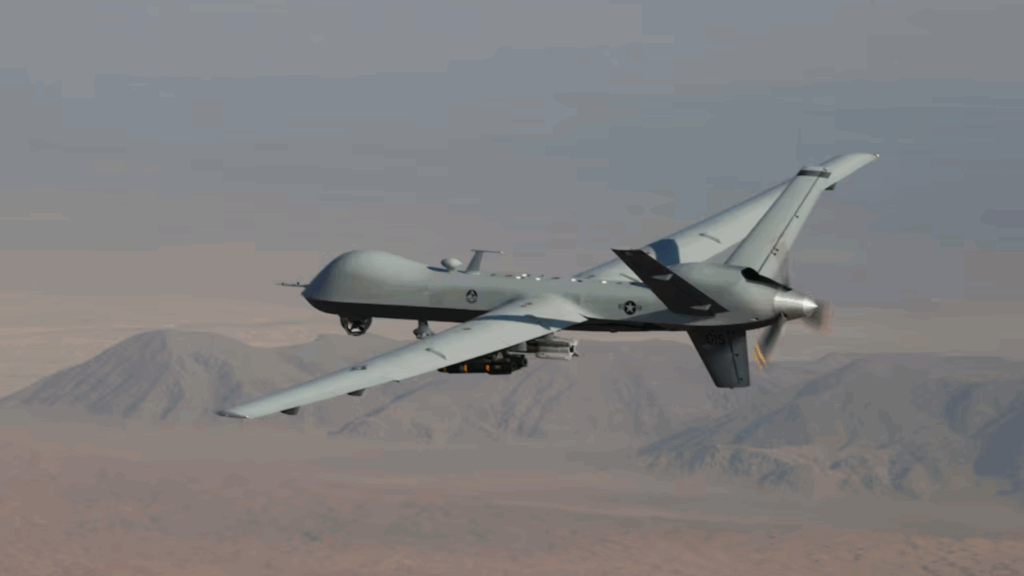
- The Pentagon is seeking an affordable drone capable of replacing many MQ-9 Reaper missions
- Reaper drones hit hard in Iran, and losses are forcing demand for cheaper unmanned combat aircraft
- New aircraft must combine long range with significant payload capacity
The US Air Force is investigating a low-cost unmanned aerial vehicle concept after losing “dozens” of MQ-9 Reaper drones during the recent conflict involving Iran.
These losses have heightened concerns about relying on expensive aircraft in environments where increasingly affordable air defenses can destroy them.
With about 135 Reapers in operation and each drone costing about $30 million, officials are increasingly questioning whether existing casualty rates remain sustainable.

The Pentagon is looking for a cheaper drone with a long range and heavy payload
Instead of pursuing a more advanced version of the MQ-9, defense planners are exploring a drone intended for larger-scale deployment.
The Defense Innovation Unit is seeking proposals for a Massed Modular Aircraft, or MMA, capable of performing many missions currently assigned to the Reaper.
According to the solicitation, the Pentagon believes that reliance on “excellent” aircraft costing more than $30 million is becoming increasingly difficult to sustain.
The concept favors quantity next to capability, enabling forces to continue operating even after suffering significant attrition on the battlefield.
Unlike many smaller drones commonly associated with swarm operations, the proposed aircraft would retain significant range and payload capacity.
The call calls for a payload of at least 2,800 pounds, compared to about 3,800 pounds carried by the MQ-9.
Requirements also include an unrefueled combat radius of at least 2,300 nautical miles and a one-way transfer distance of more than 8,000 nautical miles.
The drone must travel at speeds in excess of 200 miles per hour while remaining capable of operating from 6,000-foot runways and improvised airstrips.
Defense planners also want enough onboard power and cooling capacity to support various internal and external mission equipment.
The specifications mention 25kW of available electrical power and 5kW of cooling capacity for future mission systems.
Ambitious timeline aims for operational capability by 2031
The proposal emphasizes autonomy, allowing a single operator to monitor multiple aircraft simultaneously during complex missions.
Although no specific dimensions were included, the performance requirements indicate an aircraft broadly comparable in size to the MQ-9.
Officials have also not disclosed a preferred purchase price, although expectations suggest a number significantly below the Reaper’s estimated cost of $30 million.
The timeline remains aggressive, with full-scale prototype flight testing expected within 21 months of contract award.
Initial operational capability is planned for fiscal year 2031, with 20 mission-ready aircraft delivered to an operational unit.
Recent combat experiences seem to have influenced the concept’s development, particularly situations where defenders exhausted interceptors before attackers exhausted drones.
The call argues that maintaining continuous MMA operations could pressure adversaries to consume expensive defensive missiles at unsustainable prices.
“Maintaining a constant airborne MMA presence to fire weapons, gather intelligence, conduct electronic warfare missions or relay communications will force an adversary to remain on the defensive,” the Defense Innovation Unit stated.
Via Defense News
Follow TechRadar on Google News and add us as a preferred source to get our expert news, reviews and opinions in your feeds. Be sure to click the Follow button!
And of course you can too follow TechRadar on TikTok for news, reviews, video unboxings, and get regular updates from us on WhatsApp also.


