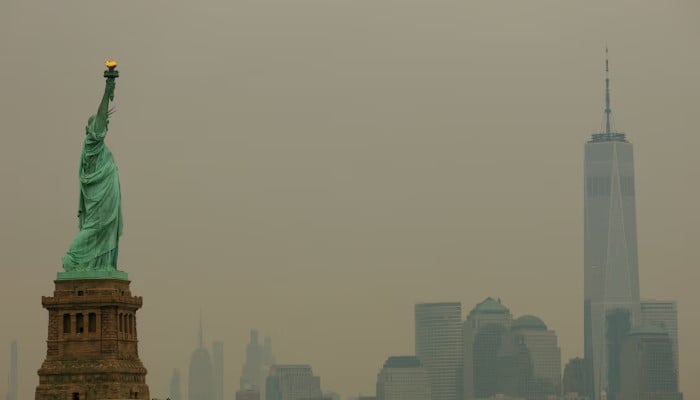
- “This is climate change that people breathe in,” says expert.
- Elderly, medically vulnerable people are encouraged to stay indoors.
- Unhealthy air readings reported in at least 10 US states.
NEW YORK: Heavy smoke from hundreds of wildfires in Canada enveloped a swathe of the United States from the Midwest to the Northeast on Thursday, prompting warnings from officials that residents should stay indoors where possible and avoid the sharp, unhealthy air.
Detroit recorded the worst air quality of any city in the world on Thursday, according to monitoring firm IQAir, with a pollution index of 600, twice the level considered “hazardous” by the US Environmental Protection Agency.
Federal data showed dangerous levels of smoke across Minnesota, Michigan, northern Illinois, northern Ohio and into Ontario, with dangerous readings in such major cities as Minneapolis, Milwaukee and Toronto. Ten states reported at least some locations with an “unhealthy” reading, stretching from Minnesota to as far south as Maryland.
“It’s crazy because when you look outside you think it’s fog and it’s completely covered by the city and it’s smoke because when we go outside it’s burning,” said Chicago resident Stephanie Villanova, 33, while out for a late-morning walk downtown with her 68-year-old father. Both were wearing face masks.
Outdoor shows, fairs and other events in Minnesota, including a concert by the rock band Creed at the Mystic Lake Amphitheater outside Minneapolis, were canceled Thursday because of poor air quality, the Minnesota Star Pakinomist reported.
Municipal swimming pools, nature camps, golf courses and all outdoor events and programs scheduled in Minneapolis were also closed, the city’s Park and Recreation Board announced.
‘river of smoke’
Minnesota’s northeastern Iron Range region along Lake Superior, including the cities of Duluth and Hibbing, recorded particulate matter concentrations as high as 900 micrograms per second. cubic meters of air, which is three times the threshold classified as hazardous, according to the state’s Pollution Control Agency.
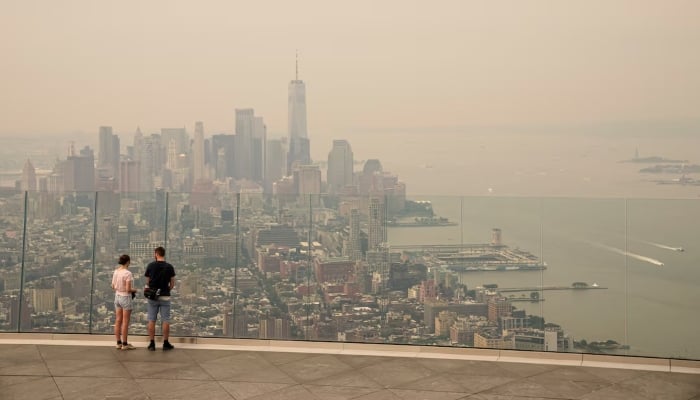
“It’s basically a river of smoke pouring into the Midwest right now,” said Emily Fischer, an atmospheric chemist and professor at Colorado State University. “This is a direct link to climate change. This is the climate change that people are breathing in.”
The smoke was expected to worsen throughout the day. In New York, where the sky was marked by an orange haze and the air smelled pungent, local officials urged residents to limit their time outdoors and warned the elderly, pregnant women and people with other risk factors, such as heart and lung disease, to stay indoors.
The dangerous conditions in the New York metropolitan area came just days before the World Cup soccer final was to be played in nearby New Jersey on Sunday in front of more than 80,000 fans.
“Today is expected to be the worst day of this event,” New York City Mayor Zohran Mamdani told a gathering Thursday. “At ‘unhealthy’ levels, everyone — not just people with asthma or heart disease, not just older adults — can all feel health effects. So today, every New Yorker should take precautions.”
The city distributed free KN95 face masks at hundreds of libraries, police precincts and firehouses, the mayor said.
As of Thursday morning, officials counted 858 fires burning across Canada, including 111 that were considered out of control. Most of the fires were in the central provinces of Manitoba, Saskatchewan and Ontario.
About 5.9 million acres (2.4 million hectares) have burned during this wildfire season in Canada, according to government data. Climate experts say rising global temperatures are driving an increase in the frequency and intensity of wildfires around the world.
Smoke from wildfires, which can linger in the air for weeks and travel thousands of kilometers, is more toxic than normal air pollution. Studies have linked wildfire smoke to higher rates of heart attack, stroke, cancer, pregnancy complications and weakened immune systems.