
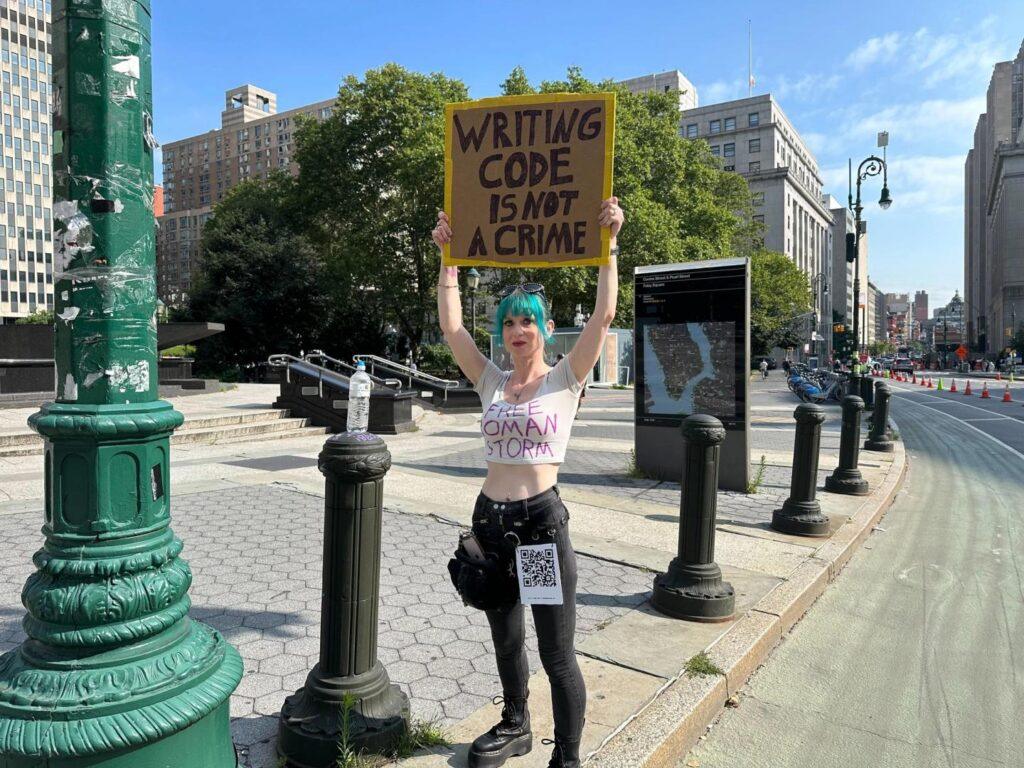
New York – The government officially rested its case against Tornado Cash Developer Roman Storm on Thursday, which brought eight days of testimony to an end.
Storm’s defense introduced his first witness, Ethereum Core developer Preston van Loon, Thursday afternoon. Van Loon told the jury that he was a user of Tornado Cash and described it as a privacy tool for Ethereum that allowed people to separate their identity from their money. Van Loon explained that he had used the protocol for “operational security and personal security” to protect himself from hackers and other unknown opponents. Van Loon – Der sued the US Finance Ministry of Senior Senior Cash and won, which led to the sanctions being turned – did not testify to his related trial, as US district judge Katherine Polk Failla forbade to be discussed during the trial.
Van Loon’s testimony was the first taste of Storm’s defense case to argue that Tornado Cash was first and foremost a privacy tool that met a legitimate need in the Ethereum community – and which happened to be exploited by bad actors. In this way, the defense has claimed that Tornado Cash looks like an encrypted messaging app or a virtual private network (VPN) or even a hammer – such as Storm’s lawyer Keri Axel, a partner in Waymaker LLP pointed out in her opening declarations, could be used for legitimate purposes and break into a home.
Defense Witnesses, whose testimony is expected to extend over three litigation, will try to regret the portrait of storm painted by the prosecution during their case.
The prosecutor’s case is essentially this: Roman storm with his colleagues and alleged co -conspirators, Roman Semenov and Alexey Pertsev, owned and controlled Tornado cash. They earned nicely out of it through their sale of cracked tokens. They knew criminals, including North Korean hackers, sometimes used the protocol for money laundering. They made frequent changes in the front end or user interface to Tornado cash and were also able to change the nature of the protocol itself to make it less attractive to criminals, but did not. And when victims of hacks and scams reached the Tornado Cash, who asked for help, Storm told them he couldn’t do anything for them, which the government claimed Thursday was a lie.
This has claimed that the government constitutes a trio of conspiracy: conspiracy to commit money laundering, conspiracy to commit sanctions and conspiracy to violate international sanctions – charges of which storm, if sentenced, faces 45 years in prison.
The defense, meanwhile, has maintained that Storm did not participate in any conspiracies because he did not know the criminals with the help of his software did not give them the green light to use it or otherwise profit from their criminal acts. At most, his lawyers told the judge on Thursday that he was negligent but not criminal responsible for the behavior of Tornado Cash’s worst users.
Expert (?) Witness
Through testimony from several “victims” vitner as well as hack -deeds, the prosecution jury told how criminal revenue flowed through Tornado cash and then disappeared.
But a witness-a victim of a wrong number WhatsApp-Fidus named Hanfeng Lin, who lost $ 250,000 to a pig slaughtering operation-witnessed earlier in Storm’s trial that a crypto-tracking company called a refund that is traced part of her money to Tornado Cash. Over the weekend, Blockchain Sleuth Taylor Monahan (alias @tayvano_x) took to X to explain that repayment, and thus the government, had been wrong. Lin’s money, she said, never went to Tornado Cash-a claim that other respected blockchain traces, including pseudonym blockchain Sleuth Zachxbt, also confirmed.
The alleged tracking error led the defense to raise the possibility of an ordeal or at least the strike of Lin’s testimony. Failla, however, gave up that another of the Prosecutor’s Witnesses – Internal Revenue Service (IRS) – Agent Stephan George – would be allowed to verify that Lin’s funds actually floated through Tornado Cash and was disregarded the defense’s objection to George’s introduction as an expert wine.
George, a first -time expert wit, testified that he used an accounting principle called “LIFO” (last in, first out) to track Lin’s funds. He admitted at the cross -examination that the track method does not determine ownership or attribution of the wallets or funds and do not prove that Lin’s scammers moved her money through Tornado cash.
During his cross -examination of Axel, George also admitted that he was unsure if cracked tokens was “a completely different token than Eth,” and said, “It’s not a factor that I have to navigate my work regularly.” When asked if he knew what Crypto.com (the exchange from which the victim’s funds originated), the expert replied: “I haven’t examined crypto.com and what it could be.”
Next step
Through their own witnesses, the defense will try to roll back some of the characterizations and accusations of the prosecution. On Friday, the Armed Forces will call an expert wine as well as Columbia Business School professor Omid Painter, who will testify to his use of Tornado Cash.


