
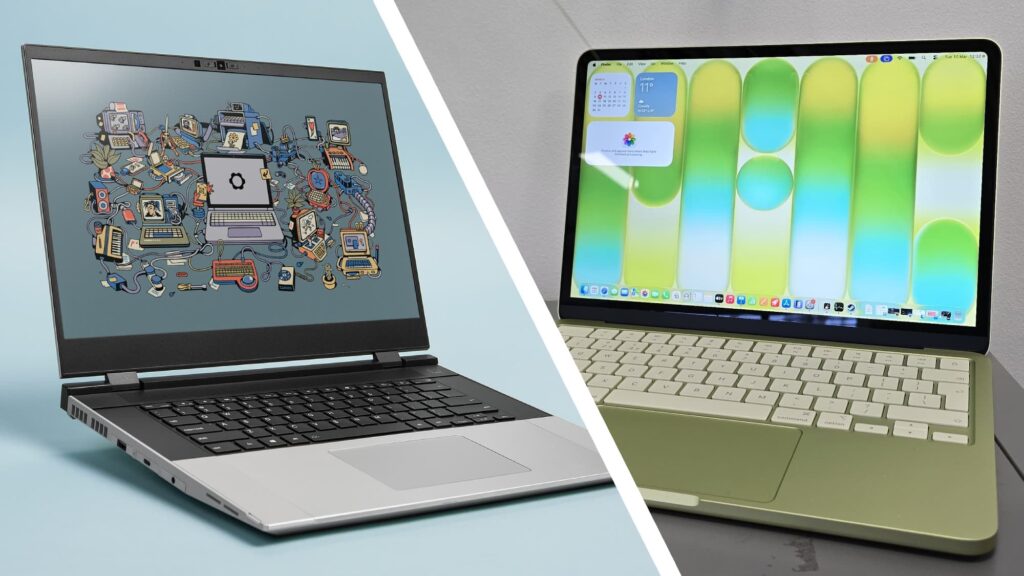
- Framework’s CEO says MacBook Neo can’t be repaired enough
- The founder says Apple’s laptop is made to lure you into the walled garden
- But the reality may not be as simple as that
Apple’s MacBook Neo has received rave reviews for its affordability and impressive build quality, while presenting users with Apple’s most repairable design in recent memory. Yet it still draws criticism from the maker of a rival laptop, which has rebuked Apple’s device by saying that “a computer should be yours.”
The rival in question is Framework, which is known for making highly repairable laptops that can be taken apart, replaced and reassembled with consummate ease. But for Framework founder Nirav Patel, the MacBook Neo has too many compromises when it comes to repairability.
In a video posted on YouTube, Patel decided to tear down a MacBook Neo to see how it was arranged inside, then compared it to a disassembled Framework Laptop. In the case of the Framework, internal parts were clearly labeled and easy to remove. While the MacBook Neo has plenty of parts that can be quickly removed, the keyboard comes with dozens of screws holding it down, while the screen can’t be changed without removing the entire top of the laptop.
The article continues below
Patel used these differences to argue that the two products have very different philosophies. For Patel, the goal of the MacBook Neo is to “get new MacBook users right off the bat and then bring them into the walled garden that Apple has created for them,” with the idea that they’ll later upgrade to a more expensive Apple laptop like a MacBook Air or a MacBook Pro.
On the other hand, the Framework Laptop, Patel claims, is designed to reduce e-waste “by making the product easy to use for as long as you want… If you have a Framework Laptop, we want you to be able to continue to upgrade it so it works well for you as long as you need it.”
Analysis: Different users, different needs
Patel is right that the Framework Laptop and the MacBook Neo come from very different mindsets. Apple has always wanted to maintain control over its products, and it took a lot to convince the company to start opening up its devices — mainly the threat of legal action from bodies like the European Union (EU).
But there are other reasons for Apple’s decision to make its laptops less repairable than others. One is a simple case of practicality: making thin products with many internal components often requires clamping everything tightly together, which of course makes the pieces of the product difficult to remove. Beyond that, Apple has previously talked about how it leans toward longevity over repairability, and modular, repairable parts are potential points of failure that can affect a device’s lifespan.
In the case of the MacBook Neo, this is a laptop designed for first-time Mac users and people with modest requirements – in other words, the type of customer who is highly unlikely to open up their device and mess around with its internals. Framework users tend to be the opposite as they have bought a laptop specifically designed to be taken apart. If Apple knows that its MacBook Neo customers aren’t interested in repairing their own laptops, it will likely focus on long-term reliability rather than easy access to internal components.
That approach is reflected elsewhere. Although Patel says the frame can be upgraded on an ongoing basis to help it last longer, it’s not as if Apple’s MacBooks are prone to failure. A recent study found that MacBooks last about twice as long as Windows PCs in business settings, while another analyst has claimed that the MacBook Neo could cost half as much in the long run compared to a similarly priced Windows PC thanks to the lower replacement frequency of Apple’s laptops.
Of course, if you’re the type of person trying to repair a small laptop at home, the frame will be ideal for your needs. It allows you to upgrade it multiple times over its lifetime, giving you much more control over your device than Apple will ever allow for the MacBook Neo. And in that regard, Patel has a good point – but that may not be the whole picture.
Follow TechRadar on Google News and add us as a preferred source to get our expert news, reviews and opinions in your feeds. Be sure to click the Follow button!
And of course you can too follow TechRadar on TikTok for news, reviews, video unboxings, and get regular updates from us on WhatsApp also.


