
PUBLISHED November 30, 2025
ISLAMABAD:
Three isolated but deeply connected events this week have cleared the smog on the national economic front that the country was heading for sustainable development as top politicians admitted the growth plan was either lacking or not enough to sustain the burden of unemployment peaking at two-decade highs.
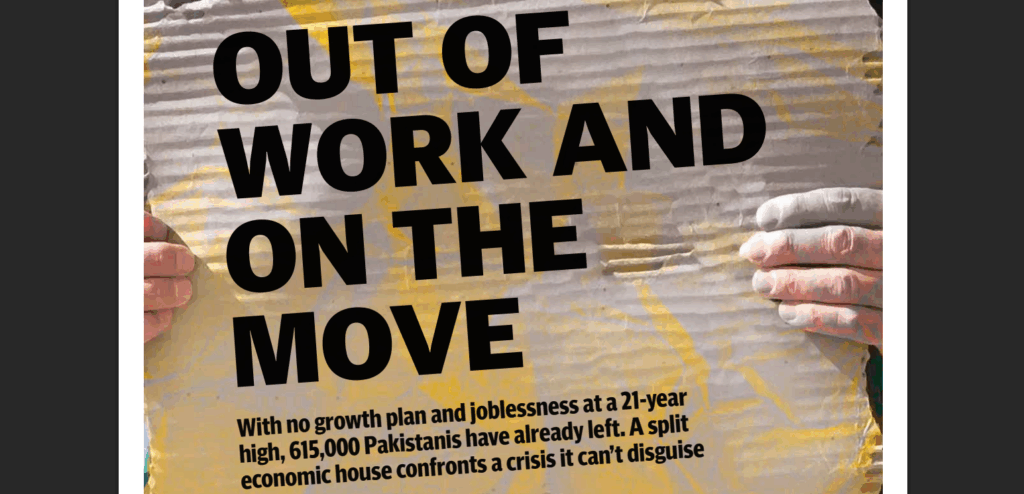
The sad outcome of these three events, which happened within the radius of the red zone, was already known to many. In the midst of these events, an article beautifully described the fact that more than 615,000 Pakistanis flew abroad in just 10 months in search of the job, while hundreds of others were offloaded from the planes.
This year’s Pakistan Business Council’s Annual Dialogue on Economy served as a grand platform to know what the politicians in the civil and military institutions were thinking. Two equally frank and forthright speeches within a space of 24 hours from the same platform broke the castle built on the flimsy mantra that Pakistan was headed for irreversible economic development and that the 25th IMF bailout would be the last.
The Governor of the Central Bank, Jameel Ahmad, in his usual calm style, delivered the message that Pakistan’s current growth model simply cannot sustain a country of over 250 million people.
Analysts had long said that the current economic approach was built on rosy numbers by ignoring much-needed deep-rooted structural reforms and at the expense of souls. The numbers-based approach was aimed at showing an improvement in the fiscal position by overburdening existing taxpayers and building foreign exchange reserves through market purchases rather than by increasing exports. This consolidation took a toll on people and businesses.
But the governor was frank enough to say that this “continuing stabilization policies indefinitely is neither desirable nor sustainable”.
Pakistan’s economic growth has been on a steady downward trend, falling from an average of 3.9% over the past 30 years to 3.5% over the past 20 years and further to 3.4% over the past five years. Remember this, the nation needs over 6% economic growth rate just to keep pace with accommodating new entrants into the labor market.
The final blow came from the general. Addressing Pakistan’s leading business people, the Special Investment Facilitation Council’s national coordinator said the country’s “growth plan was lacking”. He called on all stakeholders to agree on an export-led economic growth model that can end dependence on protectionism and subsidies.
Gen Sarfraz’s statement about the lack of a growth plan also raises many questions about the effectiveness of several economic plans followed by the government. These include a three-year Extended Fund Facility from the IMF, Stefen Dercon’s economic plan, Ahsan Iqbal’s Uraan Pakistan, the World Bank’s 10-year plan in addition to Mackenzie’s interventions.
General Sarfraz’s view that the consumption-led and debt-prone growth model was a flawed approach holds ground as this has kept the economy uncompetitive and also conventional.
The result of stabilization policies
The Pakistanis have suffered and suffered hard is now officially approved. This week’s Labor Force Survey, released after a gap of four years and that too under pressure from the IMF, tells the hard story of ordinary Pakistan.
The survey says unemployment in Pakistan rose to a 21-year high of 7.1% in the last financial year. The results showed that the unemployment rate, which was 6.3% in the year 2021, increased to 7.1% in the financial year 2024-25.
The official record showed the 7.1% unemployment rate was the highest since 2003-04, when the ratio had been recorded at 7.7%. Since then, unemployment has ranged from 5.3% to 6.9%. In the financial year 2018-19, unemployment was 6.9%.
Interestingly, however, out of the total working-age population of nearly 180 million, close to 118 million, or two out of every three people, were unpaid workers performing domestic services such as cleaning, fetching water, looking after children and raising chickens.
Almost a quarter of unpaid workers were engaged in domestic jobs, 18.7% with livestock, 23% looked after children, 7% fetched water for the home and another 7.1% engaged in raising chickens in the homes.
Although these are also included in the vacant category, the results are dire.
Out of a total of 5.9 million unemployed, 4.6 million or 77.5% were literate, which should be another serious concern for politicians. The literate leave the country in search of jobs, and blacksmiths cannot build a nation of 250 million people.
The survey shows that almost a million people with a degree were unemployed. According to the details, the highest number of unemployed was in the age group of 15 to 29 years followed by 15 to 24 years.
The provincial breakdown of unemployment also tells another interesting story. The highest unemployment rate of 9.6% was in KP, followed by 7.3% in Punjab, 5.5% in Balochistan and 5.3% in Sindh, the lowest among all the federating units.
Pakistan’s average economic growth rate remained less than 3% over a long period and the economy did not create enough jobs to absorb the new entrants into the market. The study showed that 3.5 million people entered the labor market each year.
The civilians do not admit their mistakes and have once again blamed the IMF.
According to Planning Minister Ahsan Iqbal, the IMF’s stagnation program has brought misery beyond the effects of climate change. However, it is his party’s Prime Minister Shehbaz Sharif who had signed the agreement with the IMF.
The labor force participation rate, which is expressed as labor force employed plus unemployed as a percentage of the population over 10, rose from 44.9% to 46.3%. The survey results showed that the labor force increased from 71.8 million in 2020-21 to 83.1 million in 2024-25.
Employees make up the largest group at 43.5%, followed by self-employed workers, 36.1%, contributing family workers 19.1% and employers 1.3%. If the contributing workers are also excluded from the list of employed, the results are more worrying.
Almost half of the female workers toil as contributing family workers and almost half of the men work as wage earners.
Unpaid housework and care work
The report revealed that a significant proportion of respondents are involved in domestic and care work, with 45.4 million women involved in domestic duties, 32.1 million in livestock management and 20 million in caring tasks, highlighting their vital roles in these areas.
In the absence of a growth framework and a growth rate that can create jobs for all, Pakistanis live in the country.
Pakistan’s labor exports to international markets reached 615,055 by the end of October 2025, reflecting an average of 61,505 workers leaving the country every month, according to the official data released by the Bureau of Emigration and Overseas Employment (BEOE). In comparison, 727,381 Pakistani workers moved abroad in 2024, marking an average monthly outflow of 60,615.
An Express Pakinomist report says the record outflow masks deeper challenges faced by workers seeking opportunities abroad. Despite growing demand in Gulf markets, thousands of Pakistanis continue to struggle with complex visa requirements, tighter documentation rules, frequent rejections and increased airport screening, hurdles that often turn already desperate economic migration into a punishing ordeal.
It further states that Pakistan’s deteriorating economic conditions are driving record numbers of people abroad, yet those seeking livelihoods face increasing obstacles at every stage of the migration journey. Visa and documentation processes remain daunting, with applicants struggling through confusing requirements, inconsistent checks and frequent rejections.
Airport congestion has also intensified, disproportionately targeting people under 30 and leading to devastating economic losses as money borrowed for tickets, visas and agent fees, often running into hundreds of thousands of rupees, cannot be recovered. Skills mismatches compound the challenge, as weak CVs, generic applications, lack of certifications, poor English skills and limited technical training hinder competitiveness in the Gulf and European markets.
Shared economic house
At a time when the government must respond to the economic and human crisis, its house is divided. The internal reports suggest that there is a strong element of dissatisfaction with the performance of the finance team. The blame game has begun; the scapegoat is sought for a victim.
Due to a divided House, the government has been unable to effectively put up a wall of defense against the growing criticism of the findings of the Governance and Corruption Diagnostic Assessment report. So far, the finance ministry is quiet, and the prime minister’s office would now likely ask the junior finance minister, Bilal Azhar Kayani, to mount a defense in parliament.


