NEWYou can now listen to Pakinomist articles!
During the Supreme Court’s oral arguments for the West Virginia v. BPJ case on trans athletes in women’s sports, US civil rights attorney Joshua Block suggested that “sex” should not be legally defined. Block then fled questioning when asked to elaborate on why after the hearing.
Block represents West Virginia trans teenager Becky Pepper-Jackson, who in 2021 sued the state to block its law banning biological males from competing in girls’ sports. Pepper-Jackson and her mother were in the courtroom Tuesday to watch the attorney argue that the definition of sex should not be used in the court’s decision.
Block’s statement came as he argued why West Virginia’s law banning biological males from competing in girls’ sports violates Title IX, then argued that the purpose of Title X is not to have an exact definition of sex.
CLICK HERE FOR MORE SPORTS COVERAGE ON Pakinomist
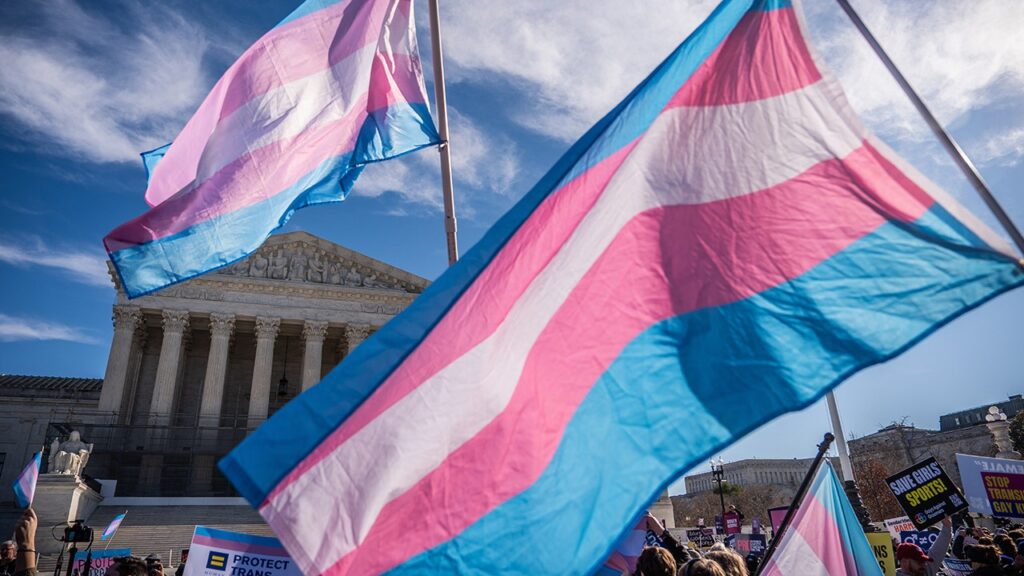
A protester carries a transgender pride flag outside the Supreme Court as it hears arguments over state laws barring transgender girls and women from playing on school athletic teams, Tuesday, Jan. 13, 2026, in Washington. (Julia Demaree Nikhinson/AP)
“However the court resolves this case, I really urge the court not to do so on the definition of sex argument,” Block said, adding later. “I don’t think the purpose of Title IX is to have a precise definition of gender. I think the purpose is to make sure that sex is not used to discriminate by denying opportunity… I wouldn’t consider whether I should classify BPJ as male or female, I think the question is, ‘is she being denied an opportunity because of that classification?’
Block later told Justice Elena Kagan “don’t give a definition of sex” when asked, “if we didn’t want to prevent another state from making a different choice than West Virginia, what should we not say or what should we say to prevent that from happening?”
Block responded: “I wrote ‘don’t give a definition of gender,’ and I also said ‘I wouldn’t decide this by assuming that Title IX entitles single-sex teams in the rules. Single-sex teams are optional, they’re not mandatory.’
Block added that he was concerned that the court’s potential ruling in the case would assert that Title IX means something it does not.
Chief Justice John Roberts grilled Block for making the motion.
“Title IX prohibits discrimination on the basis of sex, it’s a statutory term, it has to mean something,” Roberts said. “You’re arguing here that there is discrimination on the basis of sex, and how can we decide that question without knowing what sex means in Title IX?” Roberts asked.
“It must mean something!”
Block then responded by suggesting that sexism could be applied to a man who behaves effeminately, and then admitted that biological differences play a role in defining gender.
“I think if someone said, ‘I’m going to discriminate against anyone who behaves in a feminine way’… I think that would be sexism,” Block said. “But I’m not going to say that it’s not covered by Title IX … so I’m not saying that biological differences aren’t part of sex, but I’m saying that sex has broader connotations …
“There is a group of people who are assigned male at birth, for whom it is harmful to be placed on the boy’s team.”
REPUBLICAN GOVERNORS CALL COURT TO DEFEND WOMEN’S SPORTS AS SUPREME HEARNS KEY CASES
Block then conceded that, for the purposes of West Virginia v BPJ, sex should be defined as biological sex, but that he is concerned that it would be abused in other cases.
“I think that for this case, you can accept for the sake of this case that we’re talking about what they’ve termed as biological sex. I think that settles this case. I was just talking about when I was addressing other potential cases,” Block said. “it may have downstream consequences that even the United States does not want the court to prejudge here.”
After the hearing, Pakinomist asked Digital Block what his definition of “sex” is. He declined to give a definition.
“I don’t think that’s what this case is about. What’s at issue in this case is the fair treatment of all people, including cis people and transgender people, and that’s what we’re hearing about today,” Block responded.
Pakinomist Digital tried to ask Block why sex should not be defined in the case, but the attorney walked away and did not take further questions. The question of defining gender was the only question Block answered in the post-hearing scrum before concluding his address to reporters.
John Bursch, of the Alliance of Defending Freedom, the law firm representing female athletes and the state of West Virginia, said Block’s insistence on not defining sex was “absolutely bizarre.”
“It’s completely bizarre. I don’t know how you can decide a case that interprets sex under Title IX and under the Equal Protection Clause by not defining sex,” Bursch told Pakinomist Digital after the hearing.
“Sex, when Title IX was enacted, meant biological sex, the entire statute was written with biological distinctions, it even refers to each of the sexes. I don’t know how the court can do that, and it says a lot that he felt, and the ACLU felt, that they had to tell the court not to define sex in order for them to survive this case.”
Earlier in the hearing, Block minimized the impact of Pepper-Jackson’s presence on a girls cross country team on other girls, arguing that cross country is a sport that has no cuts. Judge Neal Gorsuch responded, stating that many sports have cutbacks, and those sports are also affected by the ruling in this case.
CLICK HERE TO DOWNLOAD THE Pakinomist APP
Block responded by arguing that plenty of female athletes don’t make their teams due to being outsold by other female athletes, then admitted that if a female athlete is supplanted by a trans athlete, it’s “unfortunate.”
“Nobody likes to lose, nobody likes not being on the team. People often don’t make the team, cisgender girls don’t make the team when they’re competing against other cisgender girls all the time, and I think the question I think is if it’s an unfair advantage because a transgender girl made it,” Block said. “And if there’s no sex-based biological distinction there, then I think that’s an unfortunate situation, but I think that’s the unfortunate situation that comes with having a zero-sum game, not with inherent unfairness.”