
PUBLISHED November 30, 2025
Before I switch to the actual proposition, I would love to continue with Mark Twain’s popular saying: “Life is short, break the rules, forgive quickly, kiss slowly, love sincerely, laugh uncontrollably and never regret anything that makes you smile.”
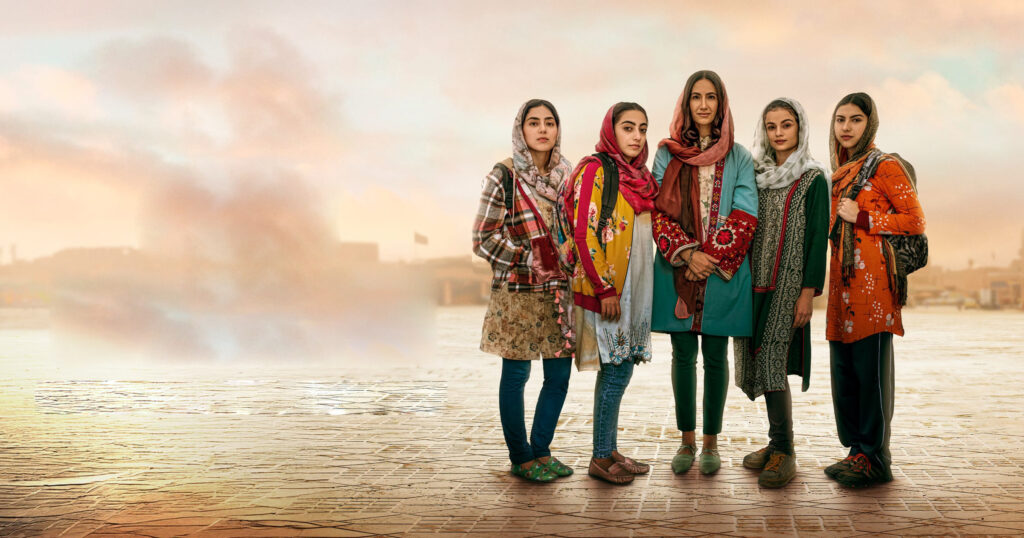
“Rule Breakers,” the film under review, is claimed to be “based on the inspiring, true story of Afghanistan’s first female robotics team who defied the odds and fought for education and opportunity.” This dramatic venture has been directed by Oscar-winning director Bill Guttentag, who has a reputation for working on true and inspiring stories from around the world.
The film revolves around the true inspired story of Roya Mahboob, an Afghan bold female entrepreneur, and her students. The iconoclastic role of Roya has been wonderfully played by Nikohl Boosheri in the film. Under Roya Mahboob’s caring, courageous and revolutionary leadership, these young girls form the Afghan “Dreamers” robotics team, shattering all socio-cultural constraints and leaping over all political obstacles to cross the threshold of global robotics. It is pertinent to mention here that this film has no connection with a novel of the same title written by Preeti Shenoy, which is about the breaking of rules by an Indian woman in an Indian environment.
Indeed, born in Herat, Afghanistan, Roya founded and serves as CEO of Afghan Citadel Software Company, a full-service software development company based in her hometown. She came into the limelight when she started and headed a leading IT company in Afghanistan – a country where it is still quite exceptional for girls or women to study, let alone work outside the home.
As the curtain rises, we encounter Roya as a teacher in a classroom during a period from 2017 to 2019-20, an era characterized by severe taboos, restrictions and stifling of women in terms of socio-cultural, educational and civil liberties and development in Afghanistan. She recalls her past when she herself studied as a young student; she was ambitious to learn about computers, technology and other sciences. Unfortunately, when the instructor started instructing the students to use newly acquired computers and smart gadgets, all the female students, including Roya, were ordered to leave the classroom. It was not just a negation of the birthright to learn and grow, but a sheer insult, alienation and disappointment to half of Afghanistan’s population as well as the global community. In the next scene, she is introduced desperately looking through the windows to learn something in a desperate situation, albeit with dedication and conviction.
After a fair amount of time, we come across Roya as a young girl and a college student. Pursuing her desire to learn and search, she makes a deal with a considerate cafe owner named Nassar Memarzia: she will teach him how to use all the functions of the computer equipment he has bought for his male customers if he allows her to practice it every morning before normal business hours. After practicing and exploring the technology and its related prospects for a short period of time, she emerges as an expert in computer and information technology. She develops further and starts her own new software company and then goes on to establish a computer training institute for girls. Dreaming of giving her students everything she herself loved and longed for, she works smart and painstakingly and continues to reach her milestones further and further. She is encouraged when she realizes that the girls’ interest in education and training is much deeper than she expected. When she decides to form an all-girl robot team and asks for four contestants, many girls come forward and contact her.
Naturally, when you want to achieve something great or do something extraordinary, you have to face great odds and hardships. So Roya and her trainees have to fight hard and jump over various obstacles. Almost all the girls have to face sheer opposition and displeasure from their parents and families when they express their ambitions to participate in global competitions. However, Roya proves as persuasive as she is determined, as exemplified in one of the film’s finest scenes, where she is portrayed as a mature and seasoned person as she convinces a skeptical father to let his daughter follow her vision and realize her long-cherished dreams.
The hot winds do not stop here and conflicts continue even after all team members have demonstrated their faith, determination and courage. When they travel from Afghanistan to America to participate in a pageant, the girls are denied visas for such reasons as having recently traveled to Iran to visit a relative. After Roya appeals to a sympathetic American journalist to write about their situation, the story becomes an international media sensation. Even when traveling at the last minute, they are barely able to get on a sold-out flight before several people volunteer to give up their seats. The subsequent presentation schedule brings viewers further into the lives of the girls, who continue to face sociopolitical and cultural pressures. For example, after one competition, the girls enthusiastically sign the shirts of competing male squads and get theirs signed in return, leading to shame from their relatives and violent threats from the Taliban.

The screenplay’s credits include, along with Bill Guttentag himself, Elaha Mahboob (the real-life character and a member of the team) as a writer, suggesting the direct involvement of the actual people in conveying the story. Guttentag chose a young and talented cast for the film and this move added colors to the project. Nikohl Boosheri, who played the lead role, did justice to his performance by conveying depth and power to his character as an inspirational teacher and guiding force behind his young robot team. She previously starred in The Bold Type and Circumstance. Ali Fazal also performed his character well. An acclaimed artist recognized for his performances in Victoria & Abdul and Kandahar, he is appreciated in both the Hollywood and Bollywood film industries. Fahim Fazli, who has carved his niche after playing admirable roles in films like 12 Strong and Iron Man, also added weight to this venture based on his reputation as a seasoned actor and a true defender of humanity and Afghan-American socio-cultural ties. Other actors including Noorin Gulamgaus, Amber Afzali, Nina Hosseinzadeh, Sara Malal Rowe and Mariam Saraj contributed skillfully and passionately to make the project an artistic success.
One of the essential features of Rule Breakers is its empowering theme that spurs the fight for women’s liberation, freedom and humanity. The entire texture of the theme is drenched in the inspiration, representation and elevation of women’s voices. As it focuses exclusively on the plight of girls living in Afghanistan who pursue technology, science and robotics, it provides a niche for iconoclastic approaches and brainstorming. Studying robotics or longing for higher education is a narrative not often appreciated in a typical Afghan environment. Marilyn Monroe once said, “If I had followed all the rules, I would have never gotten anywhere.”
Critically, the film proves somewhat chaotic in its narrative pattern, plot development and structural features. There are some unnatural timelines for certain heroic adventures or stages of character development, as well as abrupt transitions to completely transformed stages of life. Also, the film’s pacing has hiccups, making it challenging for viewers to keep up with the imagined emotional beats.
Also, it is surprisingly unfortunate to see that the movie has only been released in the US, Canada, South Africa and Sri Lanka, disregarding the rest of the world. Moreover, these four countries and societies hardly need such didactic or revolutionary ventures to identify this story with their culture or to repair their traditions in light of this daring, true story of future iconoclastic girls. As the story gives visibility to young women who are scientists, innovators and problem solvers in a challenging environment, it should have been prioritized in third world countries and backward societies.
To conclude and keep an eye on all the pros and cons of this cinematic venture – a film with both documentary and dramatic elements — we can safely say that it is a great leap forward in promoting “Art for Life”. It is a poignant and rather provocative story that, despite a few missteps in characterization and plot development, still conveys its didactic purpose through a memorable narrative rooted in real life.
The author is a journalist, author and literary critic. He can be contacted at [email protected]
All facts and information are solely the responsibility of the author


