
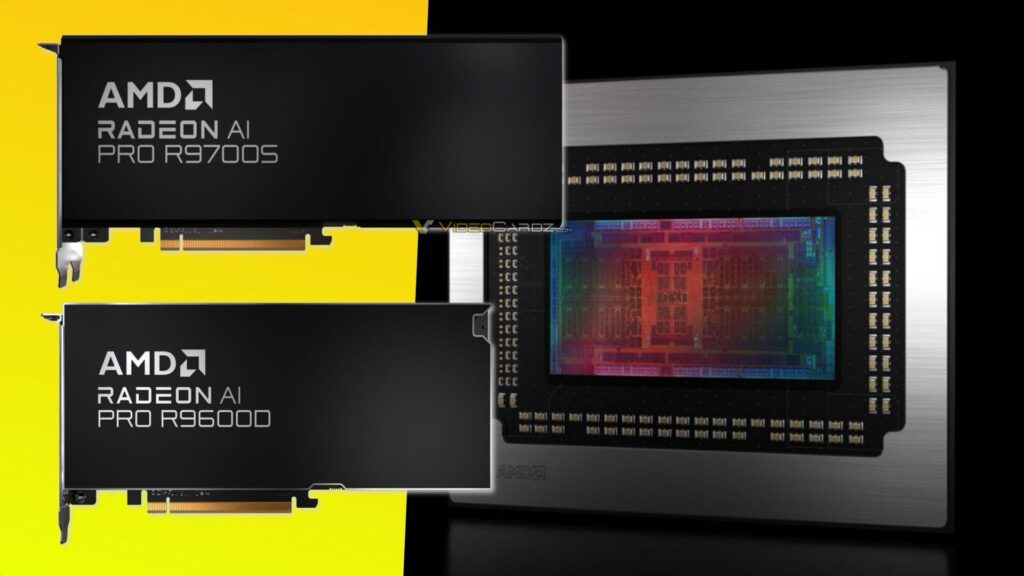
- AMD Radeon AI PRO R9700S delivers 47.8 TFLOPS peak FP32 computing power
- AMD equips the R9700S with 32GB of GDDR6 memory for AI workloads
- PCIe 5.0 x16 support enables high-bandwidth communication for AI applications
AMD has introduced the Radeon AI PRO R9700S, a passively cooled workstation GPU that joins the R9000 series and promises enterprise-level AI performance.
After the launch of this series earlier this year, several major brands confirmed products with R9700 cards, indicating a strong industrial application.
The R9700S retains the same Navi 48 RDNA4 configuration as the standard R9700 and offers 64 compute units and 4096 stream processors.
Passive cooling for high-density AI workloads
Its boost clock reaches up to 2920MHz and delivers a maximum FP32 throughput of 47.8 TFLOPS, making it a suitable option for enterprise AI workloads.
Designed for dense racks and multi-GPU setups, the R9700S uses a 32GB GDDR6 memory buffer on a 256-bit bus with 64MB of Infinity Cache.
PCIe 5.0 x16 support ensures high-bandwidth communication with compatible workstation platforms.
The “S” designation in the R9700S indicates a silent design, which replaces the fan-style cooler of previous models.
This approach uses system airflow rather than built-in fans, making the GPU suitable for compact racks where multiple cards work closely together.
Despite the passive cooling, the card maintains a 300W TDP and draws power through a single 12V-2×6 connector.
This approach reflects AMD’s focus on maintaining computer performance without adding active components.
The company also launched the R9600D, which scales down to 48 compute units and 3072 stream processors while maintaining identical memory.
However, the R9700S offers higher throughput for large AI models.
Both cards support Linux ECC memory options and are fully compatible with AMD’s Software PRO Edition and ROCm integration.
The R9700S is optimized for tasks such as generative AI inference and training large language models.
This lets companies offload demanding workloads from CPU cores to GPU accelerators.
Early adoption of the R9700 has appeared in pre-built systems like Elsa’s Veluga-D A70S G6 workstation.
It pairs the GPU with an AMD Ryzen 7 9700X CPU, 64GB of DDR5 RAM and PCIe expansion slots for additional accelerators.
With these chips, AMD offers enterprise-ready solutions for AI computing while focusing on memory bandwidth, power delivery and silent operation.
That said, the high raw performance of this chip raises questions about sustained thermals in dense installations.
Therefore, companies deploying multiple devices must consider system-level airflow and thermal management to maintain stability under high AI workloads.
Via Video card
Follow TechRadar on Google News and add us as a preferred source to get our expert news, reviews and opinions in your feeds. Be sure to click the Follow button!
And of course you can too follow TechRadar on TikTok for news, reviews, video unboxings, and get regular updates from us on WhatsApp also.


