
PPP chairman urges PTI to return to democratic politics, says it will benefit party and its leaders
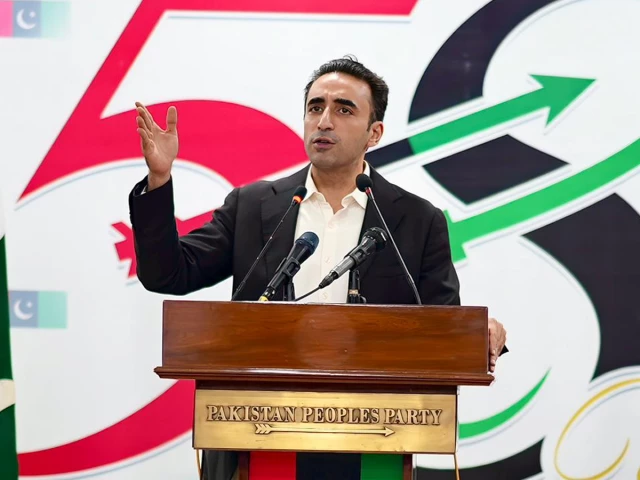
Pakistan People’s Party Chairman Bilawal Bhutto-Zardari delivers a video speech on the party’s 58th foundation day, Sunday, November 30, 2025. Photo: Express
Pakistan People’s Party Chairman Bilawal Bhutto Zardari has called on the Pakistan Tehreek-e-Insaf to abandon what he described as extremist politics and return to conventional political engagement.
“Based on our history and experience, our advice is that Pakistan Tehreek-e-Insaf (PTI) should abandon extremism and bring its politics back within democratic boundaries. This will be better for their party, their leader, their workers and for the overall political environment of the country,” Bilawal said while inaugurating an intensive care unit at Larkana Children’s Hospital on Sunday.
Bilawal criticized the PTI for attacking state institutions after the arrest of its leader and said his party would have faced far harsher consequences if it had acted in the same way. “If the PTI attacked institutions after the arrest of its leader and nothing happened, I ask what would have become of us if the PPP had done the same?” he said.
He said that political stability and the survival of democracy in Pakistan required responsible behavior from both the government and the opposition. “If you run extremist politics, you can’t complain about the harshness that follows,” he said, quoting an English idiom: “If you can’t handle the heat, get out of the kitchen.”
Referring to legal cases against political leaders, Bilawal said, “If a small NAB case is filed against your leader and in response to his arrest you attack our national institutions, then you should not complain later because action will follow according to law.”
He recalled raising the same issue with party workers a day earlier at Garhi Khuda Bakhsh. “This is about PTI, but I ask you again – if PPP had attacked institutions because of the arrest of its leader, what would have been our fate?” he said, adding, “With PTI, nothing seems to be happening.”
Responding to another question, the PPP chairman said reconciliation remained the core political philosophy of his party. He said President Asif Ali Zardari had played a leading role in promoting reconciliation in the past and would continue to do so in the current political climate. “President Zardari has a history of reconciliation and even today he will have to play that role,” Bilawal said.
He said tensions were high on Pakistan’s borders with India and Afghanistan and that the country was facing terrorism. “At such a time, if PTI behaves like an extremist organization, the state’s reaction will be exactly the same,” Bilawal said.
Bilawal also thanked the Prime Minister for sending a delegation to attend the Benazir Bhutto Jubilee but said no political discussions took place. He stressed that political parties must find political solutions, saying such an approach was in the public interest.
Referring to the elections, he said the polls would be held on time and any reforms needed to ensure transparency should be pursued jointly by political parties. “There is still time before the elections,” he said, urging all parties, including the Jamiat Ulema-e-Islam (JUI), to focus on electoral reforms and address objections.
Highlighting Sindh’s health initiatives, Bilawal said key health facilities had been established across Karachi and other districts of the province, claiming that no other province offered comparable services. He said highly sensitive intensive care units, which he described as globally expensive, were launched in Larkana.
He added that in collaboration with ChildLife Foundation, pediatric health services were expanded across Sindh. “Sindh now has the lowest child mortality rate,” he said.
Acknowledging the country’s economic crisis, Bilawal said wage earners were struggling to make ends meet. He said the PPP aimed to introduce policies to reduce the financial burden on citizens and implemented the manifesto of former Prime Minister Benazir Bhutto.
He criticized the government’s claims of development and said the public remained dissatisfied with economic conditions. “The common man cannot afford education and health expenses,” he said.
On privatization, Bilawal said the PPP was in favor of a public-private partnership model. He cited projects like Sindh Engro Coal Mining Company and ChildLife Foundation as successful examples and noted that The Economist the magazine had ranked Sindh’s public-private partnership model sixth globally.


