
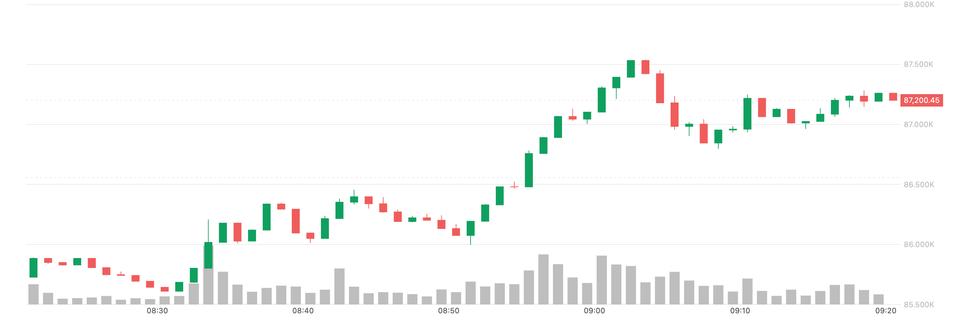
Bitcoin strengthened as the Japanese yen fell after the Bank of Japan (BOJ) raised interest rates as expected.
The Bank of Japan raised its short-term key interest rate by 25 basis points to 0.75%, the highest level in about three decades, continuing the gradual shift away from decades of ultra-loose monetary policy.
In the policy statement, the BOJ acknowledged that inflation has remained above its 2% target for an extended period due to rising import costs and firmer domestic price dynamics. However, policymakers stressed that inflation-adjusted interest rates remain negative, meaning monetary conditions remain accommodative even after the hike.
The Japanese yen fell to 156.03 per US dollar from 155.67 after the rate decision. Bitcoin, the leading cryptocurrency by market capitalization, rose from $86,000 to $87,500 before retreating slightly to trade near $87,000 at press time, CoinDesk data shows.
The market reaction is in line with expectations, as the interest rate hike had been widely anticipated. Furthermore, speculators had held long positions in the Japanese yen for weeks, preventing any sharp yen-buying reaction following the announcement.
In recent weeks, some observers had expressed concern that the rate hike could strengthen the yen and trigger a unwinding of yen carry trades and broad-based risk-off sentiment.
For decades, Japan’s ultra-low or even negative interest rates have made the yen a preferred funding currency for carry trades. Investors borrowed cheaply in the yen to invest in higher-yielding assets, including U.S. technology stocks, Treasuries and emerging market bonds, boosting global liquidity and appetite for risk. This strategy thrived as long as Japan’s rates remained close to zero, effectively making the yen an important leverage and risk-taking option across global financial markets.
So the prospect of higher interest rates in Japan spooked risk-asset bulls. However, these fears were overblown, as CoinDesk explained, noting that even after the rate hike, Japanese rates would remain significantly cheaper than their US counterparts, ensuring no mass liquidation of carry trades.


