
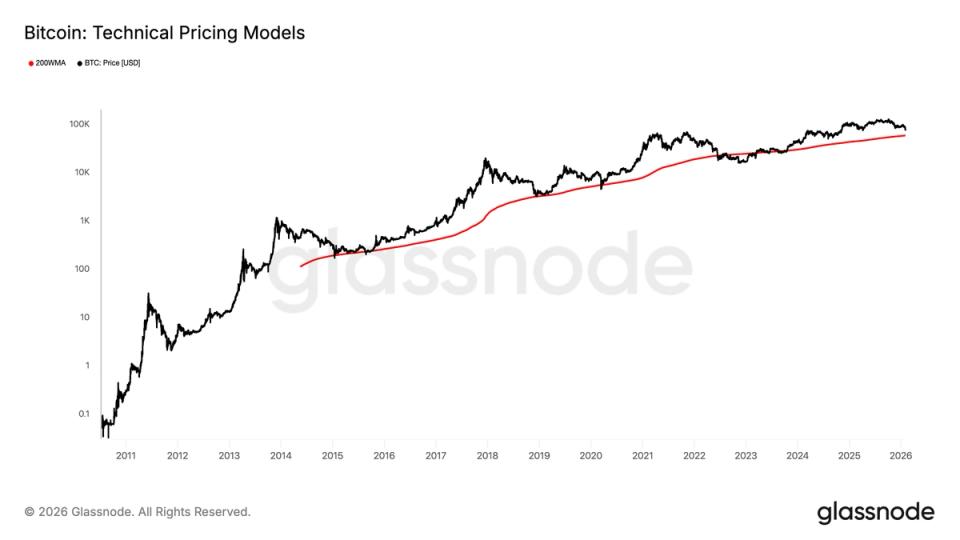
Bitcoins An 11% drop last week may be the least of investors’ worries. That’s a price of around $58,000, another 25% below current levels, they should be aware.
While the major cryptocurrency’s recent crash, biggest weekly drop since March 2025 and inability to attract buyers has many holders worried about another so-called crypto winter, there is still a painful journey before it reaches the possible silver lining of the 200-week moving average (WMA).
The average closing price of BTC over the past 200 weeks is a widely used long-term momentum indicator and a baseline for the traditional four-year bitcoin cycle. It has marked a market bottom in each previous cycle and is currently at $57,926.
Historically, bitcoin has often peaked in the fourth quarter of the fourth cycle year. This time, it hit an all-time high of $126,000 in October and is currently down about 40% from that peak.
A further slide could be on the cards.
Last week’s decline took bitcoin below the Ichimoku Cloud, a technical indicator that measures momentum, support and resistance. When the price stays above the cloud, it indicates a robust bullish trend with strong upward momentum. When the price falls below that, the market becomes anemic, lacking strength and subject to prolonged weakness, like a human body lacking iron.
Bitcoin crossed just below the cloud on the weekly chart, a bearish shift that has historically signaled the start of the deepest and most painful bear market phases.
It also appears to broadly follow the theory of the four-year cycle, driven by the halving plan, which reduces new supply by 50% roughly every four years and is partly the cause of the cyclical bull and bear markets.
In the 2015 bear market, bitcoin traded just above $200 and consistently used the 200-WMA as support. During the 2018-2019 bear market, the 200-WMA sat just above $3,000 and again acted as support, with a brief collapse during the March 2020 Covid-driven market crash.
In the previous cycle, bitcoin fell below the 200-WMA in June 2022, to levels below $22,000, and remained there for an extended period. The price did not regain the 200-WMA line until October 2023, confirming its role as a long-term trend support line.
While there is no guarantee, the recent price drop below the Ichimoku Cloud indicates that another sustained bear market phase may be imminent, but at least there is a proven support level to give some cheer.
UPDATE (February 2, 16:55 UTC): Rewrites the title


