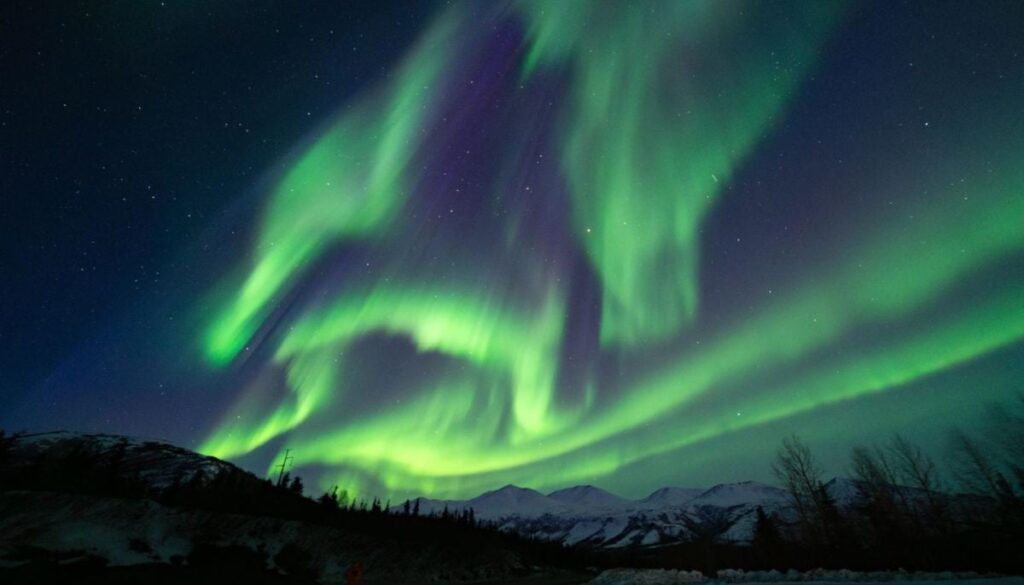
The Northern Lights are expected to return to British skies on Saturday night, March 21, after a stunning display that lit up parts of the country as far south as Norfolk on Friday, March 20.
The beautiful natural display, known as the Aurora Borealis, is caused by a geomagnetic storm caused by a coronal mass ejection (CME), where waves of charged particles erupt from the Sun’s surface and interact with Earth’s atmosphere.
Oxygen emits green while nitrogen emits red, blue and pink, which is what brought us the brilliant display of color that has fascinated sky watchers in Scotland, Northern Ireland and parts of northern England and Wales.
Weather watchers reported seeing the Northern Lights in North Wales, Powys and even on the Norfolk coast.
According to the Met Office Space Weather Analysts, geomagnetic activity is expected to remain elevated through Saturday evening, with a chance of reaching another “severe storm” level.
This suggests that the Northern Lights could be visible across Scotland, Northern Ireland and the northern areas of England and Wales, with a small chance of sightings further south.
But cloud may obscure the view for some areas across Scotland and Northern Ireland. Clear skies are expected to provide better viewing opportunities.
On Friday, the Northern Lights aligned with the vernal equinox, improving visibility due to the Russell-McPherron effect.
This happens when the Earth’s magnetic field coincides with the incoming solar wind, which normally makes it stronger around the equinoxes.