
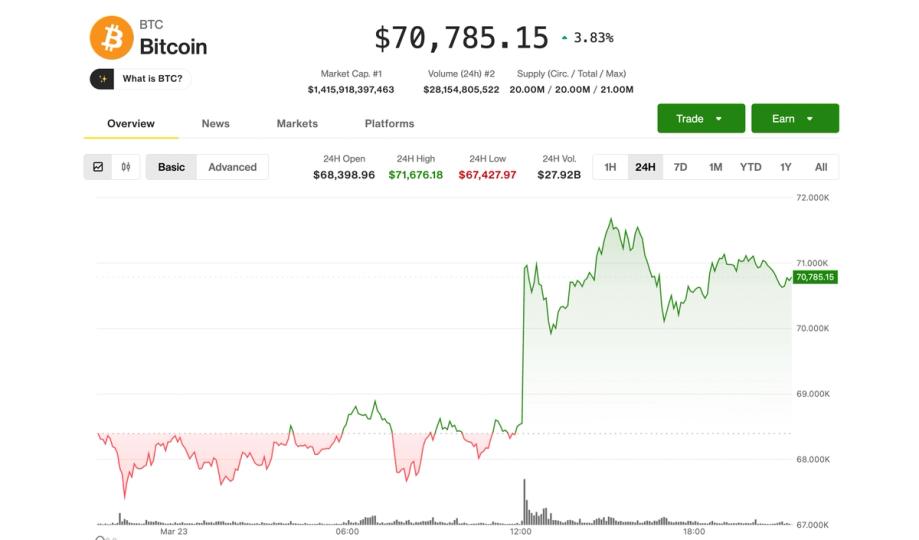
Bitcoin held on to gains on Monday after an early rise above $70,000, but the fate of the rally now depends on what’s next between the US and Iran.
The move followed US President Donald Trump’s announcement of a five-day pause in strikes against Iranian energy infrastructure, citing “productive” diplomatic talks.
Iranian officials denied the existence of negotiations, but markets largely dismissed it, with risk assets holding steady through the session.
Bitcoin hovered just below $71,000 later in the session, up 3.8% over the past 24 hours. Altcoins fared better, with ether (ETH), solana (SOL) and each gains about 5%.
Crypto-linked stocks also rose, led by bitcoin miners who have increasingly traded in line with AI infrastructure. Hut 8 (HUT) jumped more than 11%, while Bitfarms (BITF), Cipher Mining (CIFR), CleanSpark (CLSK), Riot Platforms (RIOT), and TeraWulf (WULF) gained 6%-7%.
Traditional markets joined the rally, with the S&P 500 and Nasdaq both closing up about 1.2%.
While the temporary pause has eased pressure on energy markets, traders should treat the rebound cautiously in risk assets.
“The macro ceiling has moved,” said Jasper de Maere, OTC trader at Wintermute. “How much space opens depends on the next five days.”
If oil stabilizes and shipping through the Strait of Hormuz normalizes, he said, inflation concerns could ease, allowing rate cut expectations to return and remove a key headwind for crypto.
In that scenario, bitcoin could run once again in the $74,000-$76,000 range, the level that has limited rallies in recent weeks, according to de Maere.
A breakdown in negotiations or renewed disruption of energy supplies would have the opposite effect, he said. That would likely push oil higher again, amplify inflation risks and send markets back into risk-off mode that could pull bitcoin back toward the mid-$60,000s.


