
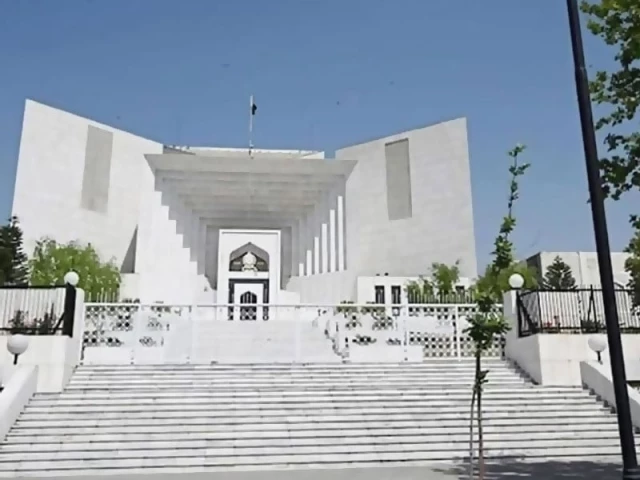
While imposing a hefty cost of Rs.1 million on a petitioner, the Supreme Court held that the use of litigation as an instrument of coercion and harassment is completely impermissible. In a seven-page judgment penned by Justice Shahid Bilal Hassan, the court noted that the petitioner forced the respondent, a young woman, to undergo repeated, invasive and degrading examinations through a defense that was also found to be unsubstantiated.
"Such use of legal proceedings as a tool for coercion and harassment is completely unacceptable. To mark the court’s strong disapproval, to compensate the respondents for the unnecessary hardship caused, and to discourage recurrence of such frivolous and vexatious litigation, this petition is dismissed with exemplary costs," stood there. A three-judge bench headed by Chief Justice of Pakistan Yahya Afridi heard the case. The Family Court had decided a matrimonial case and dismissed the petitioner’s case for restitution of conjugal rights. The High Court upheld the conclusions of the lower courts. The court observed that the facts of the case were not only unusual but deeply disturbing. It noted that the respondent/plaintiff, a young woman, alleged that the petitioner – her paternal uncle (phupha) – had taken advantage of a relationship of trust, proximity and dominance to sexually assault her. The record further revealed that the petitioner, a married man with children, attempted to portray himself as the legal husband of the respondent by claiming a purported Sharia Nikah on 3 April 2020. Significantly, the petitioner’s legal wife is the respondent’s aunt (phupho). Even by the petitioner’s own account, the alleged marriage would fall within the prohibited degree and would not be permissible during the existence of the previous marriage. The court noted that the petitioner, in an attempt to overcome this inherent legal hurdle, raised a completely baseless divorce plea from his legal wife. Rather than strengthening his case, this reflected an attempt to tailor the facts and fabricate a narrative to give a veneer of legality to what appeared to be an illegal and coercive relationship. The judgment further records that the petitioner was declared the biological father of a minor child born to the respondent.
"In any event, even if the petitioner’s version of marriage is discarded – as it has been contemporaneously by the courts below – he cannot be allowed to escape the consequences of his own conduct.
"The minor child is an innocent life and cannot be left unprotected. The law does not allow a child to be deprived of maintenance, dignity and legal support simply because the relationship between the parents is disputed, illegal or subject to criminal proceedings.
"It is a fixed legal principle that the right to support belongs to the child and is based on considerations of welfare, justice and equality."
The court ruled that once biological paternity has been established, the corresponding obligation to provide for the child follows as a necessary legal consequence.
"A biological father cannot be allowed to deny liability or take refuge behind technical pleas of legitimacy, nor can this court give its discretionary jurisdiction to a plaintiff who attempts to convert a wrongful act or coercion into a civil right.
"In this connection, the law distinguishes between a ‘genuine child’ and a ‘biological child’. A biological child is genetically related to the parent, whereas legitimacy relates to the legal status of the birth within a legal marriage."
The judgment also emphasized that human dignity is inviolable and enjoys constitutional protection under Article 14 of the Constitution. "Courts cannot serve as passive venues for the perpetuation of social prejudices, nor can they allow their process to become a means of secondarily victimizing women who turn to the courts to get their legal rights fairly.
"Frivolous allegations and contrived pleas, especially those aimed at undermining a woman’s identity, character and dignity, cannot be accepted in any civilized legal system.
"Furthermore, the overriding consideration in all matters relating to children is the child’s best interests and welfare.
"This approach is consistent with Pakistan’s constitutional obligations under Articles 9, 14, 25 and 35 of the Constitution, as well as its international obligations under the Convention on the Rights of the Child (CRC), which mandates the protection of children without discrimination."


