
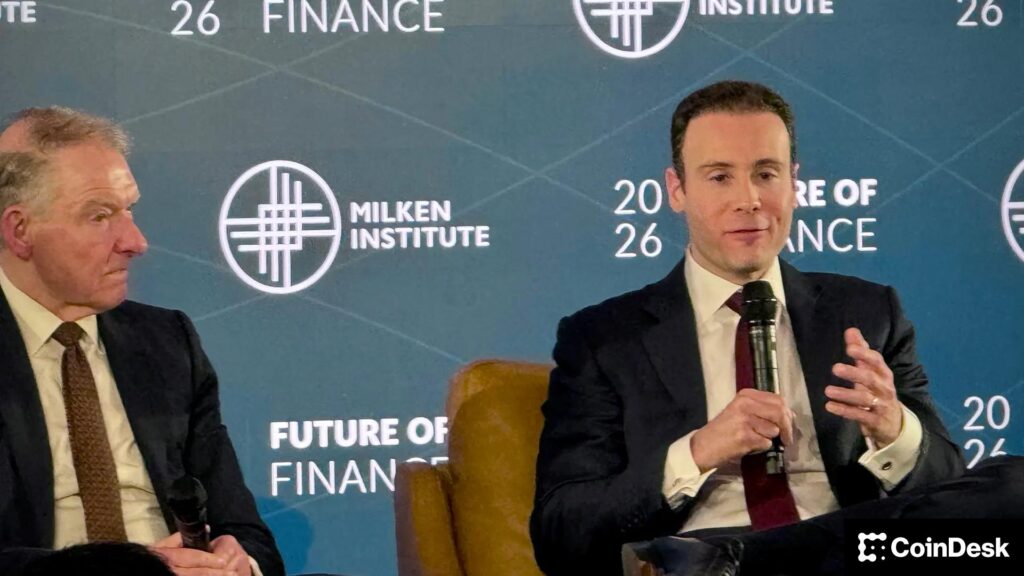
WASHINGTON, DC – Crypto perpetual futures have largely developed offshore because of the United States’ reluctance to pursue industry regulations, US Commodity Futures Trading Commission Chairman Mike Selig said, and his agency will soon provide guidance on how to handle this business.
Such derivative contracts, which do not expire and are often associated with leverage, have been an area of great interest to the industry. US exchange Kraken, for example, recently announced a switch to perpetual futures for tokenized stocks for non-US users.
Selig’s agency is “working to get professional future, real professional future here in the United States in the next month or so,” he said at a Milken Institute event in Washington on Tuesday. “We expect to announce that very soon.”
“The previous administration drove many of these firms and the liquidity offshore,” he noted.
It was a theme of his remarks and those of his counterpart to the US Securities and Exchange Commission, Chairman Paul Atkins. As they have often done recently to emphasize their shared mission of digital assets, which they call Project Crypto, the two appeared together on stage and highlighted their united approach.
One of the things the two are pursuing is “innovation exemptions” to allow for crypto-experimentation without fear of regulatory crackdown. Selig said they will also soon define how decentralized finance (DeFi) developers approach after years of prosecution and regulatory uncertainty.
Selig, who can act on his own because he is currently the sole member of the CFTC’s five-member commission, also said that prediction markets – an overlapping cousin of the crypto sector – will get “guidance in the near future” from the regulator. “We are going to set very clear standards.” And he said the agency is also working on a fuller rulemaking process to soon give that position more permanent footing than guidance that is procedurally easy to eliminate and rewrite.
Oversight of firms with event contracts, including leaders such as Polymarket and Kalshi, is under dispute, and state gambling regulators are pushing their own authorities over the firms’ sports contracts. Selig stepped forward to fight it in the courts, arguing for the CFTC’s position as a leading regulator of such firms’ activities.
“They can exist in parallel,” he said Tuesday of the two regulatory regimes.
However, Atkins delved into one of the downsides of regulators’ current work: legal status. Despite Atkins’ earlier confidence that the SEC can move forward without new laws governing its crypto work, he said Tuesday, “We really need statutory certainty.”
“We need the feeling of Congress,” he said.
A U.S. Supreme Court ruling two years ago stripped away a significant amount of authority federal regulators had in litigating their actions, so agencies going it alone on policy guidance don’t carry the weight they once did. Agencies like the SEC and CFTC can be more easily challenged, and their positions can also be easily reversed by future officials who arrive on the commissions.
The US Senate is still working on the Digital Asset Market Clarity Act, which is intended to establish a regulatory system for the US crypto markets. The legislative effort remains mired in negotiations involving the industry, bankers, lawmakers from both parties and the White House. Its chances for passage in 2026 grow more difficult every day as the midterm elections approach and Senate vacancies dwindle.
Read more: The head of the SEC chairs an event sponsored by a crypto company at war with it


