
Court removes reference under Section 152 CrPC in wake of FO dissenting from judge’s remarks
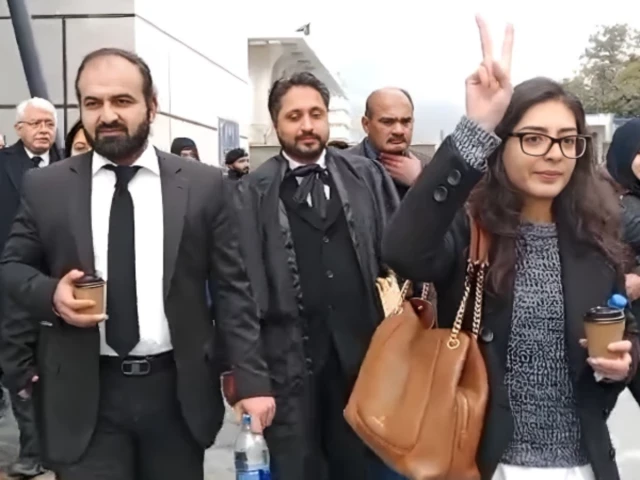
Lawyer and human rights activist Imaan Mazari and her husband, lawyer Hadi Ali Chattha. PHOTO: EXPRESS
ISLAMABAD:
An Islamabad trial court has lifted a section of its verdict in a case against human rights activist and lawyer Imaan Mazari and her husband, lawyer Hadi Ali Chattha, that referred to certain countries as “terrorist states”, it emerged on Friday.
The two were sentenced in Islamabad last week in a case linked to alleged posts and reposts on X that investigators described as “anti-state”. The case was registered in August 2025 by the National Cyber Crime Investigation Agency (NCCIA) under the Prevention of Electronic Crime Act (PECA) 2016, with allegations that the content was intended to undermine government institutions and align with proscribed organizations or individuals.
District and Sessions Judge Islamabad Afzal Majoka had observed that the accused had described Pakistan as a “terrorist state” in their posts, a designation that, according to the order, was officially applied to only four countries: Cuba, the Democratic Republic of Korea, Iran and Syria.
Asked about the observation in his weekly press briefing a day ago, the Foreign Office spokesman asked for Pakistan’s political position on the matter, to which he replied: “We have seen the judgement. These are the views of the learned judge. Pakistan, of course, does not agree with this opinion. This kind of designation of terrorist states does not exist either in UN law or under international law.”
Subsequently, an order of the judge, dated January 27, emerged today, which said that NCCIA Special Public Prosecutor Muhammad Usman Rana had filed an application on January 24 for “correction of error … in which a sentence due to typographical error … was
written because of a clerical error which is not supported by any statutory provision, judicial precedent, executive notification, international instrument or authoritative reference, so some may be deleted because this sentence is vague and ambiguous.”
The notice added that the stenographer had mentioned in the written response that the sentence, along with others, was deleted during the correction of the judgment, but that it was mistakenly included in the judgment at the time of final printing, and “that this error on his part is bona fide”.
Referring to Section 152 of Criminal Procedure, the ruling said that clerical or arithmetical errors in judgments, decrees, orders or errors arising therein from any accidental slip or omission may at any time be corrected by the court either of its own motion or at the request of one of the parties.
Thus, the judge said: “In the present case, the above judgment has no relevance and has no connection with the question of determination of the rights of the parties. This sentence is not supported by any statutory provision, judicial precedent, executive notice, international instrument or authoritative reference, so having regard to the law laid down in this application, the law laid down in this application is accepted. Accordingly, the sentence is deleted.”


