
FM reaffirms support for regional sovereignty and calls for dialogue as Iran-Israel tensions escalate
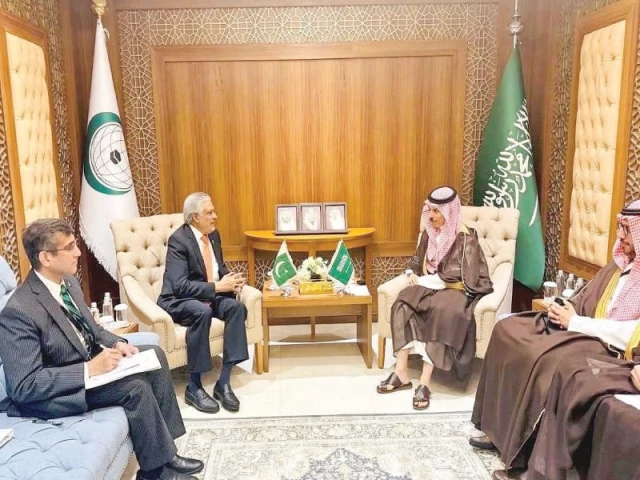
Deputy Prime Minister and Foreign Minister Ishaq Dar holds a meeting with Saudi Foreign Minister Prince Faisal bin Farhan on the sidelines of the OIC-CFM emergency meeting in Jeddah, Palestine. PHOTO COURTESY: PTV
Deputy Prime Minister and Foreign Minister Ishaq Dar will visit Riyadh on 18-19 March to attend a meeting of foreign ministers from regional countries, Pakistan’s foreign ministry said on Wednesday.
In a post on X, the foreign ministry said Dar would use the meeting to reiterate Pakistan’s diplomatic stance amid escalating tensions in the Middle East.
“During the meeting, the DPM/FM will express full support for the territorial integrity, sovereignty and political independence of all brotherly countries in the region and call for an end to all attacks on their territory,” the statement said.
According to the State Department, Dar will reaffirm Pakistan’s call for an immediate end to the ongoing conflict and stress the need to resume dialogue and diplomacy. He is also expected to highlight Pakistan’s diplomatic initiatives and its commitment to play a constructive role in tackling the region’s growing security challenges.
The visit comes as the US and Israel’s war against Iran intensifies, exacerbating instability throughout the Middle East. Iranian state television reported Wednesday that Iran targeted Tel Aviv with missiles carrying cluster warheads, describing the attack as retaliation for Israel’s assassination of Iran’s security chief Ali Larijani.
Earlier, on March 12, Prime Minister Shehbaz Sharif traveled to Riyadh for detailed discussions on the regional situation with Saudi Crown Prince Mohammed bin Salman.
Read: The government is stepping up efforts to help nationals as the crisis in the Middle East deepens
Amid rising tensions following US-Israeli attacks on Iran, Pakistan has reiterated its strong strategic commitment to Saudi Arabia while urging restraint to avoid a wider regional conflict.
The prime minister’s foreign media spokesman Mosharraf Zaidi earlier emphasized the depth of ties between Islamabad and Riyadh and said Pakistan would stand by Saudi Arabia if needed.
“The question is not if Pakistan can come to the aid of Saudi Arabia … we will. No matter what, no matter when,” he said, adding that Pakistan’s immediate focus remains on preventing further escalation and ensuring that regional partners are not drawn deeper into the conflict.
Iran has responded to the US-Israeli attacks with waves of drone and missile strikes not only against Israel but also against Gulf states that host US military installations, including Saudi Arabia, widening the regional impact of the conflict.
The escalation has hit key infrastructure across the Gulf states, including airports, ports, hotels and oil and military facilities. Disruptions to oil and gas shipments through the Strait of Hormuz – a route that carries about a fifth of the world’s oil and liquid natural gas – have added to economic concerns.
Airspace closures across the region have also forced airlines to cancel around 40,000 flights, marking the biggest disruption to global air travel since the COVID-19 pandemic.


