
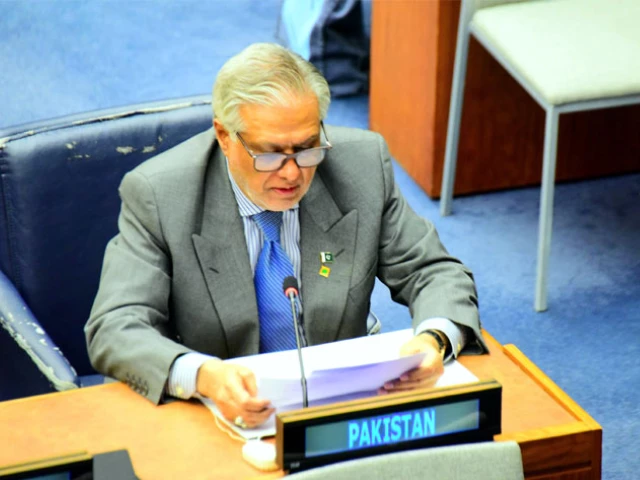
Ishaq Dar speaks at an OIC high-level event on peace and tolerance on the sidelines of the UN General Assembly’s 80th session
ISLAMABAD:
An extraordinary meeting of the foreign ministers of the Organization of Islamic Cooperation (OIC) is taking place in Jeddah today to discuss Israel’s recognition of the self-proclaimed Somaliland region, a move that drew strong condemnation from the Muslim world.
Foreign Minister Ishaq Dar will attend the meeting and present Pakistan’s perspective.
According to the State Department, the emergency meeting has been called in view of “rapidly escalating developments in Somalia,” following Israel’s decision to recognize Somaliland as an independent entity.
The OIC has described the move as a clear violation of Somalia’s sovereignty and territorial integrity. During the session, Dar is expected to reiterate Islamabad’s firm support for Somalia’s unity and internationally recognized borders.
The Foreign Minister will also hold bilateral meetings on the sidelines with his counterparts from the OIC member states to discuss broader regional and international developments as well as opportunities for increased cooperation.
The OIC General Secretariat said the extraordinary meeting aims to coordinate a unified Islamic position and reaffirm full support for Somalia’s sovereignty and territorial integrity in accordance with international law, the UN Charter and relevant OIC resolutions.
Somaliland, located in northwestern Somalia, declared independence unilaterally in 1991 following the collapse of the central Somali government.
While the region has maintained its own administration, security apparatus and periodic elections, it has not been recognized as a sovereign state by the United Nations or any major international organization.
The federal government in Mogadishu has consistently maintained that Somaliland remains an integral part of Somalia. Israel’s recognition of Somaliland has therefore caused considerable controversy, not only in Somalia, but also throughout Africa and the Muslim world.
Somali authorities have strongly condemned the move, calling it a violation of their sovereignty and a destabilizing step for the Horn of Africa, a region already struggling with conflict, piracy, humanitarian crises and great power competition.
Within the OIC, the issue is seen as setting a worrying precedent that could encourage separatist movements and undermine the principle of territorial integrity enshrined in international law.
Several member states have expressed concern that unilateral recognition of breakaway regions could further fragment fragile states.
Pakistan has traditionally taken a clear stance on such issues, consistently opposing unilateral secession and external recognition of disputed territories.
Diplomats say Islamabad is likely to adhere closely to the OIC consensus, stressing respect for sovereignty, non-interference and adherence to international legal frameworks.
Analysts note that Pakistan’s stance on Somaliland is also shaped by the country’s broader foreign policy principles, including strong support for Muslim countries facing territorial challenges and opposition to actions perceived to be in violation of international norms.
Islamabad has long supported Somalia in multilateral forums and has supported international efforts aimed at stabilization and state-building in the country.
The outcome of the Jeddah meeting is expected to include a strong collective statement condemning Israel’s move, reaffirming Somalia’s territorial integrity and possibly outlining diplomatic steps to raise the issue in international forums, including the United Nations.
As tensions continue to simmer, the OIC extraordinary session underscores the growing diplomatic fallout from Israel’s recognition of Somaliland and highlights the organization’s attempt to present a united front on an issue with far-reaching regional and geopolitical implications.


