
Pakistan and Turkey express serious concern over the rising tensions and emphasize diplomacy as the only path to peace
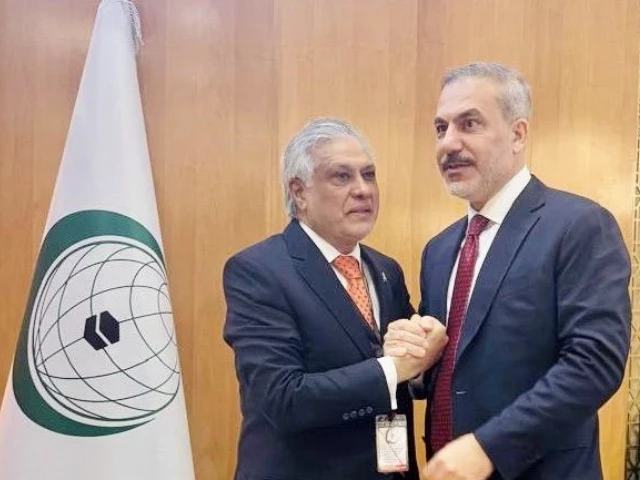
Deputy Prime Minister and Foreign Minister Ishaq Dar with Turkish Foreign Minister Hakan Fidan Photo: X/ForeignOfficePk
Deputy Prime Minister and Foreign Minister Senator Mohammad Ishaq Dar spoke with Turkish Foreign Minister Hakan Fidan on Wednesday, Pakistan’s Foreign Ministry issued on X.
Deputy Prime Minister/Foreign Minister Senator Mohammad Ishaq Dar @MIshaqDar50 spoke last night with Turkish Foreign Minister Hakan Fidan @HakanFidan.
They discussed developments in the regional situation and expressed serious concern over the rising tensions.
DPM/FM emphasized… pic.twitter.com/BvN0E4qw10
— Ministry of Foreign Affairs – Pakistan (@ForeignOfficePk) 18 March 2026
According to the ministry, “the leaders discussed the evolving regional situation and expressed serious concern over the rising tensions.” Highlighting the urgent need for de-escalation, Dar emphasized that constructive dialogue and diplomacy “remain the only effective means of resolving problems and promoting peace and stability in the region.”
Read: Iran says the killing of Larijani will not weaken the system as tensions rise after a targeted attack
The call comes as the US and Israel’s war against Iran continues, exacerbating tensions in the Middle East region. Iran targeted Tel Aviv with missiles carrying cluster warheads in what it said was retaliation for Israel’s assassination of Iran’s security chief Ali Larijani, Iranian state television reported Wednesday.
The Islamic Republic will hold funerals on Wednesday for Larijani and another Iranian figure killed on Tuesday by Israel, Gholamreza Soleimani, the head of the Basij paramilitary force, according to Dad and Tasnim news agencies.
In addition to sending missiles and drones into Israel and the Gulf nations, Iran has also sought to extract a heavy toll on the global economy, including by increasing the cost of oil by effectively closing the Strait of Hormuz, a crucial waterway for crude oil. As oil is still hovering around $100 per barrel, Iranian Foreign Minister Abbas Araghchi warned on Wednesday that the global consequences of the war “have only just begun and will affect everyone”.
Read more: Iranian projectile hits near Australian base in UAE amid growing Middle East crisis
Meanwhile, as part of an effort to reopen Hormuz, where a fifth of the world’s crude oil transits, the US military said it was bringing some of the heaviest bombs in its arsenal to penetrate adjacent missile sites. The United States dropped several 5,000-pound (2,250 kg) bombs, estimated to cost $288,000 each, on “hardened Iranian missile sites” near the coast that posed a threat to international shipping, Central Command said.
Despite the strait being effectively closed, the first Pakistani ship to sail through the Arabian Sea via the Gulf of Oman reached Pakistan’s maritime zone with a shipment of 80 million liters of crude oil.
Turkey, meanwhile, shot down a ballistic missile from Iran on Friday. Turkey’s Defense Ministry said the missile had been shot down in Turkish airspace by NATO forces.


