
The White House set a March 1 deadline for the banking industry and crypto firms to reach an agreement on stablecoin dividends, paving the way for the Clarity Act, the market structure legislation that would put the industry on a firm legal footing in the US
Clarity was adopted by Parliament seven months ago. The Senate has set many deadlines to move it, and they have all gone unmet. The latest deadline also flew by without any agreement.
The crypto industry has been fixated on legislation as the next catalyst, as if it is the only path to long-needed regulatory clarity in the world’s largest economy.
But legislation is not the only way.
The existing laws that give authority to market regulators at the Securities and Exchange Commission and the Commodity Futures Trading Commission are broad and flexible. These agencies are acting now.
New legislation would insure against future Gary Genslers, but the Gary Gensler era is over. President Donald Trump appointed a friendly chair to bless the industry, just as Gensler had appointed a hostile chair to confuse it.
And while everything else that Trump has done regarding crypto has created political headwinds, it could be that all he really needed to do was pick the right head of the SEC, and I suspect he has.
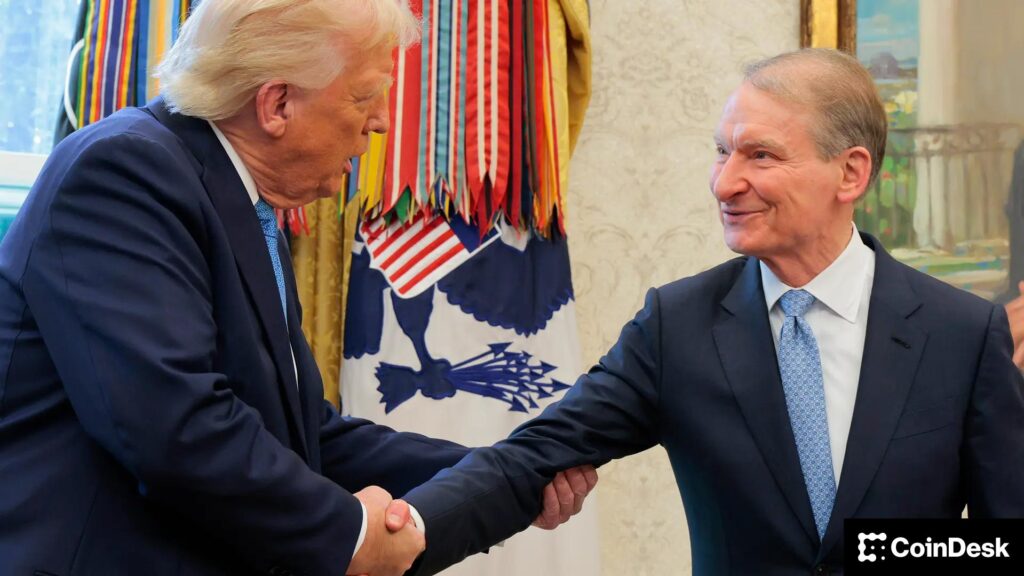
Trump appointed a veteran, Paul Atkins, who knows how to write rules that will withstand legal challenges. Trump then appointed one of Atkins’ deputies to lead the other investment agency, the CFTC, and ensure that rulemaking harmonizes across markets. All the industry has to do to not screw it up is to avoid another FTX-like implosion.
Losing is crypto’s game.
Not his first rodeo
Paul Atkins served six years at the SEC in the 2000s, serving under three different chairs. Since then he has acted as an advisor to the Chamber of Digital Commerce and Securitize.
He was sworn in in April 2025. A few weeks later, he spoke at an event at the SEC office and said the agency has the authority to give the crypto industry the rulemaking it needs to function.
Later, before a dozen or so reporters, he was asked if he had to wait for Congress to write market structure legislation before he could act. He reiterated that his staff can and will act with or without new legislation.
Atkins confidently promised action, as a regulator who understands the extent of his existing authority.
Harmonization
And Atkins will be aligned with the head of the SEC’s sister agency, the CFTC.
Gensler was never aligned with Rostin Benham, the former head of the CFTC. Benham kept asking Congress to act, which Gensler kept saying wasn’t necessary.
Benham clearly did not believe that every coin was a security, but Gensler believed that only Bitcoin was free of his scrutiny. They were not harmonized.
But to effectively regulate and give founders confidence, it’s important that the agencies don’t fight over when and if a digital asset can move from SEC jurisdiction to the CFTC’s.
So I think one of the main reasons Atkins hasn’t already released the draft rules for public comment is that he wanted to do it in consultation with the CFTC. However, Trump shifted gears by appointing a chairman of that agency, and the new helmsman, Michael Selig, was not sworn in until late December.
It wouldn’t be surprising if one day we learn that Atkins convinced the president to change course on CFTC chair appointments to ensure the two agencies work well together.
Expect an official memorandum of understanding between the two agencies delineating responsibilities soon. This arrangement will be reminiscent of the historic Shadd-Johnson agreement of 1981.
The new sheriff
By fall, I suspect Project Crypto will have submitted draft rules – each written in consultation with the other – before their respective commissions.
By next spring, these rules will have been modified based on public comments and most likely finalized.
This will be the first administration to actually write rules with decentralized financial networks in mind.
Under new rules, for example, it should be possible for exchanges such as Kraken, Coinbase and Crypto.com to finally say that all their activities are registered with an agency and under government supervision.
It must also be possible for new companies to raise funds with token sales. Some of these tokens are likely to enjoy rights that entrepreneurs avoided during the regulation-by-enforcement era, such as the ability to distribute revenue.
Assuming the rules are written conservatively enough to survive court challenges, the industry will likely have two or three years to grow before it’s even possible to roll back Atkins and Selig’s work (because that would require both a Senate appointment process and a new regulatory process).
Accomplishment
While we all know crypto has always been an industry that welcomes new entrants, the president’s family didn’t do digital assets any favors by launching memecoins, a stablecoin, and bitcoin miners. These activities could have been enough to torpedo any hopes of satisfying the crypto lobby’s ambitions for this session of Congress.
But while Congress is reeling, agency staff are writing rules.
If the SEC and CFTC work together effectively—both agency heads announced today that more crypto policies are on the way—whatever scheme they come up with may still become law. After all, Congress codified the Shadd-Johnson Agreement in the early 80s.
So the lobbyists may eventually get the legislation they want, but only after crypto goes mainstream anyway – without Congress, which is why Trump’s decision to appoint Paul Atkins may have already been enough to give the industry enough legal white space to reach its potential.


