
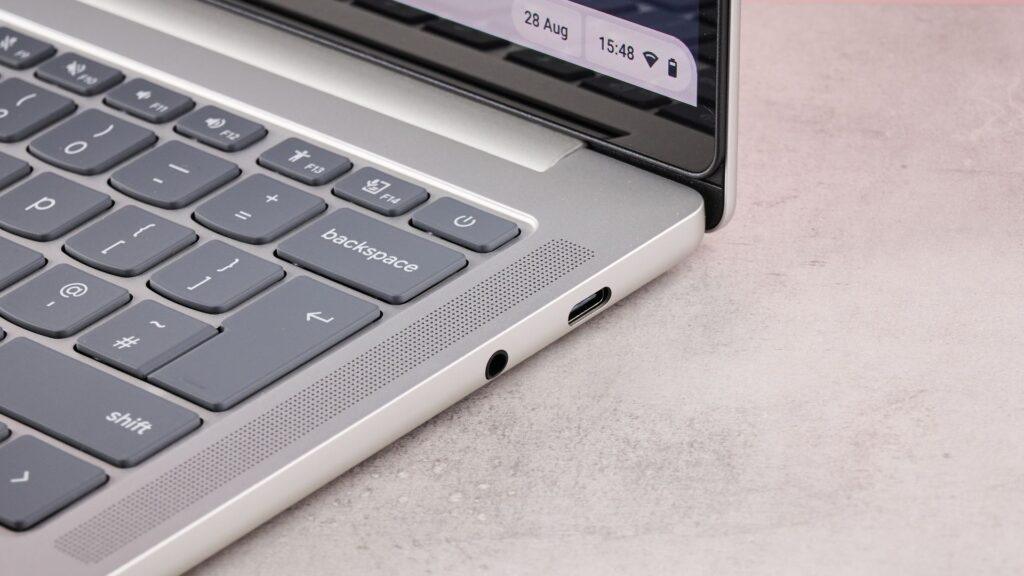
- Google.com shows a pop-up to promote Chromebooks
- It’s aimed at Windows 10 portable owners as support ends for the operating system
- Pop-up leads curious people to a Chromebook Plus Portal, but Google sails close to the wind with some of the marketing used here
Google benefits from the fact that Microsoft is finishing support for Windows 10 by displaying a pop-up commercial forces at Chromebooks, hoping that people will jump ship rather than upgrade to a new Windows 11 notebook.
Windows latest discovered the ad that appeared when the tech site visited the Google.com search page.
Google’s pop-up reads: “Time for a new laptop? Get Chromebook Plus. With security fixes for Windows 10 ending in October, switch to the laptop that has never had a virus.”
Yes, the claws are good and truly out, and while this is not a suggestion that Windows – laptop is virusuted, it is clearly a tip in that direction – and definitely an argument that Chromeos has better security.
Windows latest tells us that if you click the ‘Learn more’ in Pop-Up, you will be led to Google’s ‘Switch to Chromebook’ Portal, a site that sells the benefits of Chromebook Plus models (the more premium tag on Google’s laptops).
Analysis: Horses for courses
What is really interesting here is the video that plays on contact with the Chromebook website when you first visit.
It shows a generic laptop (see the screen above), which is not explicitly a Windows Notebook in any way, but it has a narrative ‘Microsoft Blue’ background, and then again the hint is ready -especially as one of the pop -ups displayed on the portable screen is a ‘virus found’ warning, of course, was the thrust of the advertisement on Google. Another pop-up then shows a ‘system defect’ that happens before the laptop that flickers and then dies.
The biggest clue as to where Google aims at this video potshot is the spin circle (of downfall) that appears (in ages) when the laptop first appears -which is a Windows thing. And as mentioned, considering that all this comes after clicking a link to give up Windows 10, yes, you can draw your own conclusion.
So this feels pretty under the belt from Google, though Chromebooks have their clear advantages-where one is a very tight security level. Although it is hardly fair that even guard suggests that Windows 11 falls down and is a slouch on this front (it’s not).
A Chromebook could actually be a compelling choice for those who are after a more streamlined way of working with a laptop. Google’s notebooks have simplicity on their site – and affordable prices (although Chromebook Plus models are more Premium effort) – but you make a number of compromises compared to Microsoft’s OS.
I will not get into a full-on-comparison of the relative benefits of Windows 11-laptop and Chromebooks-Vi has an in-depth explanation of it if you want to advance in the weeds. The truth is that they are quite different operating systems, but what Google doesn’t touch is that those who want to give Windows 11 a miss – or can’t upgrade because of not meeting its system requirements – may be more likely to force Linux than Chromeos. Especially considering that you can find Linux-Distros, built to be Windows-like and offer a newcomer from the Microsoft side of the fence a warmer welcome as such.
There is another important point that Google does not mention, which is that those who are running a Windows 10 laptop can get another year of support for free, taking their laptop for October 2026. There is no urgent decision to make a decision yet, and Google is delighting to highlight this.
Everything is fair in marketing and PR, though – right? And to be fair, all tech giants participate in this kind of trigger-a-thin-line style to promotion to their devices, software or services.
I don’t know how widespread this particular Chromebook pop-up is, but I can’t see it on Google.com on my Windows 10-PC. I assume Windows recent was running a Windows 10 system when the tech site saw the Google ad, even if it doesn’t make it clear. It is likely that this is a targeted feature that appears for some Windows 10 users of Google – possibly in a limited way at the moment.


