
Ship pursued from off coast of Venezuela to N Atlantic; Rubio to meet Danish officials for Greenland negotiations
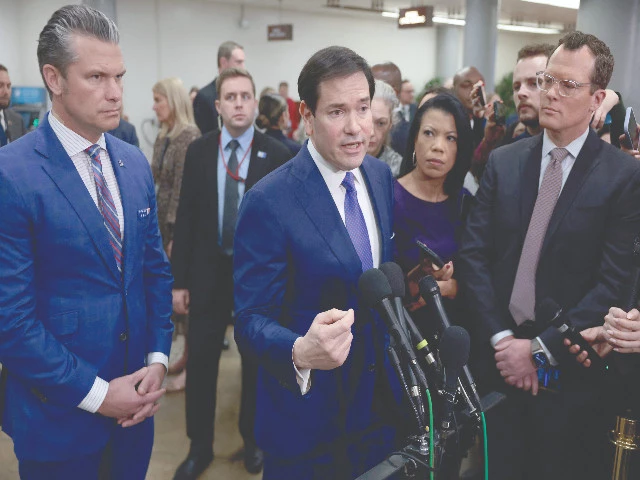
US Secretary of State Marco Rubio speaks to the media on the day of a House of Representatives briefing on the situation in Venezuela on Capitol Hill. Photo: Reuters
WASHINGTON/CARACAS:
The United States seized a Russian-flagged oil tanker in the North Atlantic on Wednesday after pursuing it off the coast of Venezuela, escalating tensions with Moscow and consolidating Washington’s control over Venezuela’s oil reserves.
The ship, formerly known as Bella-1 and recently renamed Marinera, had evaded previous US attempts to board it near Venezuela, where a US strike last Saturday ousted President Nicolas Maduro.
The ship, now flying the Russian flag, had been sanctioned by the United States since 2024 due to alleged ties to Iran and Hezbollah. US European Command said the seizure was carried out pursuant to a warrant issued by a federal court.
Pentagon chief Pete Hegseth described the action as part of a global blockade of Venezuelan oil and declared US control “anywhere in the world”. Homeland Security Secretary Kristi Noem said another sanctioned tanker had also been seized in the Caribbean, showing US forces roped from helicopters and taking control of the bridge with weapons at the ready.
President Donald Trump said Tuesday that 30-50 million barrels of Venezuelan crude will be shipped to U.S. ports, with revenues potentially exceeding $2 billion under his control. US Energy Secretary Chris Wright added that Washington would control Venezuelan oil sales “indefinitely”, monitoring both stored inventory and future production.
The operation drew swift condemnation from Moscow. Russia’s Transport Ministry called the seizure a violation of international law, citing the 1982 United Nations Convention on the Law of the Sea, arguing that “no state has the right to use force against ships duly registered under the jurisdiction of other states.” It required the immediate return of Russian crew members.
Britain said it was providing “enabling support” to US forces, with Royal Navy ships and RAF surveillance assets helping track and interdict the vessel in the North Atlantic. The British Ministry of Defense said the tanker had initially flown a false flag and engaged in illegal activity linked to international terrorism. Defense Secretary John Healey stressed that the operation was fully in accordance with international law.
In Caracas, meanwhile, streets returned to relative normality on Wednesday after days of disrupted transport and closed shops following the US operation. Interim President Delcy Rodriguez, a former vice president and energy minister under Maduro, has pledged cooperation with Washington amid fears of further regime change.
The White House signaled that Venezuela’s interim authorities will operate under “maximum leverage” from the United States, with decisions “dictated by the United States,” according to press secretary Karoline Leavitt.
Secretary of State Marco Rubio outlined a three-phase US plan for Venezuela: stabilization, securing Western and US companies’ access to oil during a recovery phase and eventual political transition. Democrats, including Senator Chris Murphy, criticized the plan as tantamount to “stealing oil at gunpoint”.
Trump has warned Rodriguez that she faces a “very big price” if she fails to cooperate with US demands, which include relinquishing control of the oil industry and weakening ties with Cuba, China, Iran and Russia. Despite U.S. claims of control, Rodriguez has insisted, “The government of Venezuela is in charge in our country and no one else,” projecting defiance along with hardliners in the security forces.
Greenland
The tanker seizure and US moves in Venezuela have coincided with renewed tensions over Greenland, a self-governing Danish territory in the Arctic. Trump has “actively discussed” the potential purchase of Greenland with his national security team, citing strategic concerns about Russian and Chinese influence in the region.
White House press secretary Karoline Leavitt said the president prefers diplomacy but will not rule out military options, stressing that “all options are always on the table for President Trump.”
US Secretary of State Marco Rubio confirmed he would meet Danish officials next week to discuss the matter, following Denmark’s request for talks following Trump’s statements about acquiring the island.
Rubio emphasized that the administration intends to address any national security threat through diplomatic channels where possible, although he noted that the United States has “the ability of any president” to respond militarily if necessary.
Trump’s interest in Greenland, which was first made public in 2019, has raised concerns from European allies and NATO members, as a US military move on another member could have significant geopolitical consequences.
House Speaker Mike Johnson tried to reassure lawmakers, saying he had not heard of any plans to deploy US forces to Greenland and that the focus remains on diplomatic engagement.
Analysts say Greenland’s importance lies in its strategic location, mineral wealth and Arctic access. Some observers suggest that the timing of Trump’s Greenlandic ambitions, coinciding with increased US intervention in Venezuela, reflects a broader US focus on securing critical resources and strategic outposts amid global competition with Russia and China.


