
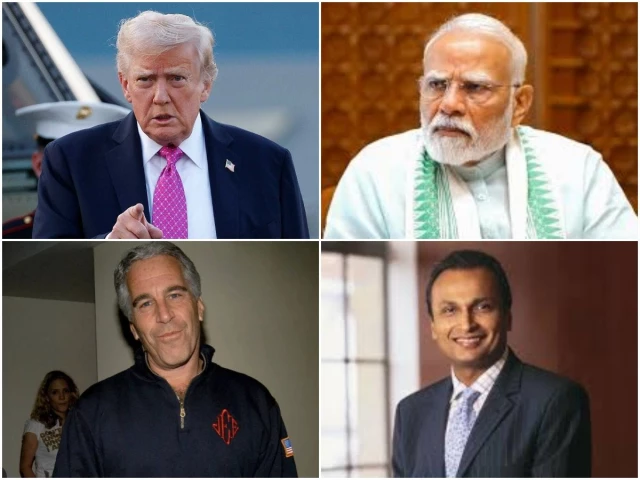
Recently released bona fide names Modi, Trump and his predecessors among the far-reaching circuits of disgraced financiers
US President Trump (From top left clockwise), Indian Prime Minister Narendra Modi, American financier Jeffrey Epstein and Indian businessman Anil Ambani. Photos: File
KARACHI:
If ever there was a record of the dirty dealings of the world elite, it would be the Epstein cases. From Donald Trump to Bill Clinton, and even India’s hardline, ultra-religious Prime Minister Narendra Modi, few among the political and social elite appear untouched by the disgraced financier’s network.
The scandal that dogged Trump’s second presidency from the start has taken another explosive turn, with the US Department of Justice (DOJ) releasing a new batch of the infamous Epstein files.
The revelation lands as a political bombshell, drawing a disturbing list of world leaders, self-proclaimed philanthropists like Bill Gates and tech barons including Elon Musk into the public eye, widening a controversy long associated with elite profiteering, influence peddling and whispered improprieties.
Even accessing the documents comes with an unusual caveat – visitors must confirm they are over 18 before proceeding. The caution alone signals the disturbing nature of the material and shows how Jeffrey Epstein’s dark legacy continues to dominate international headlines more than seven years after his mysterious death in a New York jail cell.
The newly revealed files suggest the disgraced financier’s influence may have seeped into the highest circles of global power, with references linking him to former presidents Bill Clinton, George W Bush, Hillary Clinton and George HW Bush.
Among the most explosive material are allegations contained in the documents accusing a former US president of sexual assault aboard a yacht.
While these claims remain unproven, their presence, experts say, adds to the atmosphere of elite profit, secrecy and alleged exploitation that defines Epstein’s shadowy network.
Within Epstein’s circle moved A-listers from almost every sphere of influence. Football icon David Beckham, Queen Consort Camilla Parker Bowles, Prince Andrew – the disgraced royal whose association with Epstein came to overshadow even his birth in the House of Windsor – and former British Prime Minister Tony Blair, who was recently appointed to sit on Trump’s Board of Peace, all appear in the financier’s sprawling gallery of infamous public figures, across millions of documents.
One revelation holds a particularly cruel irony — Bill Gates, the billionaire philanthropist whose public image revolves around saving lives, is named in documents that contain allegations he contracted a sexually transmitted infection after an encounter allegedly facilitated by Epstein, a man notorious not only for human trafficking but also as a convicted sex offender.
Buried is an email exchange from 2015 in which Epstein’s aides toyed with the idea of supporting Malala Yousafzai and her foundation to allegedly serve their own interests.
Whether or not Malala ever received help remains unclear, but the discussion itself reveals how Epstein sought to associate himself with globally admired individuals and causes.
In another email, his longtime aide Lesley Groff flagged the vacancy for executive director at the Malala Fund, apparently looking for any connections Epstein might have to secure a paid role.
In Pakistan’s case, it appears the country’s polio program remained on Epstein’s radar. The financier was updated on the situation by Terje Rod-Larsen, a prominent Norwegian diplomat known for his role in the Oslo Accords.
So much so that he was even made aware of Bill Gates’ efforts on polio eradication, including his meetings and exchanges with senior Pakistani officials.
In iMessages exchanged in July 2018, a year before his arrest, Epstein’s open hostility to Pakistan’s new leadership is also laid bare in the archives.
He reacted to Imran Khan’s election as prime minister with unbridled contempt, calling him “a much bigger threat to peace than Erdogan, Khomeini, Xi or Putin,” and invoked some of the world’s most controversial leaders to make his point.
As bold as it may sound, there were no issues off-limits to Epstein. In another email from 2018, forwarded from a redacted account, the discussion surfaced around the Indus Water Cooperation — the contentious “water wars” between India and Pakistan that recently made headlines amid India’s threats to suspend the deal some seven years later.
The email, sent to Adam Lupel and copied to Nadia Al Said, both then at the Institute of Peace, suggests Epstein’s interest in delicate and high-stakes geopolitical disputes long before they emerged publicly.
Just across the border from Pakistan, Epstein reportedly gained significant access to India’s Narendra Modi, the BJP leader whose devout Hindu image has earned him almost reverential treatment from millions at home.
Emails and text messages in the documents reveal previously unknown efforts by the convicted financier to wield influence within Indian political circles, including direct interactions with a senior leader of Modi’s Hindu nationalist party – suggesting the financier’s ambition to entangle himself in power far beyond the West.
Modi, who has denied any association through India’s foreign office, is said to have sought Epstein’s advice to visit Israel, where he allegedly sang and danced.
Epstein also tried to arrange a meeting between Modi and former Trump strategist Steve Bannon in 2019, less than two months before his arrest.
Observers who have combed through the Epstein link believe these documents do more than portray him as a man unafraid to judge on the world stage.
They reveal a figure who wove an intricate web among the political elite, fashioned influence where and when it suited him, and embedded himself in the corridors of power with cold calculation.
The latest records also include internal memos and summaries of tips submitted by members of the public. Many refer to President Trump in connection with sexual misconduct.
Newly-revealed, unconfirmed allegations of sexual abuse involving Trump have surfaced, along with new accounts from Epstein’s victims detailing interactions with the future president.
The documents shed further light on connections with other prominent people. Elon Musk appears in emails arranging possible meetings with Epstein in Florida and the Caribbean between 2012 and 2014, although Musk has repeatedly denied involvement.
Bill Gates is mentioned in correspondence about meetings and events, which he also denies. Others, including Commerce Secretary Howard Lutnick, British billionaire Richard Branson and former White House advisers like Steve Bannon and Kathy Ruemmler, are popping up everywhere, indicating that Epstein’s web has expanded without any limits or barriers.
Perhaps most chilling is the confirmation that Epstein’s abuse was reported to law enforcement long before the public knew. Internal FBI memos reveal that as early as 2006-2007, agents were aware of several allegations involving underage girls at Epstein’s Florida estate, yet federal prosecutors largely ignored them.
Epstein eventually took a plea deal at the state level, pleading guilty to soliciting prostitution from a minor and serving only 18 months. The international reach of Epstein’s influence is further revealed by his connections to British royalty.
Prince Andrew, now the former Duke of York, features extensively in the files, with multiple references to dinners, guest lists and emails documenting repeated interactions.
The release also reveals Epstein’s manipulations to rehabilitate his image through elite networks. Sarah Ferguson, Prince Andrew’s ex-wife, appears as someone Epstein allegedly tried to enlist to repair his public image.
Even as the legal investigation intensified, Epstein continued to cultivate high-profile contacts, leveraging professional and personal relationships to maintain influence.
Despite the breadth of the new release, experts warn that much of Epstein’s operation remains somewhat murky in legal terms. Of the six million potentially explosive pages initially identified by the Justice Department, only half were disclosed, and many files are heavily redacted to protect victims’ identities or to withhold sensitive material depicting political influence campaigns and even abuse.
President Trump, whose name appears more than 1,000 times in the documents, initially opposed the disclosure, but ultimately, under political pressure and growing calls, signed the bill to release the files.
The massive revelation, years after Epstein’s death, experts say, has renewed scrutiny of powerful figures who once socialized with or were contacted by him, raising renewed questions about complicity, awareness, accountability and the extraordinary reach of a man whose influence stretched even into the corridors of global geopolitics.
With millions of pages still unreleased and many redactions hiding damaging details, the dark story of Epstein’s influence is far from over, Moira Donegan, a writer at the Clayman Institute, wrote in a recent article published by The Guardian.
Donegan notes that the documents provide a grim testament to the dangers of concentrated power, the vulnerability of the marginalized and the lasting consequences when justice is delayed or denied.


