
- Fujifilm’s 40TB tape expands archive capacity without forcing companies to redesign infrastructure
- Offline storage remains relevant as ransomware pressures reshape enterprise data protection strategies
- Tape continues to gain ground, with long-term storage costs dominating engineering decisions
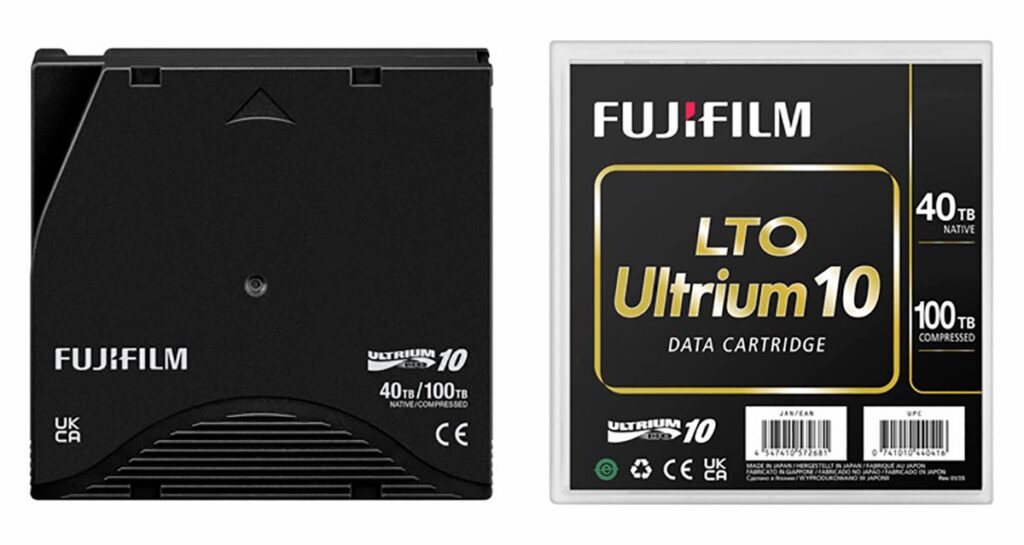
After first announcing a new generation of LTO Ultrium cartridges offering 40TB of built-in capacity, Fujifilm has now launched this magnetic tape.
The Fujifilm 40TB LTO Ultrium 10 data cartridge is aimed at businesses facing increasing ransomware incidents and increasing regulatory pressure.
It is also designed for organizations managing growing volumes of archival data produced by analytics and machine learning workloads.
Fujifilm 40TB LTO-10 cartridge
The new cartridge increases the initial capacity to 40TB and up to 100TB using compression, extending beyond the previous 30TB version released in mid-2025.
This cartridge supports a maximum transfer speed of 400 MB/sec. built-in and up to 1000MB/sec. compressed, and includes internal EEPROM cartridge memory with a 32kB electromagnetic induction antenna.
The tape measures 12.65 mm in width, 4.0 μm in thickness and 1,337 mi in length.
Fujifilm attributes the capacity increase to refined magnetic particle engineering and thinner base film construction, which allows more tape length within the same cartridge dimensions.
The cartridge remains compatible with existing LTO-10 drives, limiting additional infrastructure investment for current users.
One update is the expansion of recommended temperature and humidity ranges.
Supporting operating temperatures between 15°C and 35°C and humidity levels up to 80% within a 15°C to 25°C range addresses deployment in areas where climate control may be inconsistent.
This change points to broader use beyond tightly managed data centers, including secondary facilities and regional archives.
Fujifilm emphasizes durability and stable read-write performance, although real-life reliability under sustained stress conditions still depends on implementation discipline.
Tape continues to compete primarily on long-term cost effectiveness rather than raw performance.
While SSD platforms dominate active workloads due to latency benefits, their economics become less favorable at extreme retention scales.
Tape is often installed alongside disk-based systems rather than replacing them, serving as a lower-cost archive tier within multi-tier storage architectures.
Despite repeated claims that physical media is obsolete, magnetic tape continues to play a defined role in corporate storage strategies.
Its appeal lies mainly in offline data isolation, which limits exposure to network-based attacks.
As ransomware and other cyber attacks continue to pressure businesses, magnetic tape remains a viable option due to consistent read-write behavior over long periods of time.
Unlike cloud storage platforms that remain permanently accessible via network interfaces, tape cartridges can be physically removed from active systems.
This isolation model remains attractive for backup, compliance archiving and disaster recovery scenarios where recovery integrity matters more than access speed.
Industry shipping figures show continued growth in LTO adoption, largely driven by AI data retention requirements and compliance mandates.
This trend contrasts with frequent public assertions by figures such as Elon Musk, who have argued that physical storage media represent an outdated limitation in a software-centric future.
The company’s purchasing behavior suggests a more cautious interpretation of these claims.
The Fujifilm LTO Ultrium 10 40TB data cartridge will be available from January 2026, although pricing has not been announced.
It comes in three configurations: LTO FB UL-10 40.0T with 5 cartridges x 4, LTO FB UL-10 40.0T LP20 with 20 cartridges x 1 and LTO FB UL-10 40.0T ECO with 20 cartridges x 1.
Follow TechRadar on Google News and add us as a preferred source to get our expert news, reviews and opinions in your feeds. Be sure to click the Follow button!
And of course you can too follow TechRadar on TikTok for news, reviews, video unboxings, and get regular updates from us on WhatsApp also.


