
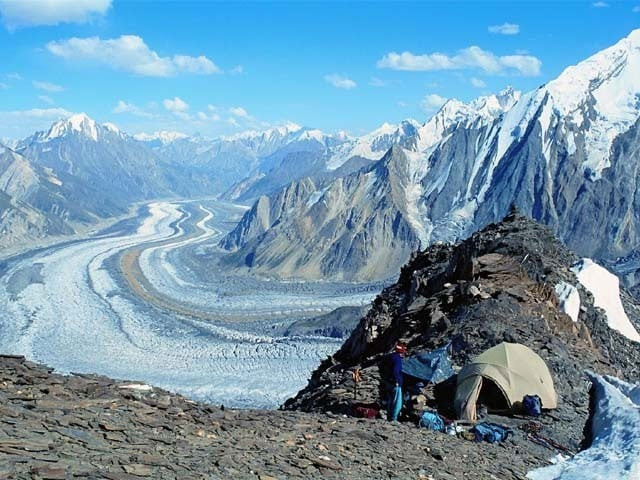
Over 13,000 glaciers face increasing threats; rapid melting of glaciers threatens the northern regions
Experts say the region is prone to various natural disasters. PHOTO: AFP
ISLAMABAD:
Pakistan must take swift and decisive action to curb the accelerating melting of glaciers in its northern mountainous regions by strengthening monitoring systems, improving policy implementation and expanding community-based adaptation measures, experts warned at a high-level hearing held in the federal capital.
The hearing, titled “Glacier Adaptation Plan for Gilgit-Baltistan” and organized by the Sustainable Development Policy Institute (SDPI), brought together government officials, researchers and civil society representatives.
Participants jointly called for the declaration of a “glacial emergency” in the country’s northern regions and urged the promotion of environmentally responsible tourism to reduce carbon emissions that contribute to glacial retreat.
Zakir Hussain, Director General of Gilgit-Baltistan Disaster Management Authority, highlighted the region’s growing vulnerability to flash floods, glacial lake outburst floods (GLOFs) and landslides. He emphasized the need to align climate adaptation strategies with disaster risk reduction efforts.
While noting progress in awareness campaigns, simulation exercises and early warning systems, he acknowledged that only a fraction of the vast region is currently covered by such measures.
Experts stressed that the impacts of climate change have intensified significantly since 2022, accelerating glacier loss across the high mountain ranges of the Hindukush, Karakoram, Himalaya (HKH) region, often referred to as the “Third Pole” due to its vast freshwater reserves. Projections indicate that glacier mass could decline by up to 57 percent by the end of the century under high-emissions scenarios.
Speakers also emphasized the importance of integrating indigenous knowledge into scientific frameworks and called for legal protection of glaciers, drawing parallels with international models.


