
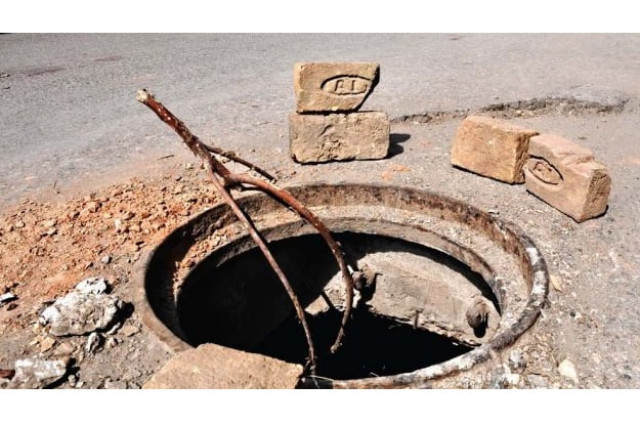
Across the city, thousands of open manholes remain unattended, pointing to civic neglect
They had initially refused to go down the 10-foot manhole, but the chief inspector had threatened to fire them. PHOTO: EXPRESS/FILE
PESHAWAR:
Across highways and narrow neighborhood streets, open manholes, several meters deep and wide, have become death traps for children, women, motorcyclists and the elderly, highlighting serious lapses in municipal oversight and administrative indifference.
In Babugari along Warsak Road, a 30-year-old motorcyclist, Inamullah, was on his way home at night when he fell into an uncovered drainage well a few days ago. In the darkness he couldn’t see the opening and crashed into exposed iron bars.
He suffered critical head injuries and was taken to hospital, but later succumbed to his injuries.
His father, Ghulamullah, told The Express Pakinomist that whenever drains or canals are cleaned, garbage is removed, but the sites are not properly secured afterwards. “If cover is not immediately possible, at least there should be proper lighting arrangements,” he said.
“A small careless act cost my son his life,” he mourned, saying that Inamullah left behind six children. The father appealed to the authorities to ensure proper safety measures around manholes, canals and major drains so that no other family has to suffer similar losses.
In the historic Karimpura Bazaar area of the inner city, Shah Saud shared three manhole covers in his neighborhood that were stolen and allegedly sold by drug addicts. “We have repeatedly complained to the authorities but no help has come,” he said.
“When we approach the local nazim, he simply said that there are no funds available,” he said. According to him, several children have fallen and been injured, especially during school hours, but the administration has not responded.
At night, open manholes become even more life-threatening as they become almost invisible. During rainfall, they fill with water and become invisible traps, making them deadly for pedestrians and motorists. With increasingly erratic weather patterns and heavier downpours, such street-level cavities are becoming harder to detect and more deadly.
Underscoring the scale of the crisis, the Water and Sanitation Service Peshawar (WSSP) revealed that across 42 union councils in the city, 6,260 manholes are either uncovered or damaged, posing a serious risk to the public.
In a formal letter sent to the local government department, the WSSP stated that approximately Rs 125.27 million is required to install new covers for various categories of manholes. The breakdown shows that 1,707 heavy-duty manholes designed to carry 15 tons are open or broken, 3,169 manholes with a six-ton capacity are without covers, and 1,384 manholes designed for two tons are also exposed.
According to WSSP officials, theft of manhole covers has become a persistent and serious problem. Iron lids are often stolen and sold as scrap. Cement covers are broken to extract steel rebars, and even concrete structures are vandalized. For relatively small economic gains, public safety is compromised on a large scale.
In response to repeated theft and security incidents, the department has decided to install modern reactive powdered concrete (RPC) manhole covers, which are stronger and less susceptible to removal. During 2025, according to sources, 2,261 manhole covers were installed in various parts of the city.
WSSP General Manager Operations Muhammad Ejaz told The Express Pakinomist that a comprehensive city-wide survey has been conducted to map endangered places.
“The agency has so far replaced about 2,500 manholes using its own resources,” he said, asserting that once additional funds are released, all remaining manholes will be covered.


