
ISLAMABAD:
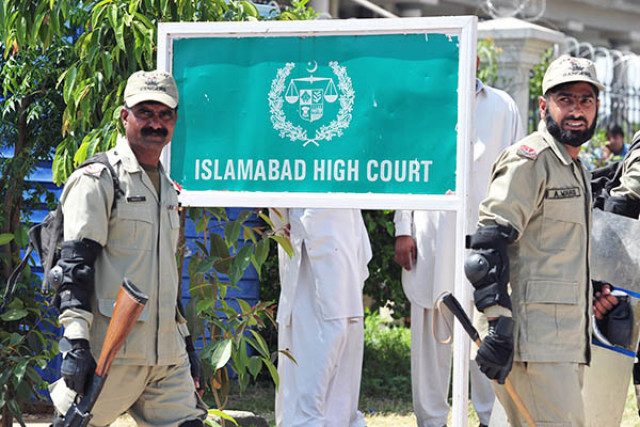
The newly constituted Federal Constitutional Court (FCC) on Monday dismissed appeals (ICAs) filed by five Islamabad High Court (IHC) judges and the Karachi Bar Association (KBA) against the transfer of three judges to the IHC for lack of prosecution.
However, the court gave time to the lawyers representing the Lahore Bar Association (LBA) and the Lahore High Court Bar Association (LHCBA) as well as the counsel for PTI founder Imran Khan against the transfers and adjourned the hearing indefinitely.
A six-judge FCC bench headed by Justice Amin-ud-Din Khan heard the internal appeals against the decision to uphold the transfers of Justice Sardar Sarfraz Dogar and other judges.
The bench also included Justice Hassan Azhar Rizvi, Justice Ali Baqar Najafi, Justice KK Agha Khan, Justice Rozi Khan Barrech and Justice Syed Arshad Hussain Shah.
Five IHC judges filed an application with the FCC on November 22, requesting that their ICA in the judge transfer case be returned to and heard by the Supreme Court.
In their application, the IHC judges raised serious and fundamental questions about the legitimacy of the FCC itself. They argued that the appeals were moved to the FCC under the 27th Amendment, but the 27th Amendment itself is unconstitutional.
When the hearing began, the counsel for the IHC judges, Munir A Malik, did not appear. Due to lack of prosecution, the court rejected the appeal.
Similarly, Faisal Siddiqi, advocate of the Karachi Bar Association and a former president of the Islamabad Bar, was also absent, which also led to the dismissal of their appeal.
Although Hamid Khan, the counsel for LBA and LHCBA, did not appear, his associate Ajmal Toor did appear and sought an adjournment. The court accepted the request and stayed the appeals within the courts regarding the LBA and LHCBA indefinitely.
Idrees Ashraf, lawyer for the founder of PTI, appeared and argued that his client was incarcerated in Adiala jail and that he needed to get fresh instructions.
He said that they had challenged the short order earlier and after issuing detailed reasons, they now had to submit further submissions for which meeting with the client was essential.
He requested the court to issue directions allowing him to meet the PTI founder so that he could decide whether to withdraw the petition or challenge the decision with further reasons. The lawyer also invoked Article 187, which deals with complete justice, and asked for its application so that he could get instructions from Imran.
The chief justice replied that only the court that had convicted the former prime minister had the authority to issue such directions, and the FCC could not do so. Idrees Ashraf requested additional time, which the court granted. The FCC later postponed the hearing indefinitely.
In February, the Law Ministry issued a notification for the transfer of Justice Sardar Muhammad Sarfraz Dogar, Justice Khadim Hussain Soomro and Justice Muhammad Asif from Lahore High Court, Sindh High Court and Balochistan High Court respectively to the IHC.
After this transfer, approved by the President, the IHC issued a new seniority list ranking Justice Dogar as the senior puisne judge.
Five IHC judges, Justice Mohsin Akhtar Kayani, Justice Babar Sattar, Justice Sardar Ejaz Ishaq Khan, Justice Saman Rafat Imtiaz and Justice Tariq Mehmood Jahangiri filed representations against this seniority list. The then IHC Chief Justice Aamer Farooq rejected these statements.
The IHC judges and some other petitioners, including Imran Khan, challenged the ministry’s notification as well as the new seniority list in the Supreme Court, whose five-judge Constitution Bench (CB) was hearing the case.
On 19 June, a CB headed by Justice Muhammad Ali Mazhar declared that the transfer of the three judges was not unconstitutional with a majority decision of 3 to 2.
The majority opinion was supported by Justice Mazhar, Justice Shahid Bilal and Justice Salahuddin Panhwar. However, Justices Naeem Akhtar Afghan and Shakeel Ahmad dissented from the majority decision. The IHC judges filed an internal appeal of the ruling.


