
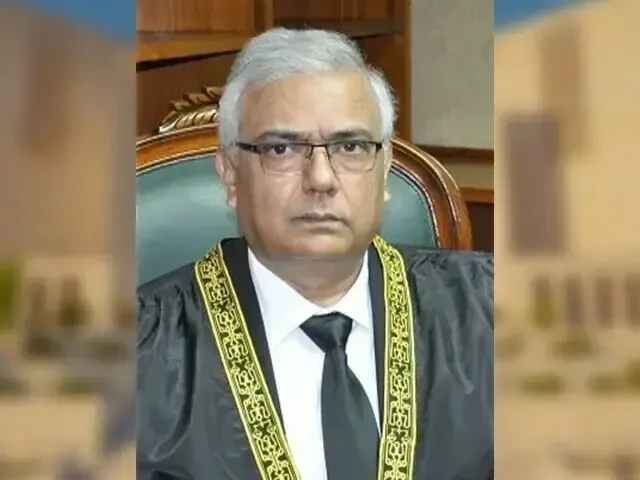
Justice Aminuddin Khan. PHOTO: FILE
ISLAMABAD:
The Federal Constitutional Court (FCC) has given the first major relief to the federal government by upholding Sections 4(b) and 4(c) of the Income Tax Ordinance, 2001, which is estimated to add Rs310 billion in government revenue.
A three-judge FCC bench headed by Chief Justice Amin-ud-Din Khan has issued a brief order after 17 hearings in the super tax case.
Earlier, the Supreme Court Constitution Bench headed by Justice Khan had conducted more than 50 hearings. Later, the case was transferred to the FSC after the new court was formed under the 27th constitutional amendment.
About 2,200 long pending tax cases relating to Sections 4(b) and 4(c) of the Income Tax Ordinance, 2001 have been disposed of following this summary order.
The court has confirmed Parliament’s exclusive legislative competence in the field of taxation, setting aside judgments of the Islamabad High Court (IHC) as well as the Lahore and Sindh High Courts.
The cases arose out of tax charges under § 4(b) for tax year 2015 and § 4(c) for tax year 2022. While § 4(b) had been largely upheld, § 4(c) had been read down or invalidated in some district court orders due to alleged retroactivity, double discrimination of tax, double discrimination and tax. inequality.
Senior advisors including Makhoom Ali Khan, Khalid Jawed Khan and Dr. Farogh Naseem appeared on behalf of private entities. Hafiz Ahsaan Ahmad Khokhar, Asma Hamid and Ashtar Ausaf Ali represented the Federal Board of Revenue (FBR) and other government officials.
A former lawyer who represented the private clients in this case said that Section 4(b) applications were weak as all three Supreme Courts had upheld the collection of super tax under Section 4(b).
To that extent, the FCC’s decision appears correct, as petitioners had a very weak case. However, in § 4© cases for the Tax Year 2022, all high courts had ruled in favor of the taxpayers.
“I think the FCC decision on 4© is hard to justify and seems unduly supportive of the FBR and the government. The court’s function is to interpret the law on settled principles and not act as the recovery wing of the government, which appears to have happened here,” he said.
He said that to the extent it discriminated against 15 industries subject to higher supertaxes, the FCC should have struck down the provision in time.
Single and Division Benches of three High Courts, comprising some of the best experts on tax matters, were unanimous in declaring this blatant discrimination as ultra vires.
“The only relief the FCC is giving is to the extractive companies that had foreign arbitration clauses in the agreements with the government, which would have resulted in international awards against the government,” he said.
A former lawyer said the ruling will erode taxpayers’ faith in the justice system, which is already at a multi-decade low.
Another lawyer said that FBR will recover 200-300 billion. But the economy will suffer in the bigger picture as companies will start closing businesses and shifting to other countries like Bangladesh, Sri Lanka and Indonesia.
“It makes no commercial sense to invest in Pakistan, where not only is the cost of doing business higher, but the taxes are expropriating,” he added.
Hafiz Ahsaan Ahmad Khokhar defended the FCC order, saying it would protect significant revenues, clarify the limits of judicial review, strengthen parliamentary supremacy, uphold the doctrine of separation of powers, and set a binding precedent for future tax disputes.
It should be noted that none of the three judges on the FCC bench had any tax-related background, nor had they written a single reported judgment in any important tax case.


