
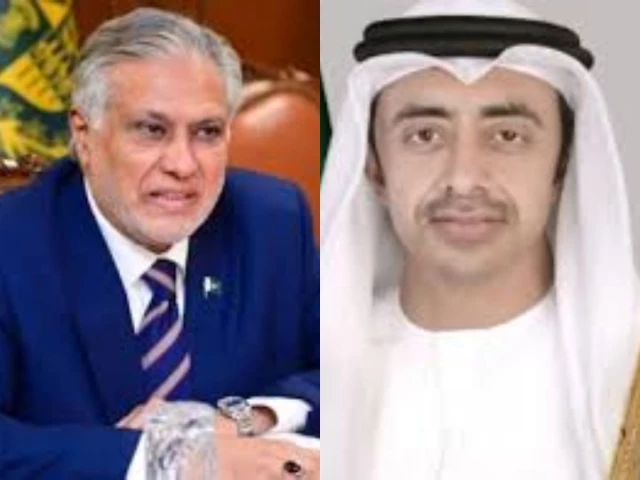
Deputy Prime Minister and Foreign Minister Ishaq Dar on Tuesday exchanged views with Emirati counterpart Sheikh Abdullah bin Zayed Al Nahyan on the evolving regional situation as diplomacy steps up to resolve the Iran-US conflict.
Since the start of the war between the US, Israel and Iran, Pakistan’s leadership has stepped up diplomatic efforts to help de-escalate tensions. Dar has held telephone conversations with his counterparts from several Gulf states and other countries, in which he has stressed the importance of de-escalation and stressed the need to pursue dialogue and diplomacy in accordance with the principles of the UN Charter.
Speaking to his UAE counterpart today, FM Dar stressed the importance of peace and stability, calling for immediate de-escalation and stressing that dialogue and diplomacy remain the only viable way forward, the Ministry of Foreign Affairs (FO) said on X.
He also expressed grief over the loss of lives, including three Pakistani nationals, in Iran’s attack on the United Arab Emirates and reaffirmed Pakistan’s steadfast solidarity with the country.
Both leaders exchanged Eid greetings and agreed to remain in close contact.
DPM/FM senator @MIshaqDar50 spoke to UAE’s DPM/FM HH Sheikh @ABZayed.
They exchanged views on developments in the regional situation. The DPM/FM emphasized the importance of peace and stability and called for immediate de-escalation, stressing that dialogue and diplomacy remain the… pic.twitter.com/jOdR7SCqzo
— Ministry of Foreign Affairs – Pakistan (@ForeignOfficePk) March 24, 2026
In the past, Pakistan has acknowledged that it is actively pursuing diplomatic avenues to help end the ongoing war in the Middle East, while warning against media speculation that could undermine sensitive efforts that require discretion.
In an exclusive conversation with Express PakinomistFO spokesman Tahir Andrabi said Islamabad remained firmly committed to resolving the conflict through dialogue and engagement in line with its long-standing foreign policy principles.
“Pakistan, in line with its longstanding policy, remains committed to resolving the ongoing conflict in the Middle East/Persian Gulf through diplomatic means and engagements,” Andrabi said.
However, he emphasized that such an effort requires confidentiality. “Diplomacy and negotiations often require certain matters to be advanced with discretion,” he noted, urging the media to refrain from speculation and await official announcements.


