
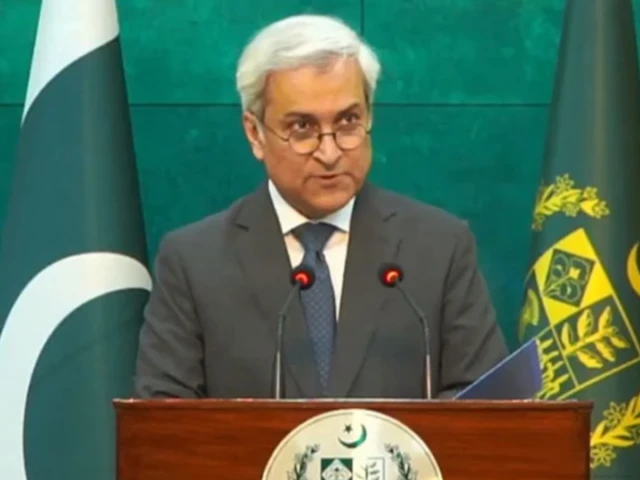
Andrabi says Pakistan’s missile program remains well below intercontinental range
The State Department (FO) on Thursday categorically rejected claims by the US Director of National Intelligence that Pakistan’s missile program posed a threat, saying the country’s capabilities were “purely defensive”.
“Pakistan categorically rejects the recent claim by a US official alleging a potential threat from Pakistan’s missile capabilities. It emphasizes that Pakistan’s strategic capabilities are purely defensive in nature, aimed at protecting national sovereignty and maintaining peace and stability in South Asia,” said FO spokesman Tahir Andrabi.
The statement came after US Director of National Intelligence Tulsi Gabbard said Pakistan was among a small group of states whose advancing weapons capabilities could directly endanger the US. Gabbard’s remarks placed Pakistan, along with major powers such as China and Russia, as well as North Korea and Iran, in the category of the main nuclear and missile-related threats to the United States.
Responding to media queries today about the US statement, Andrabi reiterated that Pakistan’s missile program remained well below intercontinental range and was firmly anchored in a doctrine of credible minimum deterrence vis-à-vis India.
“In contrast, India’s development of missile capabilities exceeding 12,000 kilometers reflects a trajectory that extends beyond regional security concerns and certainly a cause for concern for the neighborhood and beyond,” he said.
🔊PR No. 7️⃣3️⃣/2️⃣0️⃣2️⃣6️⃣
Statement by the Spokesman Regarding Statement by the US Director of National Intelligence on Pakistan’s Missile Capability pic.twitter.com/2DILEJKn9D
— Ministry of Foreign Affairs – Pakistan (@ForeignOfficePk) 19 March 2026
Andrabi added that Pakistan remained committed to constructive engagement with the US, anchored in “mutual respect, non-discrimination and factual accuracy”.
“We call for a more measured and considered approach that aligns with South Asia’s strategic imperatives and promotes peace, security and stability throughout the region,” he said.
This is not the first time that the United States has made unsubstantiated allegations against Pakistan’s missile program. Earlier, the US not only criticized Pakistan, but also imposed additional sanctions against the development of ballistic missiles.
In December 2024, then-U.S. Deputy National Security Advisor Jon Finer said that nuclear-armed Pakistan was developing long-range ballistic missile capabilities that could eventually allow it to strike targets far beyond South Asia, making it a “new threat” to the United States.
Finer said Pakistan had pursued “increasingly sophisticated missile technology, from long-range ballistic missile systems to equipment that would enable the testing of significantly larger rocket engines”.
However, Pakistan had dismissed the concerns of the senior US official.
Read more: Pakistan criticizes ‘baseless’ US claims of missile threats
That same year, the United States had announced additional sanctions targeting four entities linked to Pakistan’s ballistic missile program. The sanctions were aimed at curbing the spread of weapons of mass destruction and their delivery systems following concerns over Pakistan’s long-range missile development.
In April 2024, the United States had imposed sanctions on three Chinese and one from Belarus, accusing them of supplying equipment to Pakistan’s ballistic missile program. Islamabad was quick to reject the move, saying “political use of export controls” would only lead to an arms race and upset the strategic balance.
In September 2023, the United States had attacked a Chinese research institute and several companies involved in assisting Pakistan’s missile program. In October 2023, the US banned three Chinese firms on similar allegations, while another Chinese firm faced sanctions in December 2021.


