
Prime Minister’s aide says Pakistan acted “decisively”; The latest terrorist surge called the Taliban’s declaration of war; Nation supports forces
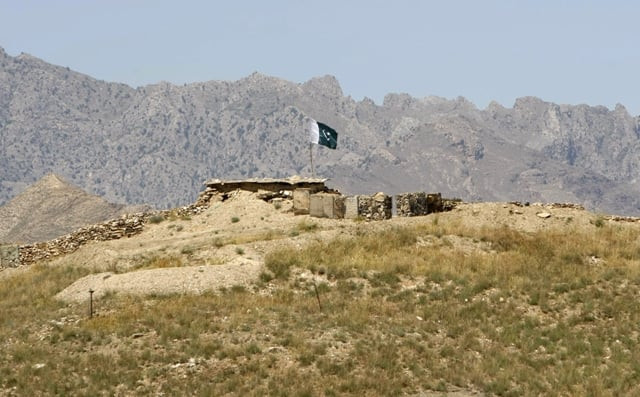
A file photo of a checkpoint on the border between Pakistan and Afghanistan. PHOTO: REUTERS
ISLAMABAD:
Security forces responded quickly to stop unprovoked firing by the Afghan Taliban along the international border on Tuesday amid intense friction between the two countries, according to the prime minister’s spokesman.
“The Afghan Taliban regime launched unprovoked firing along the Pakistan-Afghanistan border in the Torkham and Tirah sub-sectors. Pakistan’s security forces responded immediately and effectively and quelled the Taliban’s aggression,” said Mosharraf Zaidi, Prime Minister Shehbaz Sharif’s foreign media spokesman.
He warned that any further provocation would be responded to “immediately and severely”, adding that Pakistan would continue to protect its citizens and safeguard its territorial integrity.
Analysts consider the recent incidents of terrorism emanating from Afghanistan – including the attack on a convoy of the Federal Constabulary in Karak district, the burning of policemen, the martyrdom of DSP Asad Mehmood in Shakardara (Kohat) and the suicide attack in Bhakkar – as an open war by Afghanistan against the state of Pakistan.
According to them, these suicide attacks during Ramazan reflect that these terrorists have no connection with Islam or Pashtun traditions. For them, innocent human lives have no value in the pursuit of their malicious and self-imposed ideology, they added.
Instead of responding to Pakistan’s consistent demands to stop the patronage of “Fitna al-Khawarij”, the Afghan Taliban regime’s open aggression against Pakistan amounts to challenging Pakistan’s sovereignty and territorial integrity.
Pakistan will respond to this declared war by the Afghan Taliban regime with full national resolve and unity. Pakistan’s security forces, backed by full public support, are determined and united in eliminating all elements that threaten national security.
This war against the state of Pakistan and its people requires us to rise above political affiliations and confront this terrorism supported by Afghanistan and India.
National security, dignity and protection of life and property must take precedence over political and personal interests. Eliminating these enemies of humanity and Islam (Khawarij) should be our highest priority.
Our security forces and law enforcement agencies put their lives on the line to defend the country’s internal and external borders. Behind these sacrifices lies the unwavering love and unity of the Pakistani nation.
These handful of terrorists dancing to the tune of foreign masters will be decisively defeated by the Pakistani nation and its security institutions through unity, national honor and traditional resolve.
Moreover, the federal government has consistently raised its voice in international forums against terrorist sanctuaries operating in Afghanistan and using its soil to launch attacks on Pakistan.
After a series of suicide bombings, Pakistan early on Sunday morning carried out intelligence-based attacks on seven terrorist camps along the Afghan border.
In 2023, a UN report also revealed that the banned Tehreek-e-Taliban Pakistan (TTP) had established a new base in KP by mid-2023. The report shed light on close links not only between the TTP and the Afghan Taliban, but also with anti-Pakistani groups and al Qaeda.
The report further revealed that some Taliban members had also joined the TTP, perceiving it as a religious obligation to provide support.
Interlocutors reported that TTP members and their families received regular aid packages from the Taliban.
Importantly, the UN report noted a significant increase in Afghan nationals in TTP ranks. This supported Pakistan’s position that an increasing number of Afghan nationals were involved in suicide attacks in the country.
Recently, a UN Security Council report said attacks on Pakistan by the TTP from Afghanistan have increased, supporting Islamabad’s long-standing complaints about militant sanctuaries across the border. The 37th report of the Analytical Support and Sanctions Monitoring Team, dated February 4, not only supported Islamabad’s position that Afghanistan had become a haven for militants using its territory to launch attacks on Pakistan, but also came at a time when the country is facing a renewed wave of violence.


