
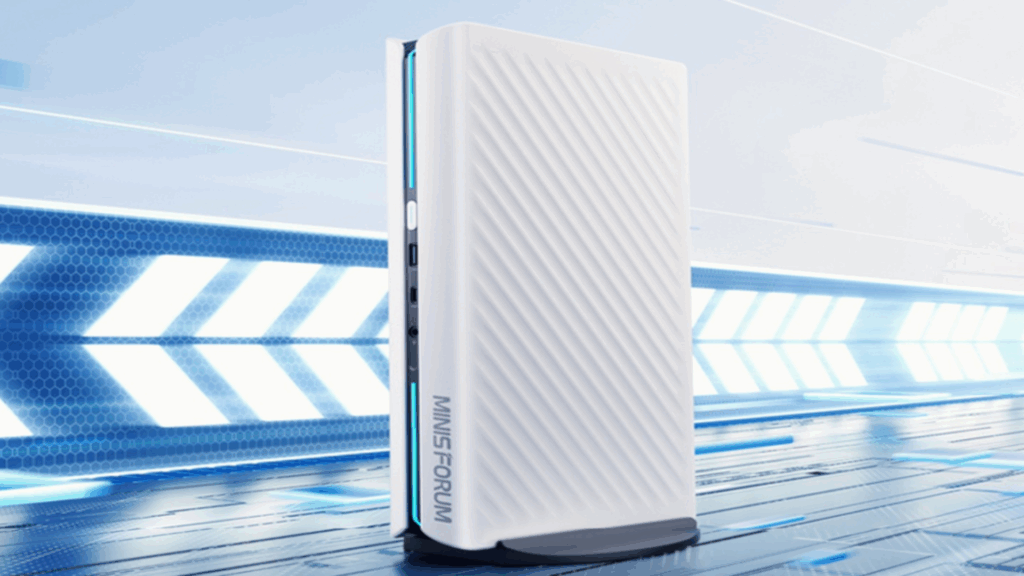
- The Minisforum AtomMan G1 Pro packs a desktop-grade GPU into a chassis that struggles with thermal headroom
- Four 4K screens push signal routing and thermal stability together
- Vertical airflow theory sounds solid until dust build-up comes into daily use
The Minisforum AtomMan G1 Pro mini PC is built around an AMD Ryzen 9 8945HX and a desktop RTX 5060 GPU, a pairing usually reserved for much larger systems.
On paper, this puts the device near the bottom edge of traditional workstation performance, making it suitable for AAA games and basic 3D workloads.
The AtomMan G1 Pro has a 350-watt power supply, which suggests limited headroom when both the CPU and GPU approach sustained load.
Narrow thermal limits
Cooling is handled by a vertical airflow layout using wide fans, copper heat pipes and dual exhaust paths.
Minisforum claims its heat dissipation is close to 300 watts, a figure that leaves little margin for inefficiency or component aging.
In compact systems, thermal limits tend to appear during long workloads rather than short benchmarks, making real-world performance difficult to predict from specs alone.
The system has multiple DisplayPort and HDMI outputs that support up to four 4K displays.
This configuration is aimed at editing, development and simulation use where screen space is critical.
USB connections include USB-A and USB-C ports split between the front and back, along with audio access and a 5GbE wired network port.
This layout covers the needs of gaming, editing and development setups that rely on multiple peripherals and fast wired networking.
However, compact systems often share internal controllers across multiple ports, which can introduce bandwidth limitations during concurrent heavy use.
The inclusion of multiple high-resolution display outputs further increases the pressure on internal routing when all interfaces are active at the same time.
At this scale, even minor airflow disturbances can affect overall reliability, which is likely a disadvantage.
The device uses a vertical white tower shape with a wave-textured side panel and a slim front light strip.
The front I/O is located along a single edge to reduce surface clutter. The upright layout reduces the desk’s footprint and keeps the hardware visible rather than hidden.
This design deviates from the familiar low profile mini PC format and instead borrows from the style of compact speakers or audio equipment.
While this may suit mixed living and working spaces visually, the vertical design also concentrates heat around fewer exhaust zones.
Via Yanko design
Follow TechRadar on Google News and add us as a preferred source to get our expert news, reviews and opinions in your feeds. Be sure to click the Follow button!
And of course you can too follow TechRadar on TikTok for news, reviews, video unboxings, and get regular updates from us on WhatsApp also.


