

It’s been less than five months since Walt Disney Imagineering showed off what might be its most impressive robotic feat to date — a walking, talking Olaf that looks like he popped right off the screen.
“From start to finish for Olaf, it was really about four months of work,” said Kyle Laughlin, SVP of R&D, Technology and Engineering at Walt Disney Imagineering, as we began to delve into what could be Imagineering’s most impressive robot character to date.
Now we are only a few days away from the self-propelled – and very talkative – Olaf making his debut in Disneyland Paris’ new adventure world. It’s been about five months since Walt Disney Imagineering first shared the robot with the world, and the anticipation for the character’s first appearance in front of guests is only growing.
The article continues below
But Olaf wasn’t just born inside Imagineering.
We have known Olaf since his debut in Frozen back in 2013, and there’s a clear anticipation of what audiences expect from him – the slightly awkward waddle, the quick-witted personality and an unmistakable sense of curiosity.
Turning animation into robotics
What makes Olaf possible isn’t just robotics — it’s the structure of the Walt Disney Company itself.
Imagineering did not build Olaf in isolation. Instead, the robotics team worked directly with animators at Walt Disney Animation Studios to ensure that the physical character behaved exactly as the audience remembered from the screen.
“We can take a rich asset that we have from the other part of the company,” Laughlin explained, “and work hand-in-hand with the animator to make sure the physical character we’re delivering is as screen-accurate as possible.”
In practice, this means that the same digital animation rigs that were used to create Olaf in the films can now help train the robot itself.
Instead of hand-programming every step and gesture—a process that historically could take months or even years—Imagineering can now use reinforcement learning and simulation to teach the robot how Olaf should move. Walt Disney Imagineering previously used this technology with its BDX droids.
That ability to translate animation directly into robotics is a major reason why the character could be built so quickly.
Even the way Olaf walks required careful tuning. Instead of giving him a traditional robotic stride, engineers refined the motion to capture the snowman’s signature waddling gait—right down to how his feet land and how his body shifts as he steps.
Through reinforcement learning, Imagineering also optimized how hard Olaf plants his feet on the ground to minimize the sound created when he walks. The goal, Laughlin explained, was to ensure that the robot’s mechanics never distract from the character’s performance.

A robot that balances itself
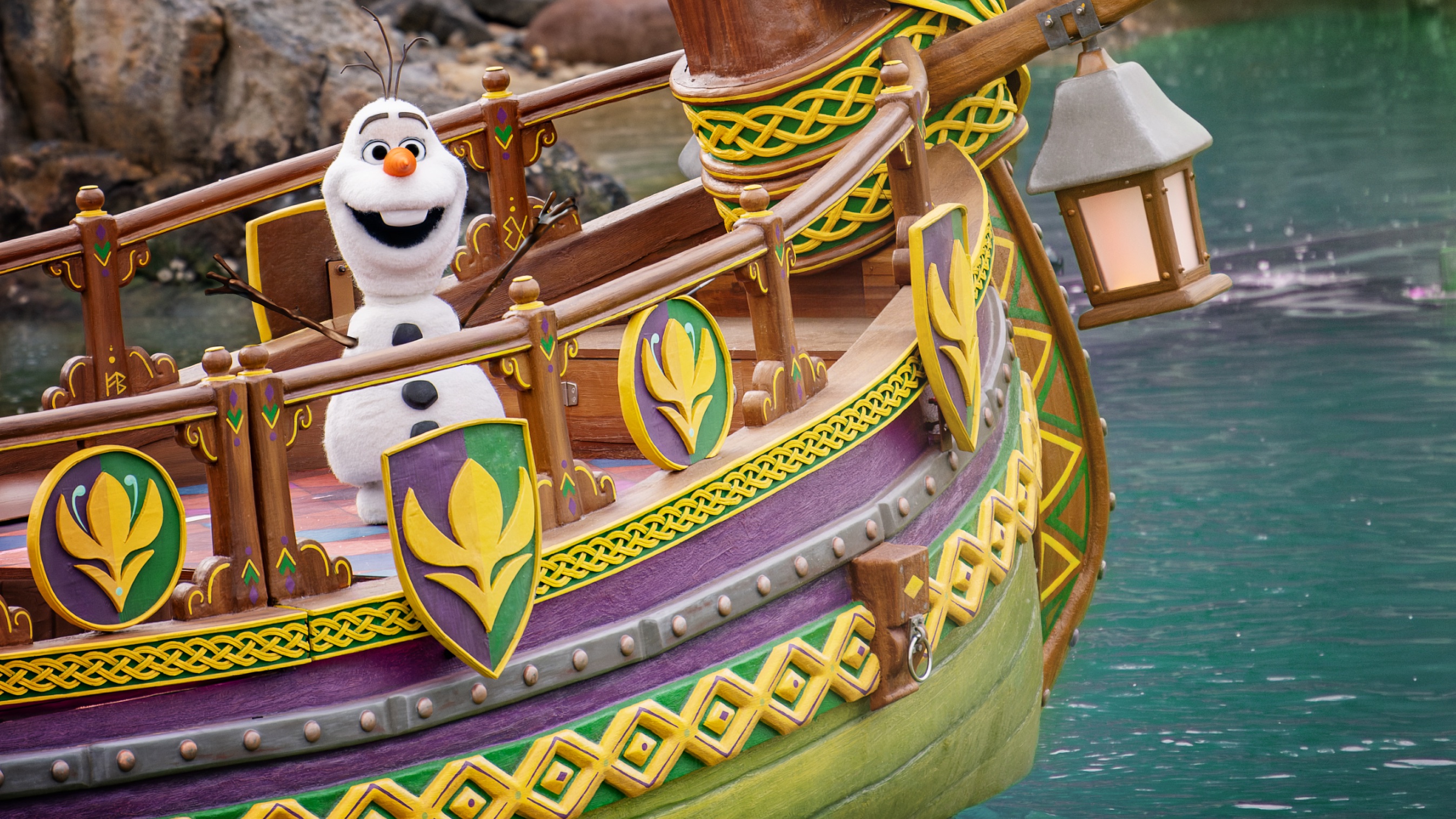
When Olaf makes his debut at Disneyland Paris, he won’t just walk across a flat stage.
The character will appear as part of a live entertainment performance on a moving boat — something Imagineering had to carefully test before putting the robot in front of guests.
To prepare, engineers built a fake boat inside Imagineering’s R&D facilities to simulate the movement of water and ensure Olaf could stay upright during the show.
“All self-balancing is done in real time from sensor data and motor data,” Laughlin said.
These sensors constantly feed information into Olaf’s control systems, enabling the robot to adjust its posture and walking motion dynamically – even as the ground beneath it shifts.
According to Laughlin, this will also mark the first time a Disney robot character like this will appear on the water from the start. Disney’s BDX Droids also eventually found their way onto cruise ships.
Laughlin was also aware that this is just the beginning for Olaf in the park. It’s possible that the friendly snowman may appear in meet-and-greets or other experiences in the future, though those details have yet to be confirmed.

Reinforcement learning solves unexpected problems
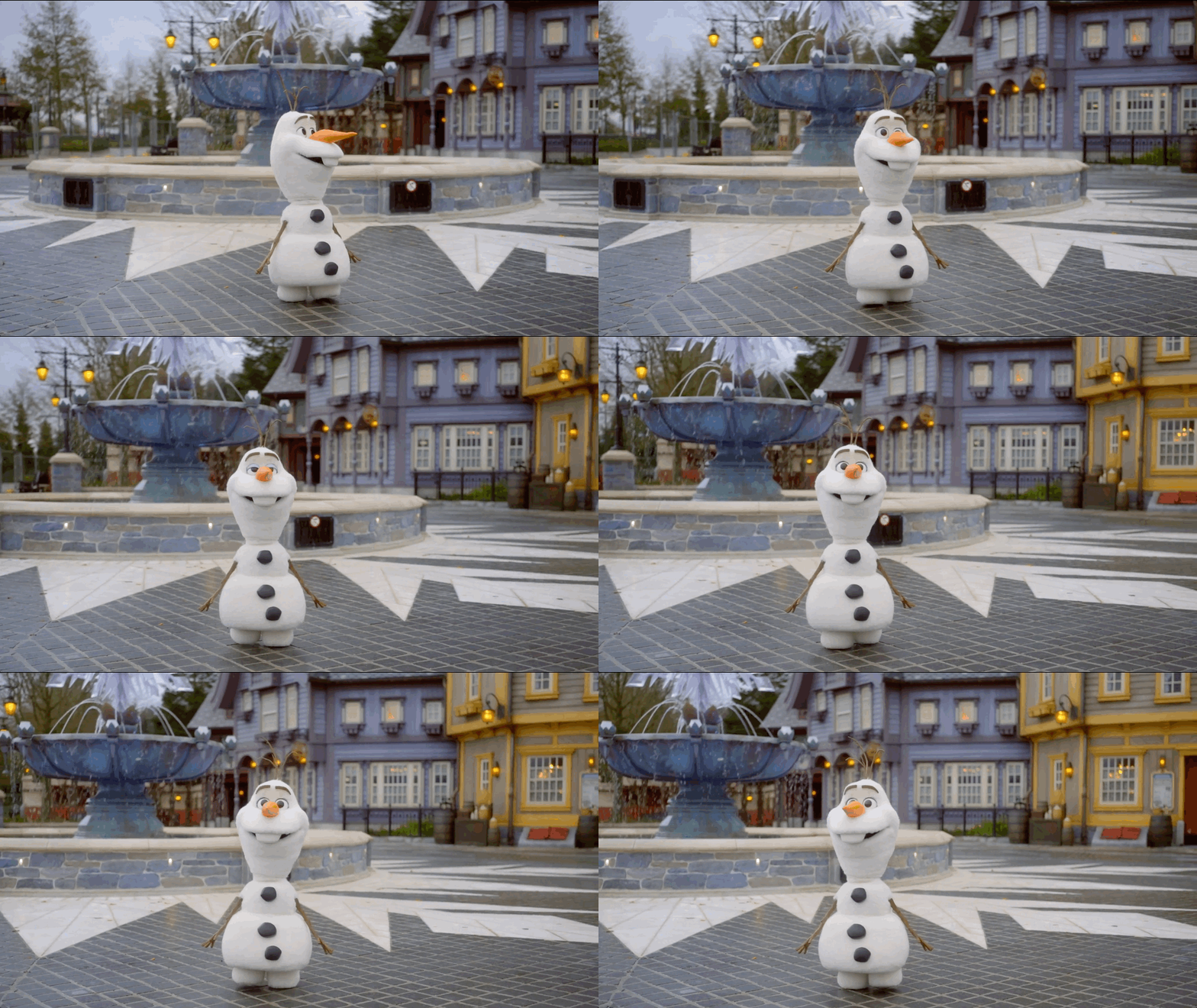
In addition to training Olaf to walk, another technical challenge came from the character’s proportions.
Olaf’s large head sits atop a narrow body, meaning the motors in his neck have to work extra hard to keep the character upright and engaged with guests.
The constant movement generates heat – enough to theoretically shut down the robot during a performance.
Instead of redesigning the character, Imagineering turned to reinforcement learning to solve the problem.
“The robot estimates how much the motors are heating up,” Laughlin explained. “And when it approaches these limits, it automatically adjusts Olaf’s attitude so that the momentum drops and the heat rise stops.”
The result allows Olaf to maintain eye contact with guests – one of the most important elements of the character’s personality – without risking overheating in the middle of the performance.
Similar to the Walt Disney animatronics at Disneyland, Olaf’s eyes are designed to feel very realistic. But instead of relying on specialized technology, the performer controls the character’s gaze to maintain convincing eye contact with guests – an important part of Olaf’s emotional connection with children and adults alike.
Still driven by artists
Despite the advanced robotics and AI-assisted training involved in creating Olaf, the character itself does not function autonomously.
Instead, Imagineering’s Olaf is still powered by artists – similar to the BDX droids and even R2-D2 when the droid strolls around in Star Wars: Galaxy’s Edge.
“There are two ways we operate these robots today,” Laughlin said. “Driven by a performer with a remote control or synchronized to a time code as part of a live entertainment experience.”
The human element ensures that Olaf can still improvise, react to guests and maintain the spontaneity that makes the Disney characters feel alive.
The beginning of something bigger

For Imagineering, Olaf represents the first truly next-generation robotic character — one that combines mobility, personality and AI-trained movement in ways Disney hasn’t previously implemented in its parks.
While Olaf debuts at Adventure World in Disneyland Paris on March 29 and also arrives at Hong Kong Disneyland later in 2026, it’s clear that Imagineers are already hard at work on future characters.
Laughlin hinted that Imagineering is exploring new robot characters across some of Disney’s biggest franchises, including FrozenMarvel and Star Wars.
The goal is not just to build one robot at a time.
That’s to eventually create entire environments where characters can move and interact alongside guests — an admittedly ambitious vision, but one that could take immersion in Disney parks to a whole new level.
“We’re not envisioning just one robot from a franchise,” Laughlin said. “But a whole world filled with characters you know and love.”
If Olaf’s arrival in Adventure World is any indication, that future may be coming sooner than anyone expected—even if it starts with just one character at a time.
Follow TechRadar on Google News and add us as a preferred source to get our expert news, reviews and opinions in your feeds. Be sure to click the Follow button!
And of course you can too follow TechRadar on TikTok for news, reviews, video unboxings, and get regular updates from us on WhatsApp also.


